Kouassi Nzoughet Judith, Guehlouz Khadidja, Leruez Stéphanie, Gohier Philippe, Bocca Cinzia, Muller Jeanne, Blanchet Odile, Bonneau Dominique, Simard Gilles, Milea Dan, Procaccio Vincent, Lenaers Guy, Chao de la Barca Juan M, Reynier Pascal
Faculté de santé, Institut MITOVASC, UMR CNRS 6015, INSERM U1083, Université d'Angers, 49933 Angers, France.
Faculté de Pharmacie de Paris, CiTCoM UMR 8038 CNRS, Université Paris Descartes, 75270 Paris, France.
Metabolites. 2020 Jan 28;10(2):49. doi: 10.3390/metabo10020049.
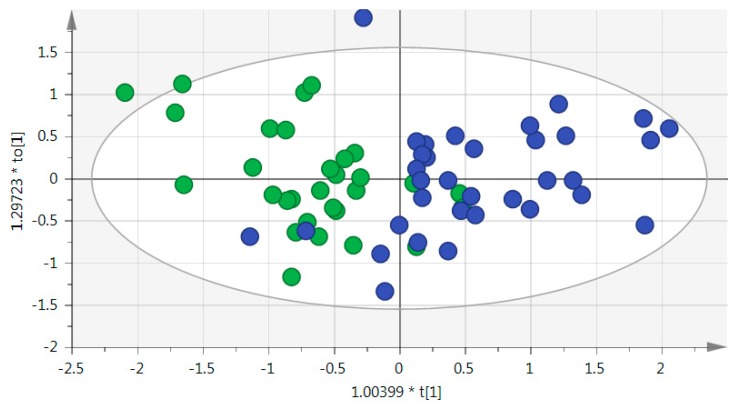
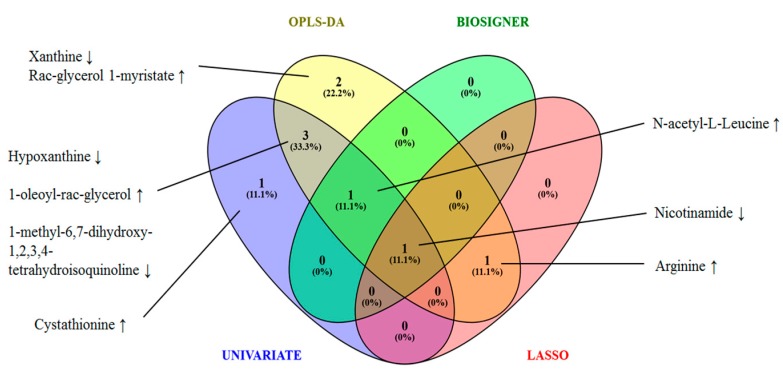
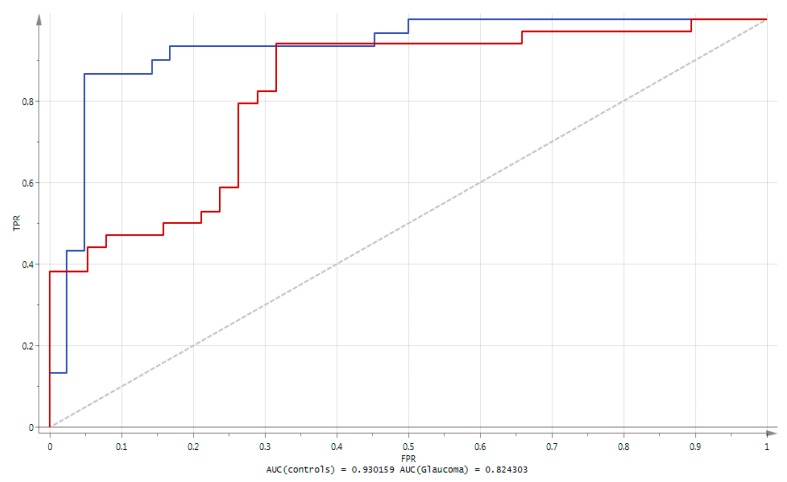
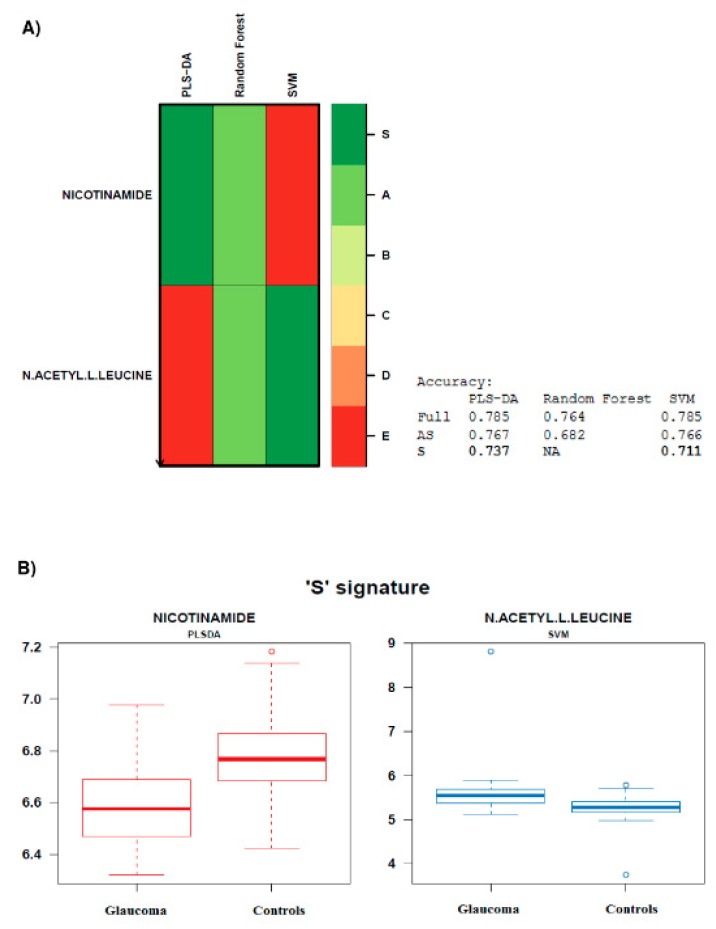
Glaucoma is an age related disease characterized by the progressive loss of retinal ganglion cells, which are the neurons that transduce the visual information from the retina to the brain. It is the leading cause of irreversible blindness worldwide. To gain further insights into primary open-angle glaucoma (POAG) pathophysiology, we performed a non-targeted metabolomics analysis on the plasma from POAG patients ( = 34) and age- and sex-matched controls ( = 30). We investigated the differential signature of POAG plasma compared to controls, using liquid chromatography coupled to high resolution mass spectrometry (LC-HRMS). A data mining strategy, combining a filtering method with threshold criterion, a wrapper method with iterative selection, and an embedded method with penalization constraint, was used. These strategies are most often used separately in metabolomics studies, with each of them having their own limitations. We opted for a synergistic approach as a mean to unravel the most relevant metabolomics signature. We identified a set of nine metabolites, namely: nicotinamide, hypoxanthine, xanthine, and 1-methyl-6,7-dihydroxy-1,2,3,4-tetrahydroisoquinoline with decreased concentrations and N-acetyl-L-Leucine, arginine, RAC-glycerol 1-myristate, 1-oleoyl-RAC-glycerol, cystathionine with increased concentrations in POAG; the modification of nicotinamide, N-acetyl-L-Leucine, and arginine concentrations being the most discriminant. Our findings open up therapeutic perspectives for the diagnosis and treatment of POAG.
青光眼是一种与年龄相关的疾病,其特征是视网膜神经节细胞逐渐丧失,视网膜神经节细胞是将视觉信息从视网膜传导至大脑的神经元。它是全球不可逆失明的主要原因。为了更深入了解原发性开角型青光眼(POAG)的病理生理学,我们对34例POAG患者和30例年龄及性别匹配的对照者的血浆进行了非靶向代谢组学分析。我们使用液相色谱-高分辨率质谱联用技术(LC-HRMS)研究了POAG血浆与对照相比的差异特征。采用了一种数据挖掘策略,该策略结合了带有阈值标准的过滤方法、带有迭代选择的包装方法以及带有惩罚约束的嵌入式方法。这些策略在代谢组学研究中通常单独使用,每种策略都有其自身的局限性。我们选择了一种协同方法来揭示最相关的代谢组学特征。我们鉴定出一组九种代谢物,即:烟酰胺、次黄嘌呤、黄嘌呤和1-甲基-6,7-二羟基-1,2,3,4-四氢异喹啉浓度降低,而N-乙酰-L-亮氨酸、精氨酸、RAC-甘油1-肉豆蔻酸酯、1-油酰-RAC-甘油、胱硫醚在POAG中浓度升高;烟酰胺、N-乙酰-L-亮氨酸和精氨酸浓度的改变最具鉴别性。我们的发现为POAG的诊断和治疗开辟了治疗前景。