Department of Psychology, Institute of Psychiatry, Psychology and Neuroscience, King's College London, Guy's Campus, Addison House, London, SE1 1UL, UK.
Institute of Cognitive Neuroscience, University College London, 17 Queen Square, London, WC1N 3AR, UK.
Mol Autism. 2020 Feb 3;11(1):11. doi: 10.1186/s13229-019-0305-1.
One of the main diagnostic features of individuals with autism spectrum disorders is nonverbal behaviour difficulties during naturalistic social interactions. The 'Interactional Heterogeneity Hypothesis' of ASD proposes that the degree to which individuals share a common ground substantially influences their ability to achieve smooth social interactions.
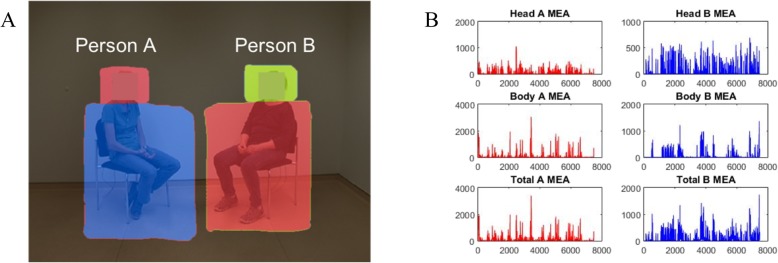
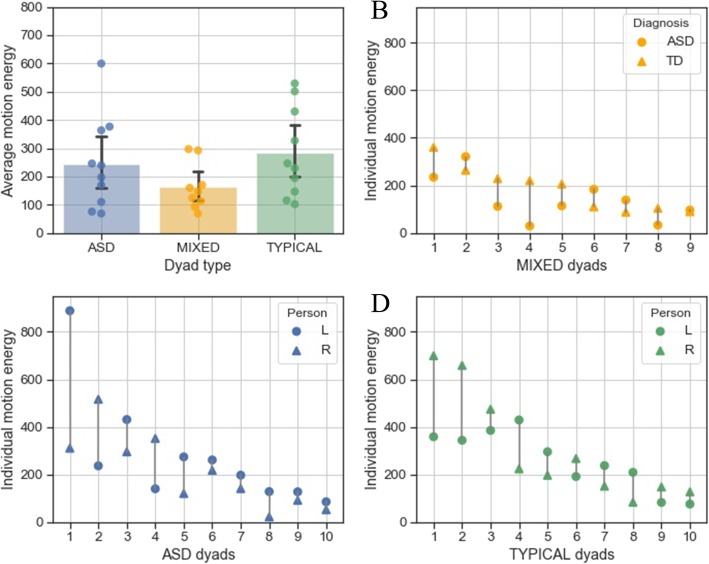
To test this hypothesis, we filmed 29 autistic and 29 matched typically developed adults engaged in several conversational tasks. Windowed cross-lagged correlations were computed using the time series of motion energy of both individuals in a dyad. These coefficients were then compared across the three dyad types that were homo- or heterogenous with respect to diagnosis: pairs of two autistic individuals, two typically developed individuals or pairs of one autistic and one typically developed person.
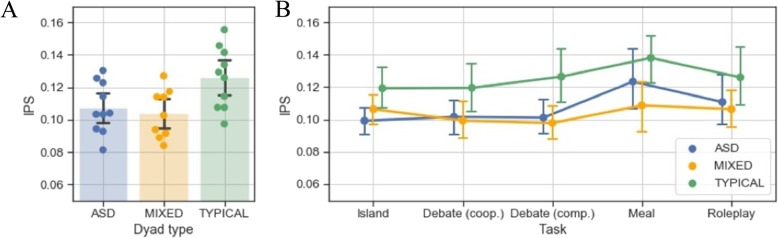
We found that all dyad types achieved above-chance interpersonal synchrony, but that synchrony was more expressed in typical dyads compared to both autistic and mixed dyads.
The method presented here provides only one, albeit objective and robust, approach to explore synchrony. The methodological choices as well as the lack of consideration for other communication modalities may limit our interpretation of the findings. Moreover, the sample size is small with respect to exploring associations between synchrony and various outcome and social skill measures.
The present results do not provide support for the Interactional Heterogeneity Hypothesis given that autistic individuals do not coordinate better when interacting with another autistic individual, compared to when interacting with a typical individual.
自闭症谱系障碍个体的主要诊断特征之一是在自然社交互动中存在非言语行为困难。自闭症的“互动异质性假说”提出,个体之间共同基础的程度极大地影响他们实现流畅社交互动的能力。
为了检验这一假设,我们拍摄了 29 名自闭症患者和 29 名匹配的典型发展成年人在几个会话任务中的表现。使用二人组中每个人的运动能量时间序列计算了窗口交叉滞后相关。然后,将这些系数与三种具有相同或不同诊断的二联体类型进行比较:两个自闭症个体的对、两个典型发展个体的对或一个自闭症个体和一个典型发展个体的对。
我们发现所有二联体类型都实现了高于机会的人际同步,但与自闭症和混合二联体相比,典型二联体的同步性更高。
这里提出的方法仅提供了一种方法,尽管是客观和稳健的方法来探索同步性。方法选择以及没有考虑其他沟通模式可能会限制我们对研究结果的解释。此外,与探索同步性与各种结果和社交技能衡量标准之间的关联相比,样本量较小。
鉴于自闭症个体在与另一个自闭症个体互动时并没有比与典型个体互动时更好地协调,因此本研究结果不支持互动异质性假说。