Departamento de Ecología, Genética y Evolución/Laboratorio de Eco-Epidemiología, Facultad de Ciencias Exactas y Naturales, Universidad de Buenos Aires, Buenos Aires, Argentina.
Instituto de Ecología, Genética y Evolución (CONICET-IEGEBA), CONICET-Universidad de Buenos Aires, Buenos Aires, Argentina.
Parasit Vectors. 2020 Feb 3;13(1):47. doi: 10.1186/s13071-020-3912-y.
Melanic (dark) morphs have been barely reported in peridomestic and sylvatic conditions for Triatoma infestans, the most important vector of Chagas disease in the Southern Cone of South America. Adults with dark and small yellow markings on the connexivum were collected after manual searches conducted by technical personnel in 62 domiciliary units in Cruz del Eje, Córdoba Province, Argentina. The last community-wide insecticide spraying campaign before the study had been conducted three years earlier. We investigated if there was a measurable color morph variation (melanic and non-melanic) in wings and connexivum; we determined infestation, distribution of melanic and non-melanic forms, and correspondence of colorimetric variation with variations in morphology (wing size and shape and body length), development (wing fluctuating asymmetry), physiology (nutritional status) or behaviour (flight initiation).
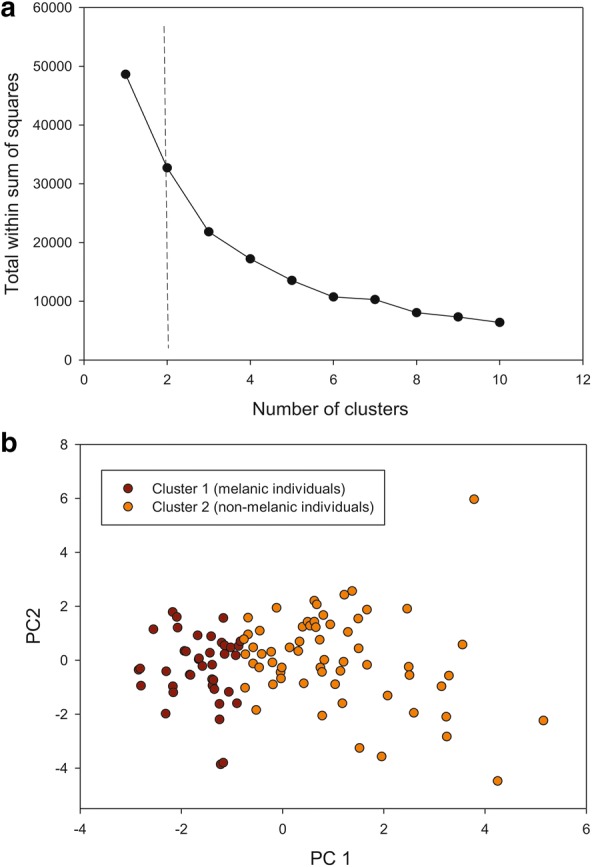
Forty-nine females, 54 males and 217 nymphs were collected in 24 domiciliary units. House infestation and colonization were 53% and 47%, respectively. Most of the T. infestans individuals (83.2%) were collected in chicken coops; intradomicile infestation was recorded in only one case. The chromatic cluster analysis showed two well-defined groups: melanic and non-melanic. The melanic group included 17 (35%) females and 25 (46%) males. Peridomestic infestation was lower for melanic than for non-melanic adults. Melanic morphs were collected in houses from several localities. Sexual dimorphisms were confirmed by morphometric measurements. Body length was large in melanic adults (P < 0.01 only for males). Differences between groups were significant for wing size and shape, but not for weight or weight/body length ratio. Melanic females and males showed significantly higher fluctuating asymmetry (FA) indices than their non-melanic counterparts.
This is the second report of melanic forms of T. infestans in domestic and peridomestic habitats in the Dry Chaco region of Argentina. Although non-melanic adults exhibited a higher infestation rate, melanic adults were widespread in the area and were collected in the infested domicile and in most types of peridomestic annexes. Differences in morphometric variables between groups might be due to different ecological adaptations. The higher FA levels observed in melanic individuals suggest a higher developmental instability and a selective advantage of non-melanic individuals in domestic and peridomestic habitats.
在南美南部锥体的恰加斯病最重要的媒介——三带喙库蚊(Triatoma infestans)的家栖和森林栖环境中,黑色素(深色)变体很少被报道。在阿根廷科尔多瓦省克鲁兹德尔埃杰的 62 个住宅单元中,技术人员进行了人工搜索后,收集到了连接体上有黑色和小黄色标记的成年个体。在研究之前,最后一次社区范围的杀虫剂喷洒活动是在三年前进行的。我们调查了翅膀和连接体是否存在可衡量的颜色形态变化(黑色素和非黑色素);我们确定了感染情况、黑色素和非黑色素形态的分布以及颜色变化与形态(翅膀大小和形状以及体长)、发育(翅膀波动不对称)、生理学(营养状况)或行为(飞行启动)的变化的对应关系。
在 24 个住宅单元中收集到 49 只雌性、54 只雄性和 217 只若虫。房屋感染率和定植率分别为 53%和 47%。大多数三带喙库蚊个体(83.2%)是在鸡舍中收集到的;仅在一个案例中记录了室内感染。色度聚类分析显示出两个定义明确的群体:黑色素和非黑色素。黑色素组包括 17 只(35%)雌性和 25 只(46%)雄性。与非黑色素成体相比,黑色素成体的围生感染率较低。黑色素形态在来自多个地点的房屋中被收集到。形态测量学测量证实了性二态性。黑色素成年个体的体长较大(仅雄性 P<0.01)。组间差异在翅膀大小和形状上显著,但在体重或体重/体长比上不显著。黑色素雌性和雄性的波动不对称(FA)指数明显高于非黑色素个体。
这是阿根廷干燥查科地区家栖和围生栖环境中三带喙库蚊黑色素变体的第二份报告。尽管非黑色素成体表现出更高的感染率,但黑色素成体在该地区广泛分布,并在受感染的住宅和大多数类型的围生附件中被收集到。组间形态变量的差异可能是由于不同的生态适应。在黑色素个体中观察到的更高的 FA 水平表明更高的发育不稳定性和非黑色素个体在家庭和围生环境中的选择优势。