Department of Linguistics, University of Washington, Seattle, WA 98195;
Institute for Learning & Brain Sciences, University of Washington, Seattle, WA 98195.
Proc Natl Acad Sci U S A. 2020 Feb 18;117(7):3484-3491. doi: 10.1073/pnas.1921653117. Epub 2020 Feb 3.
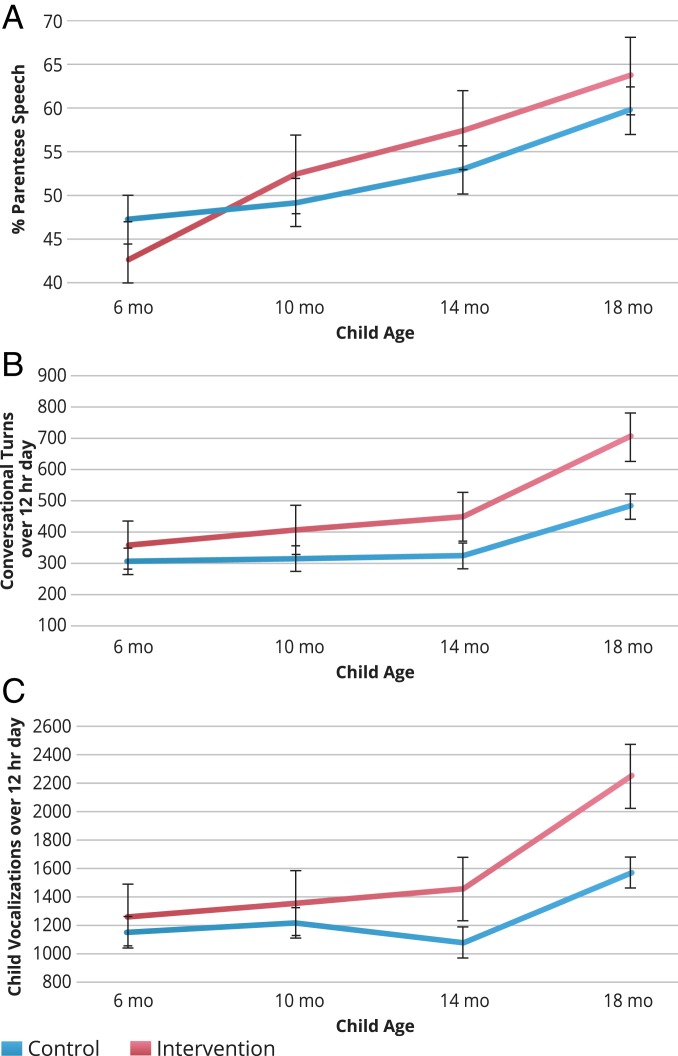
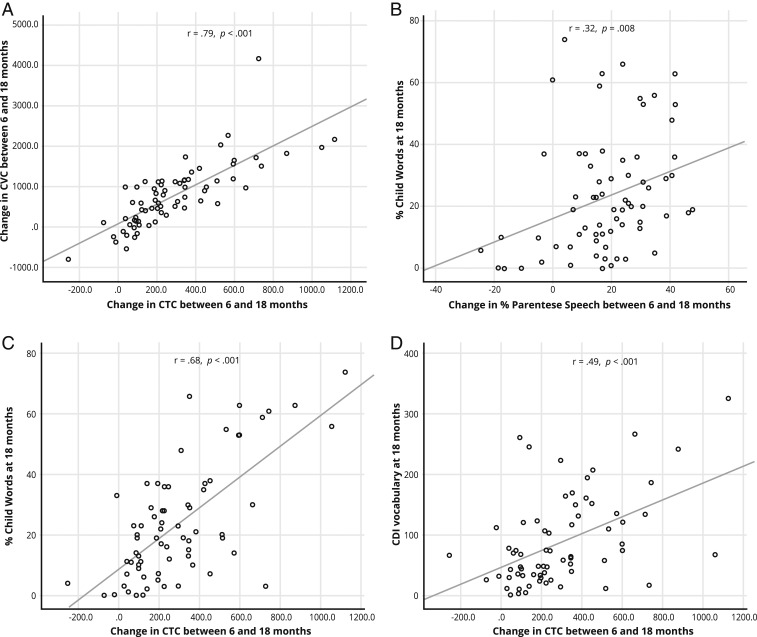
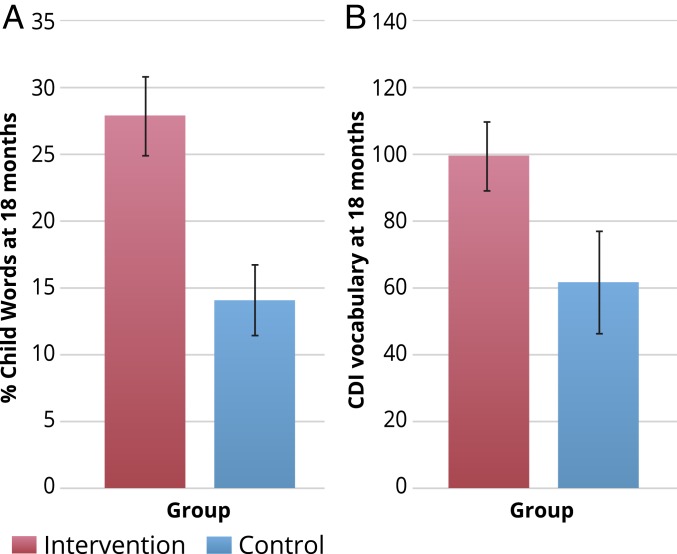
Parental language input is one of the best predictors of children's language achievement. Parentese, a near-universal speaking style distinguished by higher pitch, slower tempo, and exaggerated intonation, has been documented in speech directed toward young children in many countries. Previous research shows that the use of parentese and parent-child turn-taking are both associated with advances in children's language learning. We conducted a randomized controlled trial to determine whether a parent coaching intervention delivered when the infants are 6, 10, and 14 mo of age can enhance parental language input and whether this, in turn, changes the trajectory of child language development between 6 and 18 mo of age. Families of typically developing 6-mo-old infants ( = 71) were randomly assigned to intervention and control groups. Naturalistic first-person audio recordings of the infants' home language environment and vocalizations were recorded when the infants were 6, 10, 14, and 18 mo of age. After the 6-, 10-, and 14-mo recordings, intervention, but not control parents attended individual coaching appointments to receive linguistic feedback, listen to language input in their own recordings, and discuss age-appropriate activities that promote language growth. Intervention significantly enhanced parental use of parentese and parent-child turn-taking between 6 and 18 mo. Increases in both variables were significantly correlated with children's language growth during the same period, and children's language outcomes at 18 mo. Using parentese, a socially and linguistically enhanced speaking style, improves children's social language turn-taking and language skills. Research-based interventions targeting social aspects of parent-child interactions can enhance language outcomes.
父母的语言输入是预测儿童语言能力的最佳指标之一。父母语,一种接近普遍的说话方式,其特点是音高更高、节奏更慢、语调夸张,在许多国家针对幼儿的言语中都有记录。先前的研究表明,父母语的使用和亲子轮流说话都与儿童语言学习的进步有关。我们进行了一项随机对照试验,以确定在婴儿 6、10 和 14 个月大时进行的父母指导干预是否可以增强父母的语言输入,以及这是否会反过来改变儿童在 6 至 18 个月之间的语言发展轨迹。典型发展的 6 个月大婴儿的家庭(n=71)被随机分配到干预组和对照组。当婴儿 6、10、14 和 18 个月大时,记录了他们家庭语言环境和发声的自然主义第一人称音频记录。在 6、10 和 14 个月的录音之后,干预组,但不是对照组的父母参加了个人辅导预约,以获得语言反馈,在自己的录音中听取语言输入,并讨论促进语言发展的适龄活动。干预组在 6 至 18 个月期间显著增强了父母使用父母语和亲子轮流说话的能力。这两个变量的增加与同期儿童的语言增长以及儿童 18 个月时的语言结果显著相关。使用父母语,一种社交和语言上增强的说话方式,可以提高儿童的社交语言轮流和语言技能。针对亲子互动社会方面的基于研究的干预措施可以提高语言结果。