Transplantation Center, The Third Xiangya Hospital, Central South University, Changsha, Hunan, 410013, PR China.
Department of Urology, Zhongshan Hospital, Fudan University, Shanghai Key Laboratory of Organ Transplantation, Shanghai, 200032, PR China.
Cell Death Dis. 2020 Feb 3;11(2):79. doi: 10.1038/s41419-020-2276-8.
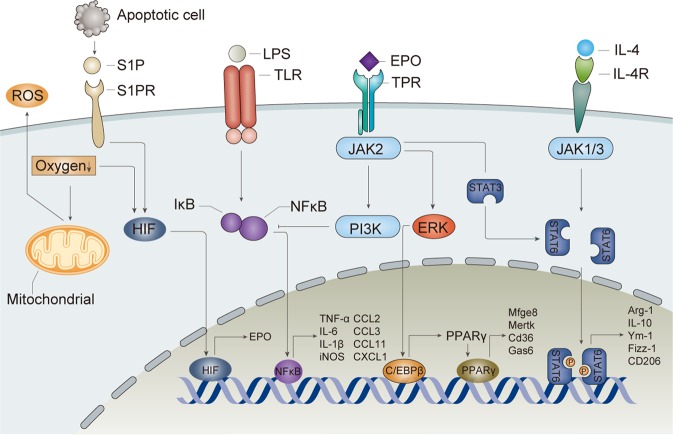
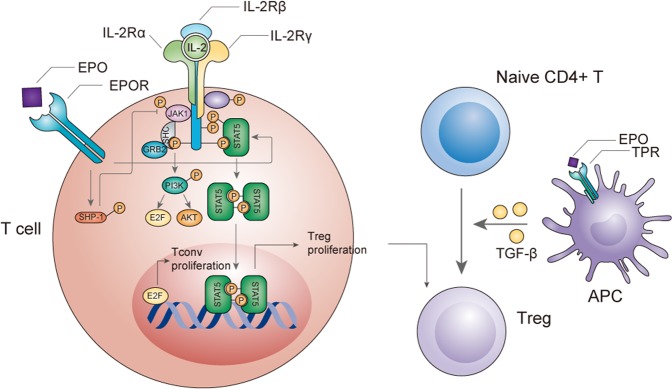
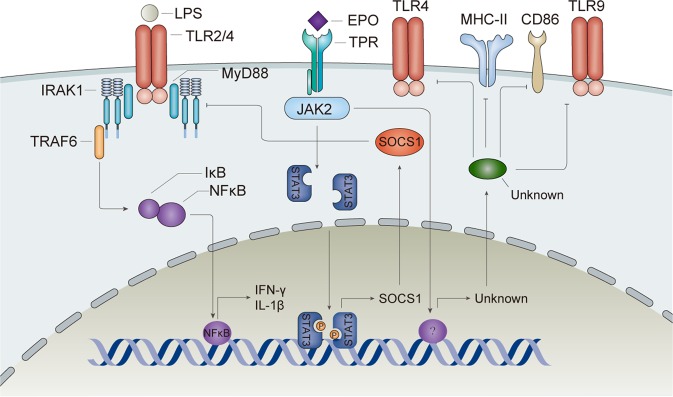
Erythropoietin (EPO) is an evolutionarily conserved hormone well documented for its erythropoietic role via binding the homodimeric EPO receptor (EPOR). In past decades, evidence has proved that EPO acts far beyond erythropoiesis. By binding the tissue-protective receptor (TPR), EPO suppresses proinflammatory cytokines, protects cells from apoptosis and promotes wound healing. Very recently, new data revealed that TPR is widely expressed on a variety of immune cells, and EPO could directly modulate their activation, differentiation and function. Notably, nonerythropoietic EPO derivatives, which mimic the structure of helix B within EPO, specifically bind TPR and show great potency in tissue protection and immune regulation. These small peptides prevent the cardiovascular side effects of EPO and are promising as clinical drugs. This review briefly introduces the receptors and tissue-protective effects of EPO and its derivatives and highlights their immunomodulatory functions and application prospects.
促红细胞生成素(EPO)是一种进化上保守的激素,通过与同源二聚体 EPO 受体(EPOR)结合,其在促红细胞生成方面的作用已有充分的文献记载。在过去的几十年中,有证据表明 EPO 的作用远不止于促红细胞生成。通过与组织保护受体(TPR)结合,EPO 可以抑制促炎细胞因子,保护细胞免受凋亡并促进伤口愈合。最近的新数据表明,TPR 广泛表达于各种免疫细胞上,EPO 可以直接调节它们的激活、分化和功能。值得注意的是,非促红细胞生成素衍生的 EPO 类似物模拟 EPO 中螺旋 B 的结构,特异性地与 TPR 结合,并在组织保护和免疫调节方面具有很强的效力。这些小肽可以预防 EPO 的心血管副作用,有望成为临床药物。本文简要介绍了 EPO 及其衍生物的受体和组织保护作用,并强调了它们的免疫调节功能和应用前景。