Department of Astronomy, School of Science, The University of Tokyo, Bunkyo-ku, Tokyo 113-0033, Japan.
Research Center for the Early Universe, School of Science, The University of Tokyo, Bunkyo-ku, Tokyo 113-0033, Japan.
Sci Rep. 2020 Feb 3;10(1):1671. doi: 10.1038/s41598-020-58060-0.
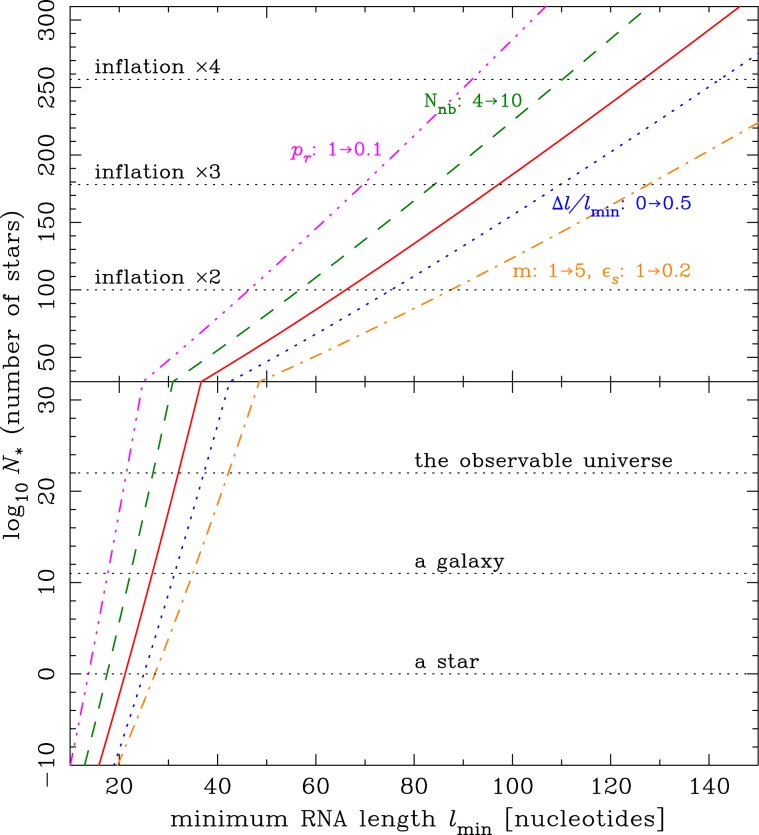
Abiotic emergence of ordered information stored in the form of RNA is an important unresolved problem concerning the origin of life. A polymer longer than 40-100 nucleotides is necessary to expect a self-replicating activity, but the formation of such a long polymer having a correct nucleotide sequence by random reactions seems statistically unlikely. However, our universe, created by a single inflation event, likely includes more than 10 Sun-like stars. If life can emerge at least once in such a large volume, it is not in contradiction with our observations of life on Earth, even if the expected number of abiogenesis events is negligibly small within the observable universe that contains only 10 stars. Here, a quantitative relation is derived between the minimum RNA length l required to be the first biological polymer, and the universe size necessary to expect the formation of such a long and active RNA by randomly adding monomers. It is then shown that an active RNA can indeed be produced somewhere in an inflationary universe, giving a solution to the abiotic polymerization problem. On the other hand, l must be shorter than ~20 nucleotides for the abiogenesis probability close to unity on a terrestrial planet, but a self-replicating activity is not expected for such a short RNA. Therefore, if extraterrestrial organisms of a different origin from those on Earth are discovered in the future, it would imply an unknown mechanism at work to polymerize nucleotides much faster than random statistical processes.
非生物起源的有序信息以 RNA 的形式存储,这是生命起源的一个重要未解决的问题。预计具有自我复制活性的聚合物长度需要大于 40-100 个核苷酸,但通过随机反应形成具有正确核苷酸序列的如此长的聚合物在统计上似乎不太可能。然而,由单次膨胀事件创造的我们的宇宙可能包含超过 10 颗类似太阳的恒星。如果生命至少能在如此大的体积中出现一次,那么这与我们对地球上生命的观察并不矛盾,即使在仅包含 10 颗恒星的可观测宇宙中,生物起源事件的预期数量可以忽略不计。在这里,推导出了第一个生物聚合物所需的最小 RNA 长度 l 与宇宙大小之间的定量关系,期望通过随机添加单体形成如此长且活跃的 RNA。然后表明,在膨胀宇宙中确实可以在某个地方产生活性 RNA,从而解决非生物聚合问题。另一方面,对于在地球行星上接近 1 的生物起源概率,l 必须短于~20 个核苷酸,但对于如此短的 RNA 不期望具有自我复制活性。因此,如果在未来发现与地球上的生物起源不同的外星生物,这将意味着存在一种未知的机制,可以比随机统计过程更快地聚合核苷酸。