Mathematical Ecology Research Group, University of Oxford, Oxford, United Kingdom.
Future of Humanity Institute, University of Oxford, Oxford, United Kingdom.
Astrobiology. 2021 Mar;21(3):265-278. doi: 10.1089/ast.2019.2149. Epub 2020 Nov 19.
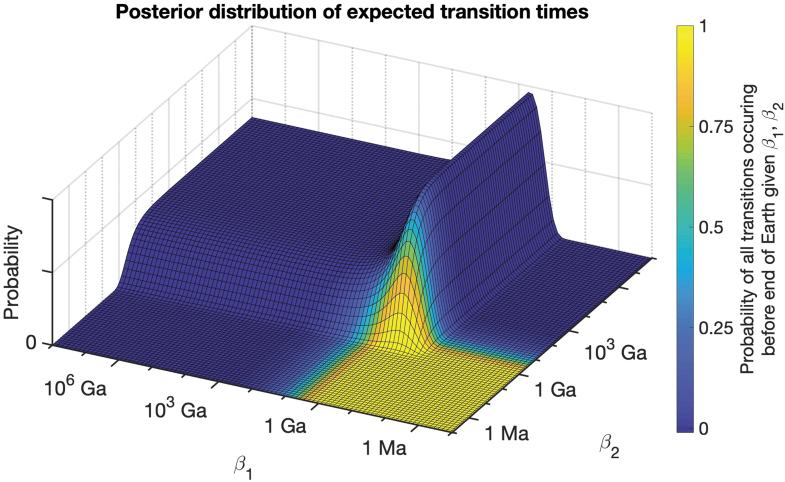
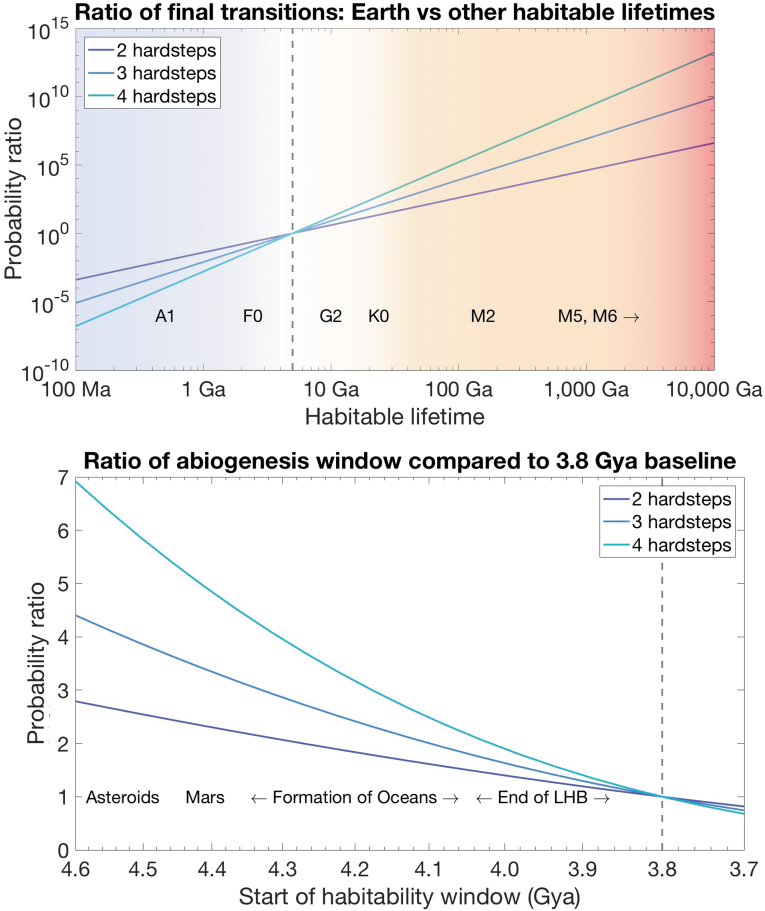
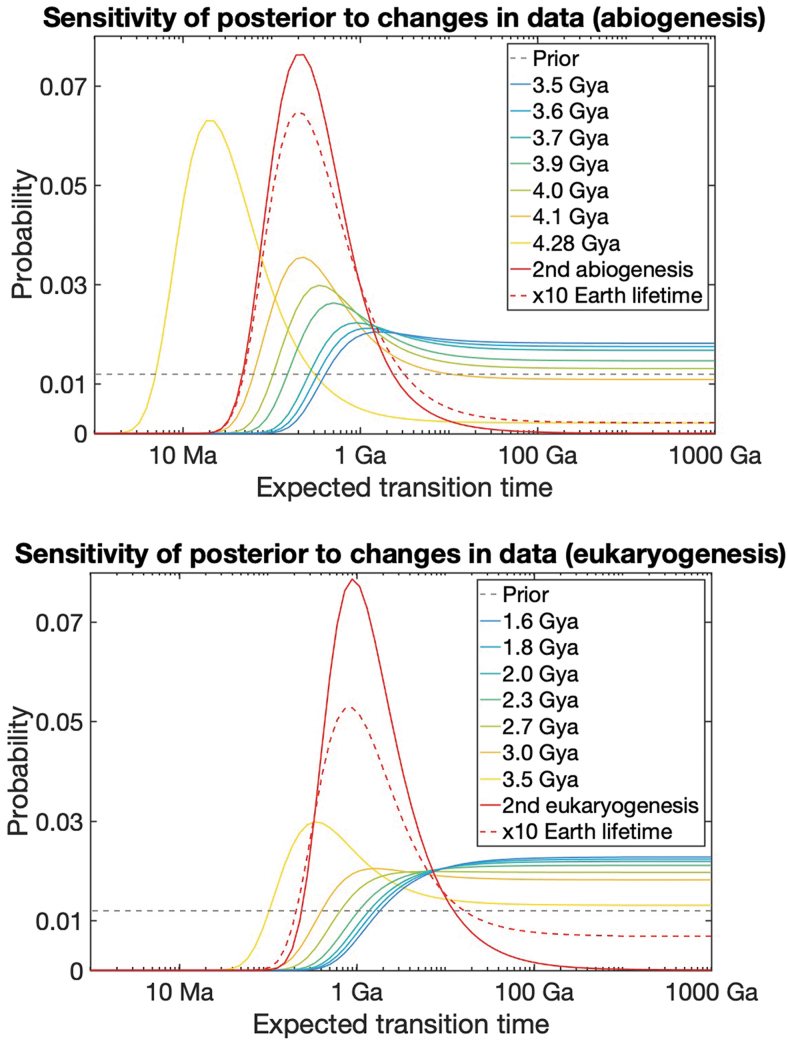
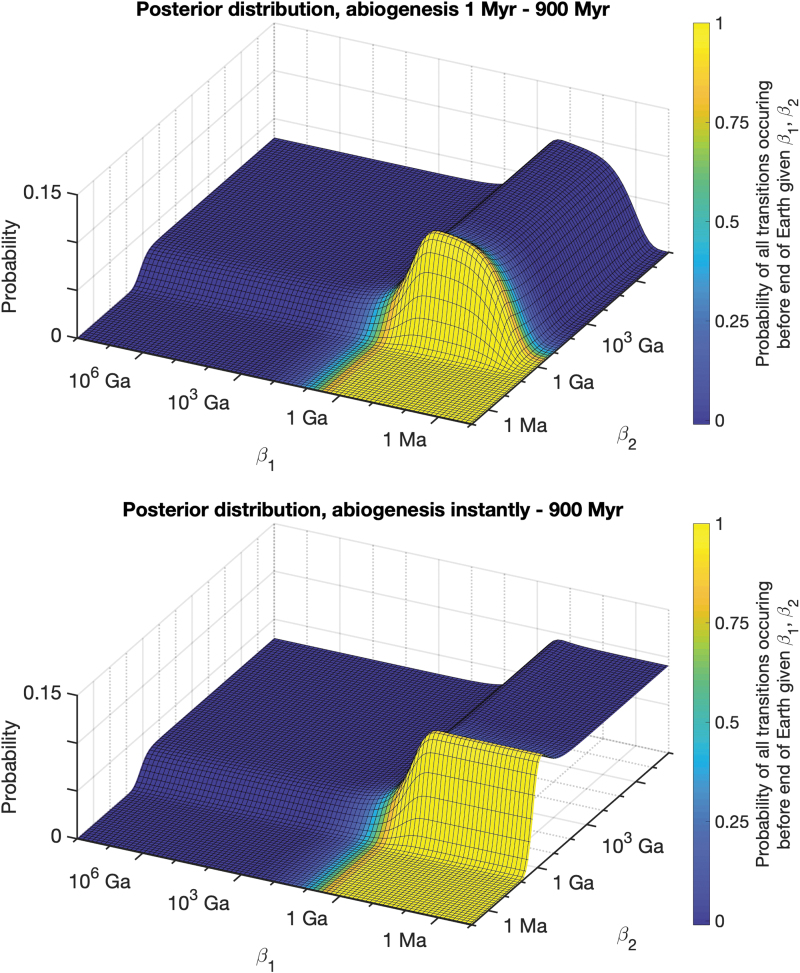
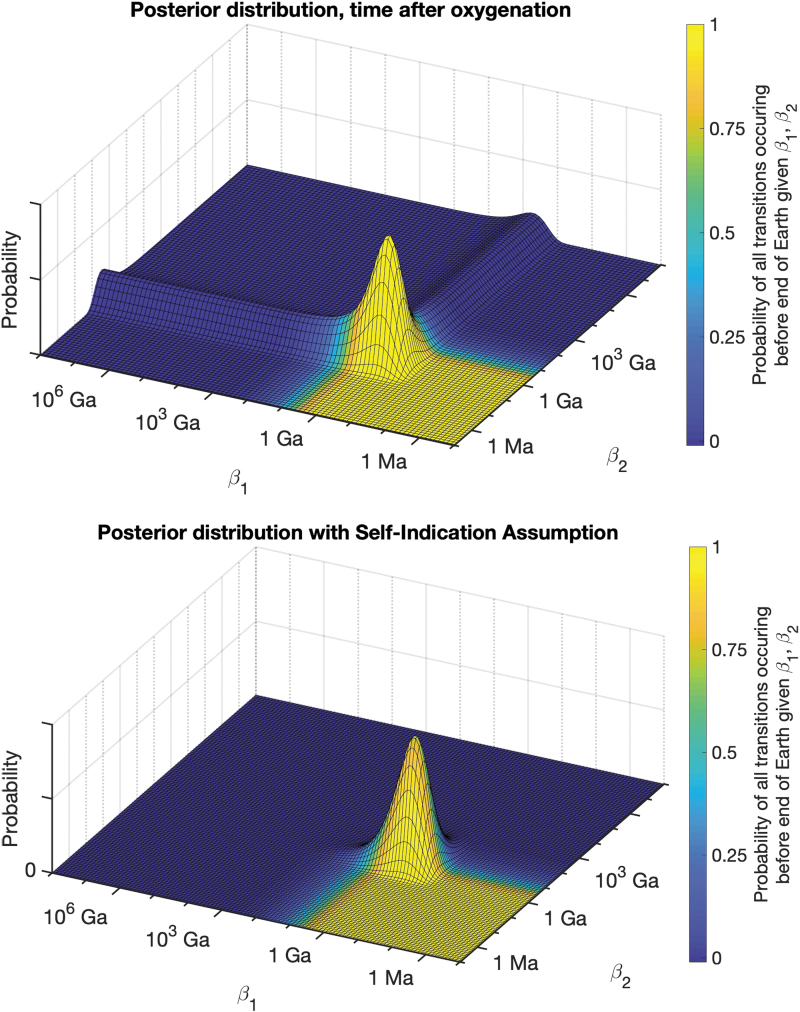
It is unknown how abundant extraterrestrial life is, or whether such life might be complex or intelligent. On Earth, the emergence of complex intelligent life required a preceding series of evolutionary transitions such as abiogenesis, eukaryogenesis, and the evolution of sexual reproduction, multicellularity, and intelligence itself. Some of these transitions could have been extraordinarily improbable, even in conducive environments. The emergence of intelligent life late in Earth's lifetime is thought to be evidence for a handful of rare evolutionary transitions, but the timing of other evolutionary transitions in the fossil record is yet to be analyzed in a similar framework. Using a simplified Bayesian model that combines uninformative priors and the timing of evolutionary transitions, we demonstrate that expected evolutionary transition times likely exceed the lifetime of Earth, perhaps by many orders of magnitude. Our results corroborate the original argument suggested by Brandon Carter that intelligent life in the Universe is exceptionally rare, assuming that intelligent life elsewhere requires analogous evolutionary transitions. Arriving at the opposite conclusion would require exceptionally conservative priors, evidence for much earlier transitions, multiple instances of transitions, or an alternative model that can explain why evolutionary transitions took hundreds of millions of years without appealing to rare chance events. Although the model is simple, it provides an initial basis for evaluating how varying biological assumptions and fossil record data impact the probability of evolving intelligent life, and also provides a number of testable predictions, such as that some biological paradoxes will remain unresolved and that planets orbiting M dwarf stars are uninhabitable.
目前尚不清楚外星生命的丰富程度,也不知道这种生命是否可能具有复杂性或智能性。在地球上,复杂智能生命的出现需要经历一系列先前的进化转变,如无生源说、真核生物起源和有性繁殖、多细胞生物以及智能本身的进化。其中一些转变在有利的环境中也可能极其不可能发生。智能生命在地球生命后期的出现被认为是少数罕见进化转变的证据,但在化石记录中其他进化转变的时间尚未在类似的框架中进行分析。使用一种结合了无信息先验和进化转变时间的简化贝叶斯模型,我们证明了预期的进化转变时间可能超过地球的寿命,也许是许多数量级。我们的结果证实了 Brandon Carter 最初提出的观点,即在宇宙中,智能生命是极其罕见的,假设其他地方的智能生命需要类似的进化转变。要得出相反的结论,需要非常保守的先验假设、更早的转变证据、多次转变实例,或者需要一个可以解释为什么进化转变在没有稀有机会事件的情况下需要数亿年的替代模型。尽管该模型很简单,但它为评估不同的生物学假设和化石记录数据如何影响进化出智能生命的概率提供了一个初步的基础,同时也提供了一些可测试的预测,例如某些生物学悖论将仍然无法解决,以及围绕 M 矮星运行的行星是不适宜居住的。