Department of Human Genetics, KU Leuven, Leuven, Belgium.
The Centre for Applied Genomics (TCAG), The Hospital for Sick Children, Toronto, ON, Canada.
Mol Psychiatry. 2021 Aug;26(8):4496-4510. doi: 10.1038/s41380-020-0654-3. Epub 2020 Feb 3.
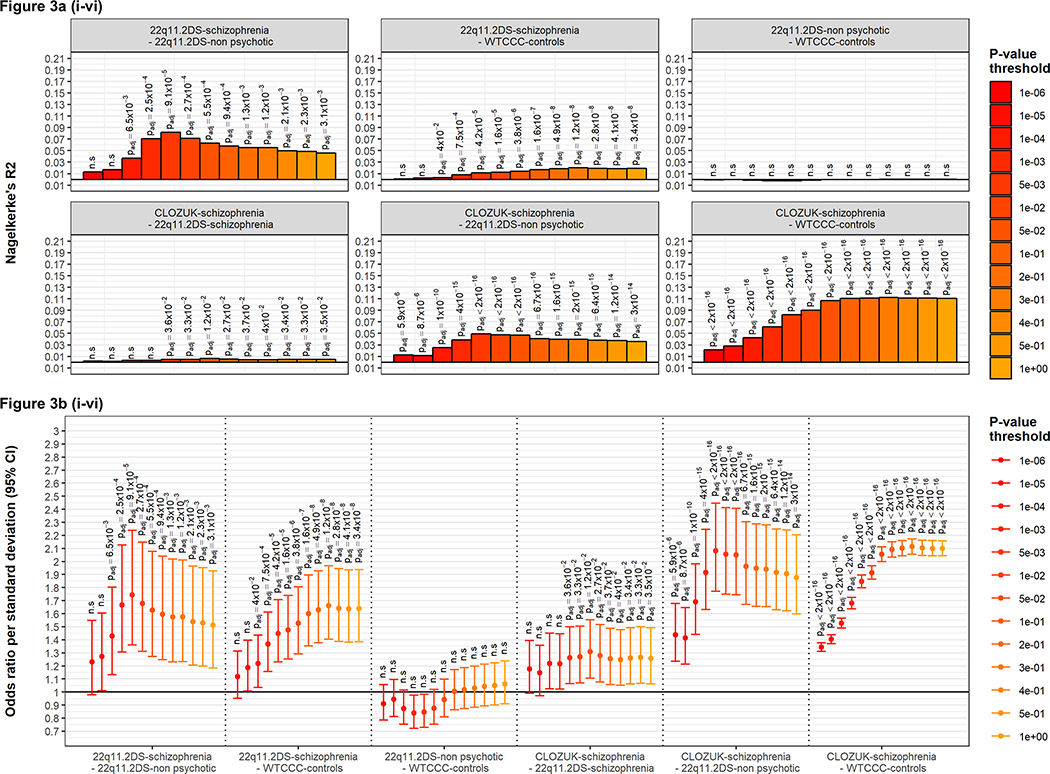
Schizophrenia occurs in about one in four individuals with 22q11.2 deletion syndrome (22q11.2DS). The aim of this International Brain and Behavior 22q11.2DS Consortium (IBBC) study was to identify genetic factors that contribute to schizophrenia, in addition to the ~20-fold increased risk conveyed by the 22q11.2 deletion. Using whole-genome sequencing data from 519 unrelated individuals with 22q11.2DS, we conducted genome-wide comparisons of common and rare variants between those with schizophrenia and those with no psychotic disorder at age ≥25 years. Available microarray data enabled direct comparison of polygenic risk for schizophrenia between 22q11.2DS and independent population samples with no 22q11.2 deletion, with and without schizophrenia (total n = 35,182). Polygenic risk for schizophrenia within 22q11.2DS was significantly greater for those with schizophrenia (p = 6.73 × 10). Novel reciprocal case-control comparisons between the 22q11.2DS and population-based cohorts showed that polygenic risk score was significantly greater in individuals with psychotic illness, regardless of the presence of the 22q11.2 deletion. Within the 22q11.2DS cohort, results of gene-set analyses showed some support for rare variants affecting synaptic genes. No common or rare variants within the 22q11.2 deletion region were significantly associated with schizophrenia. These findings suggest that in addition to the deletion conferring a greatly increased risk to schizophrenia, the risk is higher when the 22q11.2 deletion and common polygenic risk factors that contribute to schizophrenia in the general population are both present.
22q11.2 缺失综合征(22q11.2DS)患者发生精神分裂症的比例约为四分之一。本国际脑与行为 22q11.2DS 联盟(IBBC)研究旨在确定除 22q11.2 缺失导致的约 20 倍风险增加外,导致精神分裂症的遗传因素。我们对 519 名无 22q11.2 缺失的 22q11.2DS 患者的全基因组测序数据进行了分析,比较了 25 岁及以上患有和不患有精神障碍的个体之间常见和罕见变异的全基因组比较。可用的微阵列数据使我们能够直接比较 22q11.2DS 与无 22q11.2 缺失、有或无精神分裂症的独立人群样本(共 35182 名)之间精神分裂症的多基因风险。22q11.2DS 中精神分裂症的多基因风险在患有精神分裂症的个体中显著更高(p=6.73×10)。22q11.2DS 与基于人群的队列之间的新的相互病例对照比较表明,无论是否存在 22q11.2 缺失,精神病患者的多基因风险评分均显著更高。在 22q11.2DS 队列中,基因集分析的结果表明,一些罕见变异可能影响突触基因。22q11.2 缺失区域内的常见或罕见变异与精神分裂症均无显著相关性。这些发现表明,除了缺失导致精神分裂症的风险大大增加外,当 22q11.2 缺失和导致一般人群精神分裂症的常见多基因风险因素都存在时,风险更高。