Department of Pathophysiology, Chengde Medical University, Chengde, Hebei 067000, P.R. China.
Mol Med Rep. 2020 Mar;21(3):1097-1106. doi: 10.3892/mmr.2020.10934. Epub 2020 Jan 13.
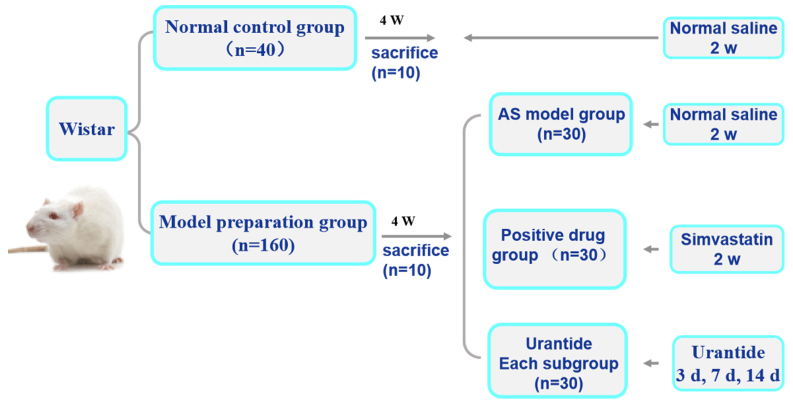
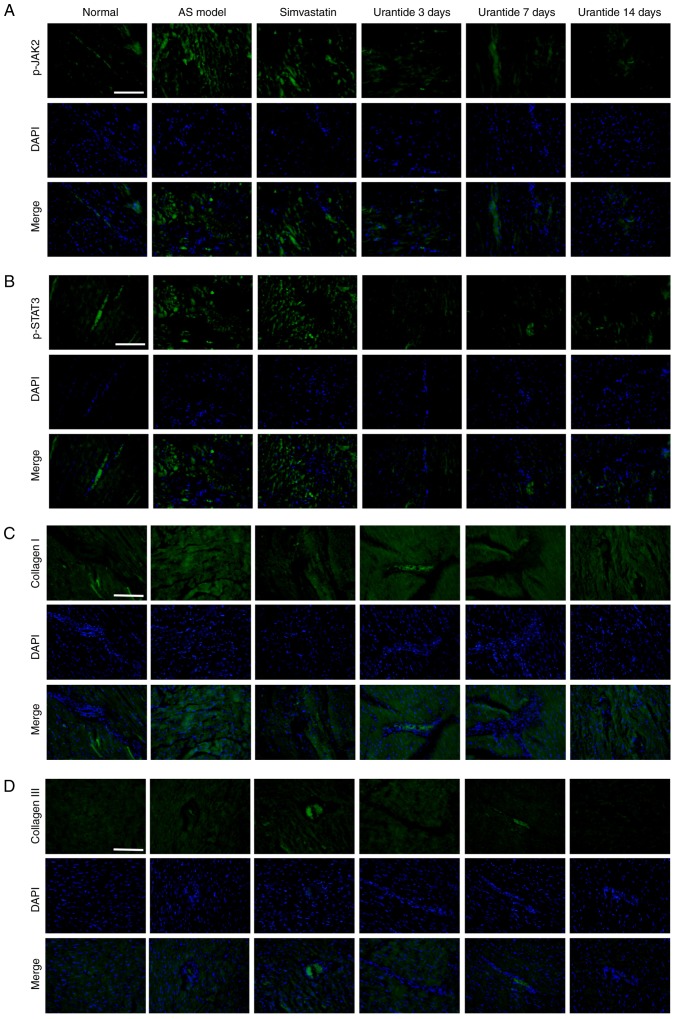
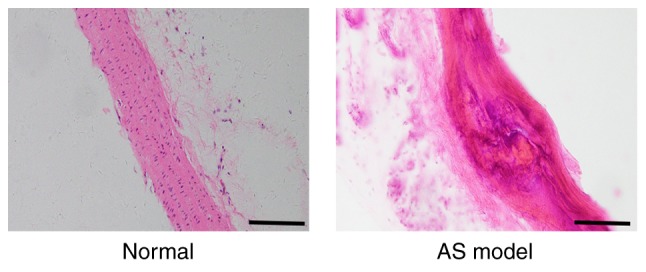
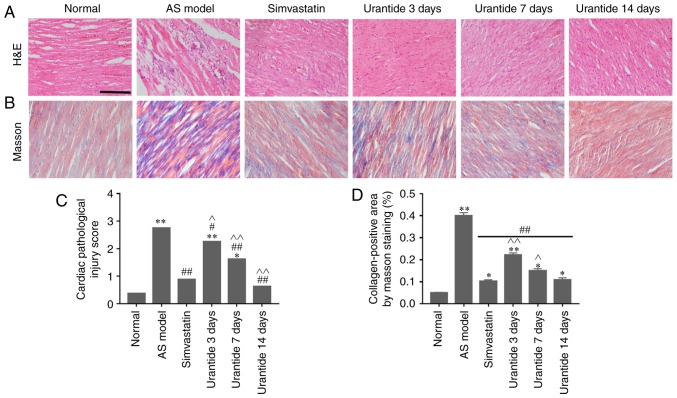
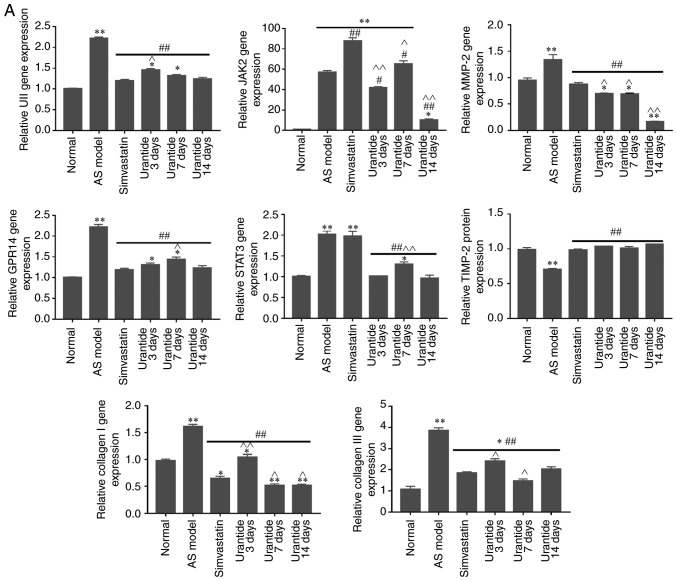
The aim of the present study was to investigate the effect of urantide on collagen metabolism in the hearts of rats with atherosclerosis (AS) by evaluating the expression of Janus kinase 2 (JAK2)/signal transducer and activator of transcription 3 (STAT3) pathway constituents. Urantide was delivered to rats with AS via tail vein injection for 3, 7 and 14 days. Serological indicators were identified by an automated biochemical analyzer. Histomorphological changes in the cardiac tissue of rats were observed by pathological staining techniques. The expression of genes and proteins was assessed using reverse transcription‑quantitative PCR and western blot analysis, respectively. Localization of proteins was detected by immunofluorescence. Overexpression of urotensin II (UII) and its receptor, G protein‑coupled receptor 14 (GPR14), was observed in the hearts of rats with AS and the expression of both proteins significantly declined after urantide administration. Triglyceride, total cholesterol, low‑density lipoprotein, high‑density lipoprotein and calcium levels were improved in rats with AS following treatment with urantide. Notably, urantide was able to antagonize the UII/GPR14 system. Urantide treatment resulted in markedly decreased expression levels of matrix metalloproteinase 2 (MMP‑2), collagen type I/III, and genes and proteins in the JAK2/STAT3 pathway. By contrast, TIMP metallopeptidase inhibitor 2 (TIMP‑2) levels were increased. In addition, the MMP‑2/TIMP‑2 protein ratio was significantly decreased in rats treated with urantide compared with AS rats with no urantide treatment. Constituents of the JAK2/STAT3 pathway and collagen type I/III were found to be localized in the diseased tissue and blood vessels of the hearts of rats with AS. In conclusion, urantide was able to effectively block the UII/GPR14 system by regulating the JAK2/STAT3 pathway and collagen metabolism. Inhibition of the UII/GPR14 system may prevent and potentially treat atherosclerotic myocardial fibrosis. Based on the current results, it was hypothesized that collagen metabolism may be associated with the JAK2/STAT3 pathway.
本研究旨在通过评估 Janus 激酶 2(JAK2)/信号转导和转录激活因子 3(STAT3)通路成分的表达,研究尿速肽对动脉粥样硬化(AS)大鼠心脏胶原代谢的影响。通过尾静脉注射将尿速肽递送至 AS 大鼠,分别在第 3、7 和 14 天进行给药。使用自动生化分析仪鉴定血清学指标。通过病理染色技术观察大鼠心脏组织的形态学变化。采用逆转录-定量 PCR 和 Western blot 分析分别评估基因和蛋白的表达,通过免疫荧光检测蛋白定位。在 AS 大鼠心脏中观察到尿速肽 II(UII)及其受体 G 蛋白偶联受体 14(GPR14)的过表达,给予尿速肽后两种蛋白的表达均显著下降。AS 大鼠经尿速肽治疗后,甘油三酯、总胆固醇、低密度脂蛋白、高密度脂蛋白和钙水平得到改善。值得注意的是,尿速肽能够拮抗 UII/GPR14 系统。尿速肽治疗导致基质金属蛋白酶 2(MMP-2)、I 型/III 型胶原和 JAK2/STAT3 通路的基因和蛋白表达水平显著降低,而 TIMP 金属蛋白酶抑制剂 2(TIMP-2)水平升高。此外,与未用尿速肽治疗的 AS 大鼠相比,用尿速肽治疗的大鼠 MMP-2/TIMP-2 蛋白比值显著降低。JAK2/STAT3 通路和胶原 I/III 成分被发现定位于 AS 大鼠心脏病变组织和血管中。总之,尿速肽通过调节 JAK2/STAT3 通路和胶原代谢,能够有效阻断 UII/GPR14 系统。抑制 UII/GPR14 系统可能预防和潜在治疗动脉粥样硬化性心肌纤维化。基于目前的结果,假设胶原代谢可能与 JAK2/STAT3 通路有关。