Department of Anesthesiology, Zunyi Medical University, Zunyi, Guizhou 563003, P.R. China.
Mol Med Rep. 2020 Mar;21(3):1527-1536. doi: 10.3892/mmr.2020.10966. Epub 2020 Jan 28.
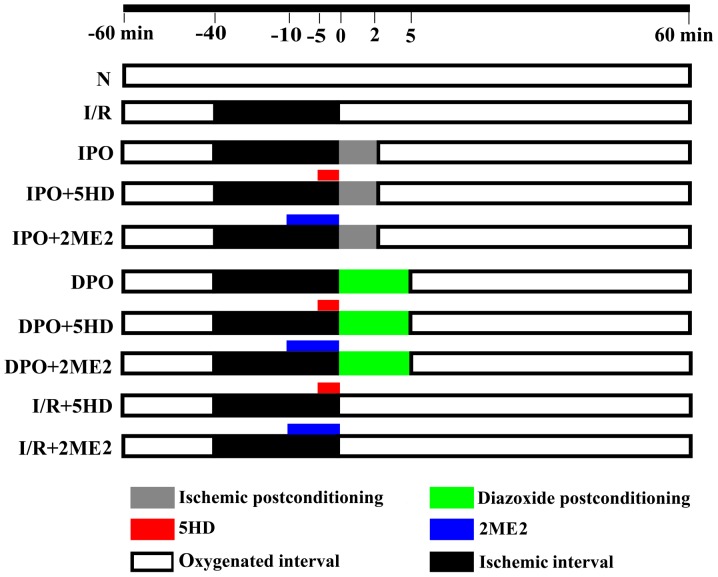
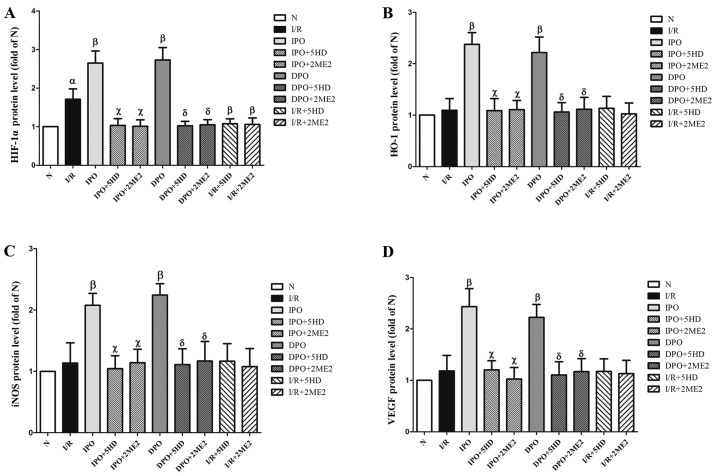
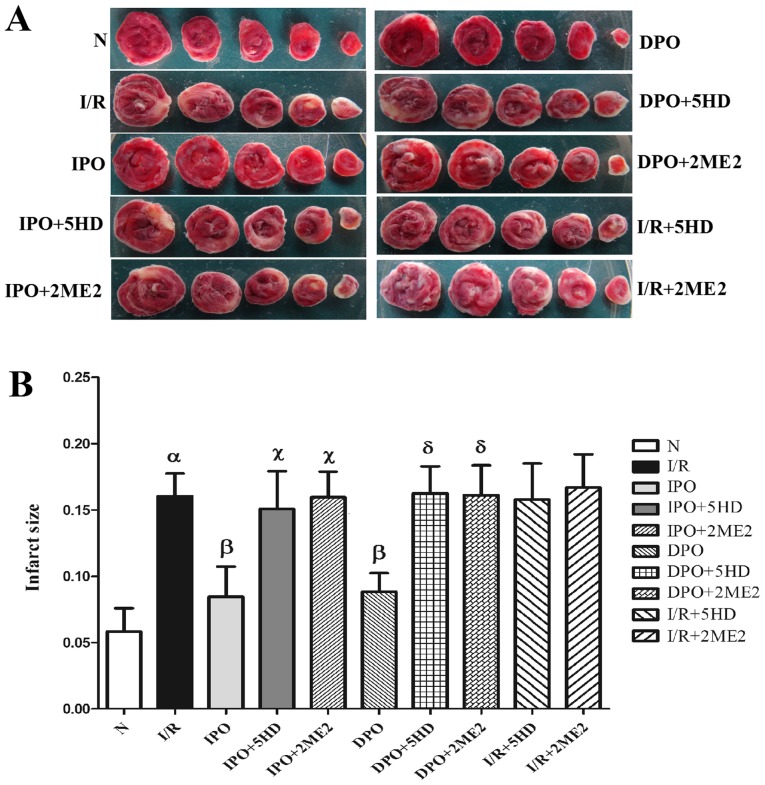
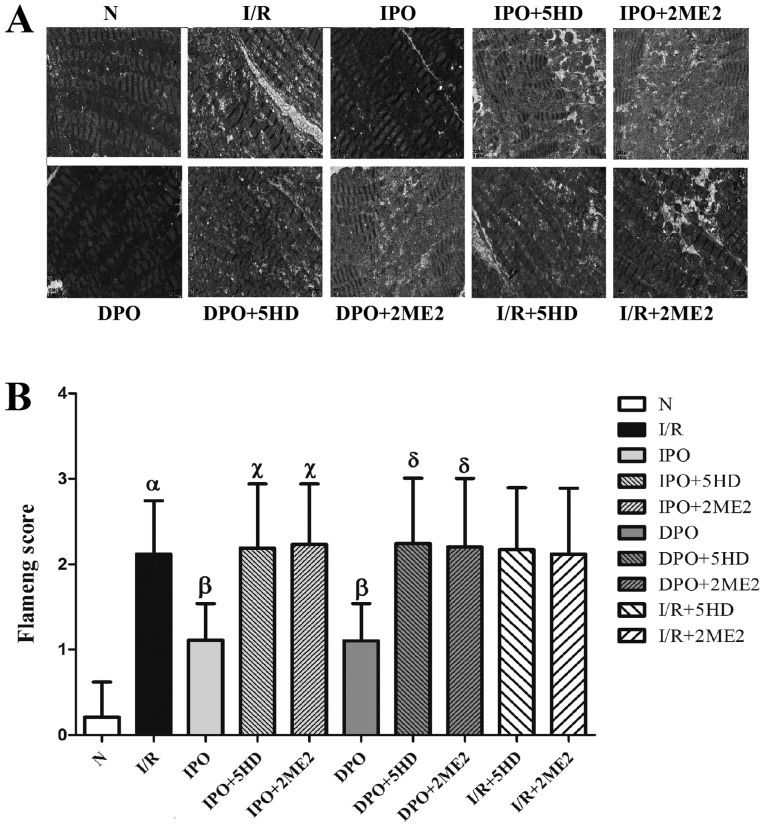
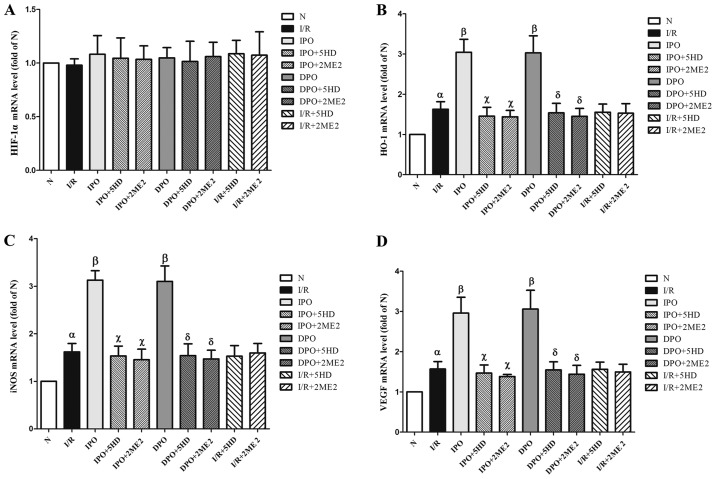
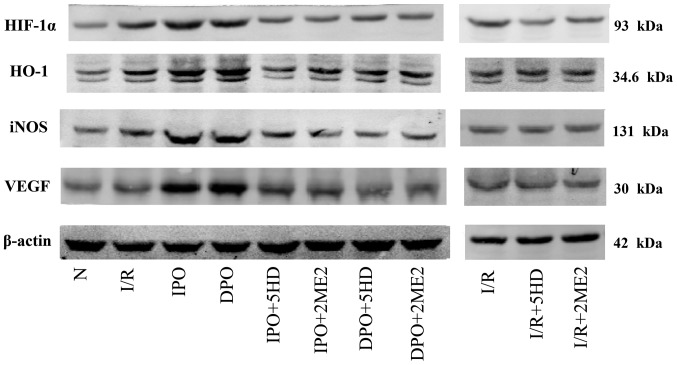
Ischemic post‑conditioning (IPO) and diazoxide post‑conditioning (DPO) has been proven to reduce myocardial ischemia reperfusion injury (MIRI); however, the mechanisms of IPO/DPO are still not clear. The present study aimed to investigate whether mitochondrial ATP‑sensitive potassium channels (mitoKATP) channels are activated by IPO/DPO, which may further activate the hypoxia inducible factor 1/hypoxic response element (HIF‑1/HRE) pathway to mitigate MIRI. Using a Langendorff perfusion device, healthy male (250‑300 g) Sprague Dawley rat hearts were randomly divided into the following groups. Group N was aerobically perfused with K‑H solution for 120 min. Group ischaemia/reperfusion (I/R) was aerobically perfused for 20 min, then subjected to 40 min hypoxia plus 60 min reperfusion. Group IPO was treated like the I/R group, but with 10 sec of hypoxia plus 10 sec of reperfusion for six rounds before reperfusion. Group DPO was exposed to 50 µM diazoxide for 5 min before reperfusion and otherwise treated the same as group I/R. In groups IPO+5‑hydroxydecanoic acid (5HD), DPO+5HD and I/R+5HD, exposure to 100 µM 5HD (a mitoKATP channel specific blocker) for 5 min before reperfusion as described for groups IPO, DPO and I/R, respectively. In groups IPO+2‑methoxyestradiol (2ME2), DPO+2ME2 and I/R+2ME2, exposure to 2 µM 2ME2 (a HIF‑1α specific blocker) for 10 min before reperfusion as described for groups IPO, DPO and I/R respectively. Cardiac hemodynamics, myocardial injury and the expression of HIF‑1/HRE pathway [HIF‑1α, heme oxygenase (HO‑1), inducible nitric oxide synthase (iNOS) and vascular endothelial growth factor (VEGF)] were detected in each group. The infarct size and mitochondrial Flameng scores of groups IPO/DPO were significantly decreased compared with the I/R group (P<0.05), but the myocardial protective effects of IPO/DPO could be eliminated by 5HD or 2ME2 (P<0.05). In addition, IPO/DPO could increase the mRNA expression of HIF‑1α and the downstream factors of the HIF‑1/HRE pathway (the mRNA and protein expression of HO‑1, iNOS and VEGF; P<0.05). However, the myocardial protective effects and the activation the HIF‑1/HRE pathway mediated by IPO/DPO could be eliminated by 5HD or 2ME2 (P<0.05). Therefore, the activation of the HIF‑1/HRE pathway by opening mitoKATP channels may work with the mechanism of IPO/DPO in reducing MIRI.
缺血后处理(IPO)和二氮嗪后处理(DPO)已被证明可减轻心肌缺血再灌注损伤(MIRI);然而,IPO/DPO 的机制仍不清楚。本研究旨在探讨 IPO/DPO 是否通过激活线粒体三磷酸腺苷敏感性钾通道(mitoKATP)通道,进一步激活低氧诱导因子 1/低氧反应元件(HIF-1/HRE)通路,从而减轻 MIRI。使用 Langendorff 灌注装置,将健康雄性(250-300g)Sprague Dawley 大鼠心脏随机分为以下几组。N 组用 K-H 溶液有氧灌注 120min。I/R 组有氧灌注 20min,然后缺氧 40min 加再灌注 60min。IPO 组处理方式与 I/R 组相同,但在再灌注前进行 6 轮 10 秒缺氧加 10 秒再灌注。DPO 组在再灌注前用 50µM 二氮嗪处理 5min,其余处理与 I/R 组相同。在 IPO+5-羟基癸酸(5HD)、DPO+5HD 和 I/R+5HD 组中,在再灌注前用 100µM 5HD(mitoKATP 通道特异性阻断剂)处理 5min,处理方式与 IPO、DPO 和 I/R 组相同。在 IPO+2-甲氧基雌二醇(2ME2)、DPO+2ME2 和 I/R+2ME2 组中,在再灌注前用 2µM 2ME2(HIF-1α 特异性阻断剂)处理 10min,处理方式与 IPO、DPO 和 I/R 组相同。各组均检测心功能、心肌损伤及 HIF-1/HRE 通路表达[HIF-1α、血红素加氧酶(HO-1)、诱导型一氧化氮合酶(iNOS)和血管内皮生长因子(VEGF)]。与 I/R 组相比,IPO/DPO 组梗死面积和线粒体 Flameng 评分明显降低(P<0.05),但 5HD 或 2ME2 可消除 IPO/DPO 的心肌保护作用(P<0.05)。此外,IPO/DPO 可增加 HIF-1/HRE 通路下游因子(HO-1、iNOS 和 VEGF 的 mRNA 和蛋白表达)的 mRNA 表达(P<0.05)。然而,IPO/DPO 通过开放 mitoKATP 通道激活 HIF-1/HRE 通路介导的心肌保护作用和激活作用可被 5HD 或 2ME2 消除(P<0.05)。因此,通过开放 mitoKATP 通道激活 HIF-1/HRE 通路可能与 IPO/DPO 减轻 MIRI 的机制有关。