Independent Unit of Experimental Neuropathophysiology, Department of Pathophysiology, Medical University of Lublin, Jaczewskiego 8, PL-20-954, Lublin, Poland.
Pharmacol Rep. 2020 Feb;72(1):80-86. doi: 10.1007/s43440-019-00029-6. Epub 2019 Dec 20.
Due to co-occurrence of seizures and cardiovascular disorders, nebivolol, a widely used selective β-blocker with vasodilatory properties, may be co-administered with antiepileptic drugs. Therefore, we wanted to assess interactions between nebivolol and four conventional antiepileptic drugs: carbamazepine, valproate, phenytoin and phenobarbital in the screening model of tonic-clonic convulsions.
Seizure experiments were conducted in the electroconvulsive threshold and maximal electroshock tests in mice. The chimney test served as a method of assessing motor coordination, whereas long-term memory was evaluated in the computerized step-through passive-avoidance task. To exclude or confirm pharmacokinetic interactions, we measured brain concentrations of antiepileptic drugs using the fluorescence polarization immunoassay.
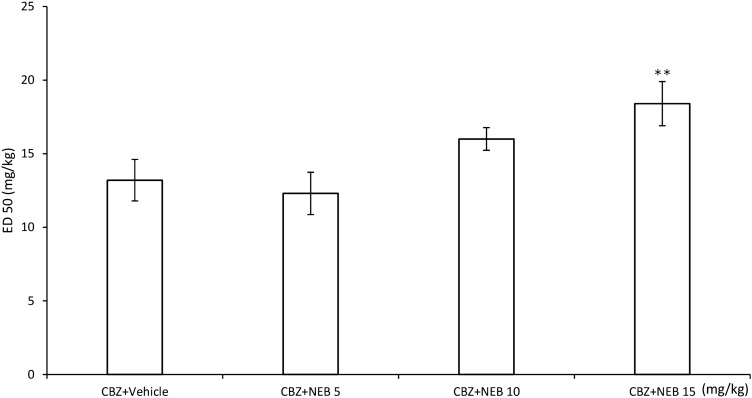
It was shown that nebivolol applied at doses 0.5-15 mg/kg did not raise the threshold for electroconvulsions. However, nebivolol at the dose of 15 mg/kg reduced the anti-electroshock properties of carbamazepine. The effect of valproate, phenytoin, and phenobarbital remained unchanged by combination with the β-blocker. Nebivolol significantly decreased the brain concentration of valproate, but did not affect concentrations of remaining antiepileptic drugs. Therefore, contribution of pharmacokinetic interactions to the final effect of the nebivolol/carbamazepine combination seems not probable. Nebivolol alone and in combinations with antiepileptic drugs did not impair motor performance in mice. Nebivolol alone did not affect long-term memory of animals, and did not potentiate memory impairment induced by valproate and carbamazepine.
This study indicates that nebivolol attenuated effectiveness of some antiepileptic drugs. In case the results are confirmed in clinical settings, this β-blocker should be used with caution in epileptic patients.
由于癫痫发作和心血管疾病的同时发生,广泛应用于临床的具有血管舒张作用的选择性β受体阻滞剂奈必洛尔可能与抗癫痫药物联合应用。因此,我们希望评估奈必洛尔与四种传统抗癫痫药物(卡马西平、丙戊酸钠、苯妥英钠和苯巴比妥)之间的相互作用,评估方法为强直-阵挛性惊厥筛选模型。
在电惊厥阈和最大电休克试验中进行了惊厥实验,在转棒实验中评估运动协调能力,在计算机化的被动回避任务中评估长期记忆。为了排除或确认药代动力学相互作用,我们使用荧光偏振免疫分析法测量了抗癫痫药物在脑内的浓度。
结果表明,奈必洛尔 0.5-15mg/kg 的剂量不会提高电惊厥的阈值。然而,奈必洛尔 15mg/kg 的剂量降低了卡马西平的抗电休克作用。β受体阻滞剂联合使用对丙戊酸钠、苯妥英钠和苯巴比妥的作用没有影响。奈必洛尔显著降低了丙戊酸钠在脑内的浓度,但不影响其余抗癫痫药物的浓度。因此,药代动力学相互作用对奈必洛尔/卡马西平联合治疗的最终效果的贡献似乎不大。奈必洛尔单独使用以及与抗癫痫药物联合使用均未损害小鼠的运动表现。奈必洛尔单独使用不会影响动物的长期记忆,也不会增强丙戊酸钠和卡马西平诱导的记忆障碍。
本研究表明奈必洛尔减弱了一些抗癫痫药物的疗效。如果在临床环境中得到证实,那么β受体阻滞剂应在癫痫患者中谨慎使用。