Division of Gastroenterology, Hepatology and Nutrition, Department of Pediatrics, Nationwide Children's Hospital, Columbus, OH, USA.
Department of Pediatric Gastroenterology and Nutrition, Emma Children's Hospital, Amsterdam UMC, University of Amsterdam, Amsterdam, The Netherlands.
Neurogastroenterol Motil. 2020 Aug;32(8):e13809. doi: 10.1111/nmo.13809. Epub 2020 Feb 3.
To compare antegrade continence enema (ACE) treatment and sacral nerve stimulation (SNS) in children with intractable functional constipation (FC) and fecal incontinence (FI).
We performed a retrospective review of children 6-18 years old with FC and FI treated with either ACE or SNS at our institution. We recorded symptoms at baseline, 6 months, 12 months, 24 months, and their most recent visit after starting treatment. We compared improvement in FI, bowel movement (BM) frequency, abdominal pain, laxative use, and complications. Patients were contacted to evaluate perceived benefit using the Glasgow Children's Benefit Inventory.
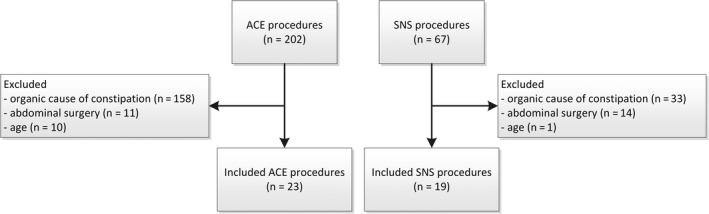
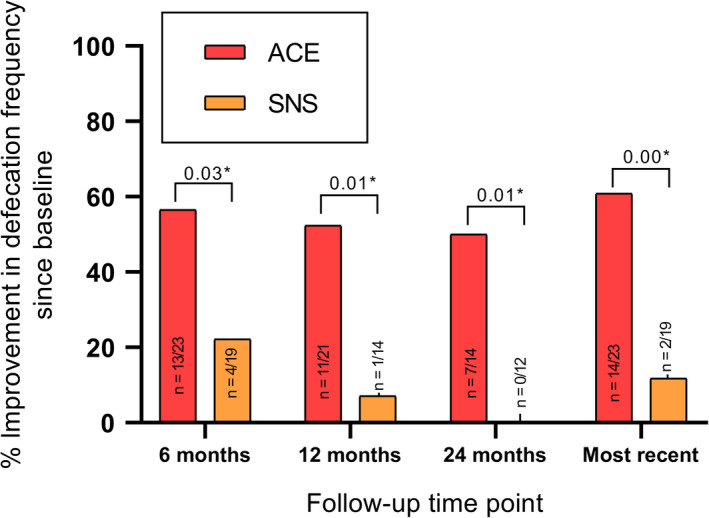
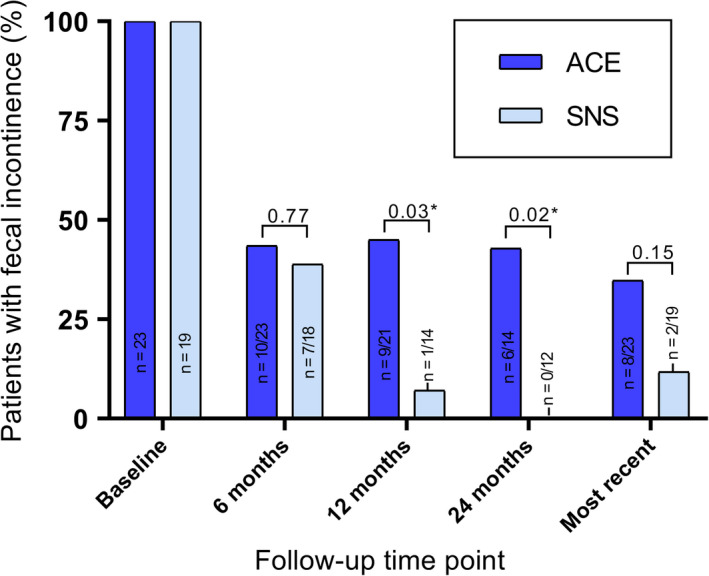
We included 23 patients treated with ACE (52% female, median age 10 years) and 19 patients treated with SNS (74% female, median age 10 years). Improvement in FI was greater with SNS than ACE at 12 months (92.9% vs 57.1%, P = .03) and 24 months (100% vs 57.1%, P = .02). Improvement in BM frequency was greater with ACE, and children were more likely to discontinue laxatives at all follow-up time points (all P < .05). Improvement in abdominal pain was greater with ACE at the most recent visit (P < .05). Rate of complications requiring surgery was similar between groups (26.3% vs 21.7%). Benefit was reported in 83.3% and 100% of ACE and SNS groups, respectively (NS).
Although both ACE and SNS can lead to durable improvement in children with FC and FI, SNS appears more effective for FI and ACE more effective in improving BM frequency and abdominal pain and in discontinuation of laxatives.
比较经肛门持续灌洗(ACE)治疗与骶神经刺激(SNS)治疗儿童难治性功能性便秘(FC)伴大便失禁(FI)的效果。
我们对在我院接受 ACE 或 SNS 治疗的 6-18 岁 FC 伴 FI 儿童进行了回顾性研究。我们记录了基线、6 个月、12 个月、24 个月以及开始治疗后最近一次就诊时的症状。我们比较了 FI、排便频率、腹痛、泻药使用和并发症的改善情况。通过格拉斯哥儿童受益量表评估患者对治疗效果的主观感受。
我们纳入了 23 例 ACE 治疗患者(52%为女性,中位年龄 10 岁)和 19 例 SNS 治疗患者(74%为女性,中位年龄 10 岁)。12 个月(92.9%比 57.1%,P=0.03)和 24 个月时(100%比 57.1%,P=0.02)SNS 治疗 FI 的改善情况优于 ACE。ACE 组在改善排便频率方面更有优势,且在所有随访时间点更有可能停用泻药(均 P<0.05)。ACE 组在最近一次就诊时腹痛改善更明显(P<0.05)。需要手术干预的并发症发生率在两组间相似(26.3%比 21.7%)。ACE 和 SNS 组分别有 83.3%和 100%的患者报告治疗有效(无统计学差异)。
尽管 ACE 和 SNS 均可使 FC 伴 FI 儿童获得持久改善,但 SNS 对 FI 的疗效更优,而 ACE 则在改善排便频率、腹痛和停用泻药方面更具优势。