Department of Aquatic Ecology and Environmental Biology, Institute for Water and Wetland Research, Radboud University, AJ Nijmegen, the Netherlands.
Department of Plant Ecology and Evolution, Evolutionary Biology Centre, Uppsala University, Uppsala, Sweden.
PLoS One. 2020 Feb 4;15(2):e0228383. doi: 10.1371/journal.pone.0228383. eCollection 2020.
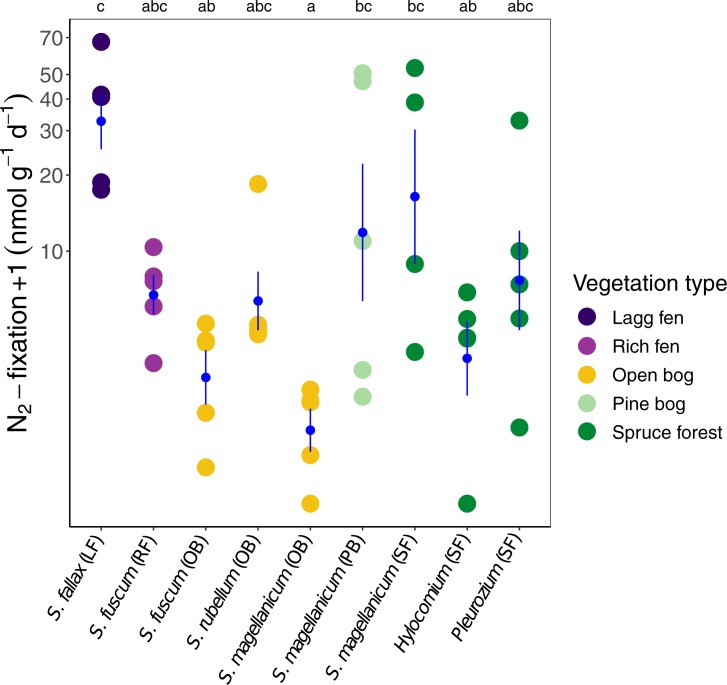
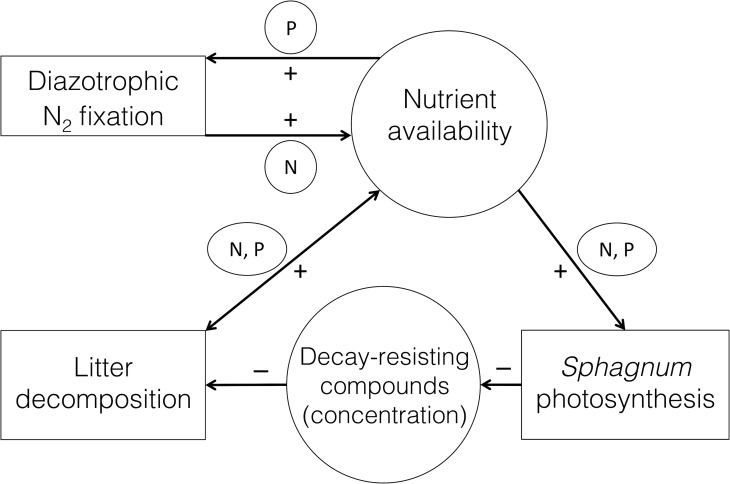
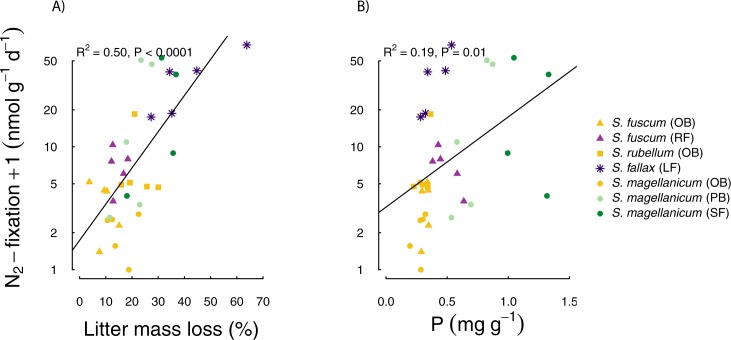
Biological nitrogen (N) fixation is an important process supporting primary production in ecosystems, especially in those where N availability is limiting growth, such as peatlands and boreal forests. In many peatlands, peat mosses (genus Sphagnum) are the prime ecosystem engineers, and like feather mosses in boreal forests, they are associated with a diverse community of diazotrophs (N2-fixing microorganisms) that live in and on their tissue. The large variation in N2 fixation rates reported in literature remains, however, to be explained. To assess the potential roles of habitat (including nutrient concentration) and species traits (in particular litter decomposability and photosynthetic capacity) on the variability in N2 fixation rates, we compared rates associated with various Sphagnum moss species in a bog, the surrounding forest and a fen in Sweden. We found appreciable variation in N2 fixation rates among moss species and habitats, and showed that both species and habitat conditions strongly influenced N2 fixation. We here show that higher decomposition rates, as explained by lower levels of decomposition-inhibiting compounds, and higher phosphorous (P) levels, are related with higher diazotrophic activity. Combining our findings with those of other studies, we propose a conceptual model in which both species-specific traits of mosses (as related to the trade-off between rapid photosynthesis and resistance to decomposition) and P availability, explain N2 fixation rates. This is expected to result in a tight coupling between P and N cycling in peatlands.
生物固氮是支持生态系统初级生产的重要过程,特别是在那些氮素供应限制生长的生态系统中,如泥炭地和北方森林。在许多泥炭地中,泥炭藓(Sphagnum 属)是主要的生态系统工程师,与北方森林中的羽藓一样,它们与生活在其组织内和组织上的各种固氮微生物(氮固定微生物)密切相关。然而,文献中报道的固氮速率的巨大差异仍然需要解释。为了评估栖息地(包括养分浓度)和物种特征(特别是凋落物分解能力和光合作用能力)对固氮速率变异性的潜在作用,我们比较了瑞典沼泽地、周围森林和沼泽地中各种泥炭藓物种相关的固氮速率。我们发现固氮速率在苔藓物种和栖息地之间存在明显差异,并且表明物种和栖息地条件强烈影响固氮。我们在这里表明,较高的分解率,解释为较低水平的分解抑制化合物和较高的磷(P)水平,与较高的固氮活性有关。结合我们的研究结果和其他研究结果,我们提出了一个概念模型,其中苔藓的物种特异性特征(与快速光合作用和抗分解之间的权衡有关)和磷的可用性,解释了固氮速率。这预计将导致泥炭地中磷和氮循环的紧密耦合。