Institute of Biophysics, Ulm University, Albert-Einstein-Allee 11, 89081, Ulm, Germany.
Sci Rep. 2020 Feb 4;10(1):1758. doi: 10.1038/s41598-020-58634-y.
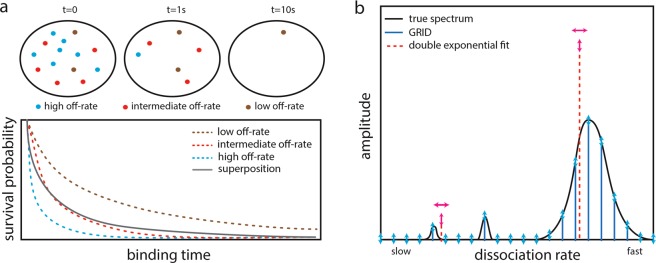
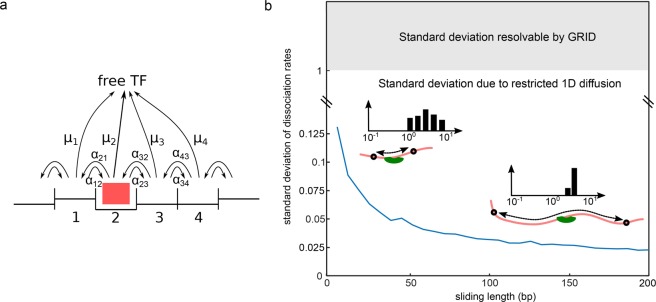
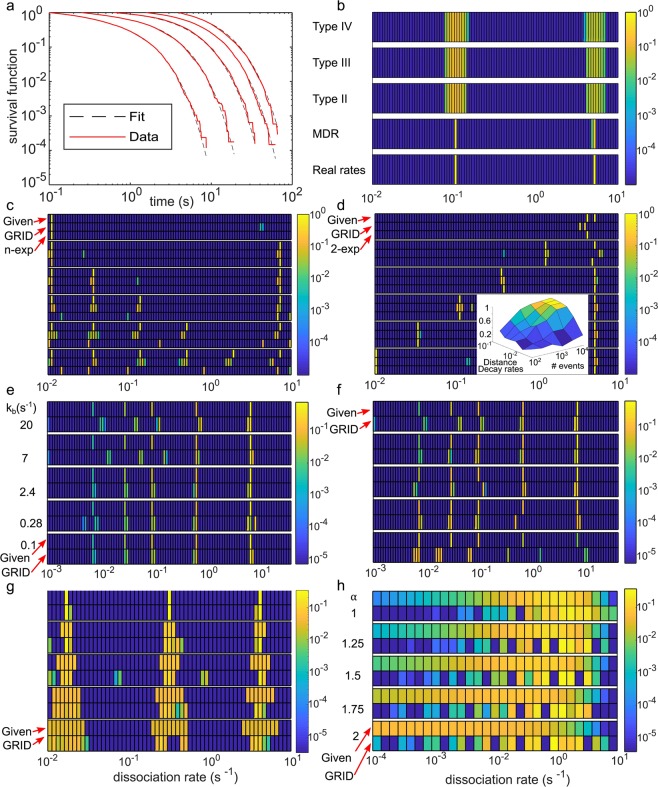
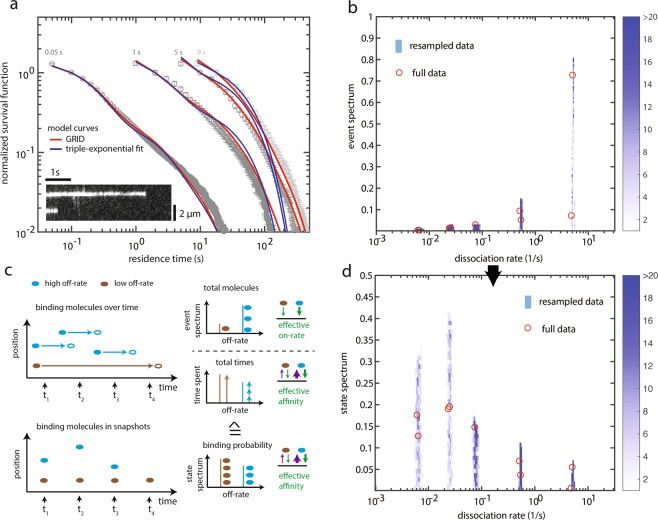
Actions of molecular species, for example binding of transcription factors to chromatin, may comprise several superimposed reaction pathways. The number and the rate constants of such superimposed reactions can in principle be resolved by inverse Laplace transformation of the corresponding distribution of reaction lifetimes. However, current approaches to solve this transformation are challenged by photobleaching-prone fluorescence measurements of lifetime distributions. Here, we present a genuine rate identification method (GRID), which infers the quantity, rates and amplitudes of dissociation processes from fluorescence lifetime distributions using a dense grid of possible decay rates. In contrast to common multi-exponential analysis of lifetime distributions, GRID is able to distinguish between broad and narrow clusters of decay rates. We validate GRID by simulations and apply it to CDX2-chromatin interactions measured by live cell single molecule fluorescence microscopy. GRID reveals well-separated narrow decay rate clusters of CDX2, in part overlooked by multi-exponential analysis. We discuss the amplitudes of the decay rate spectrum in terms of frequency of observed events and occupation probability of reaction states. We further demonstrate that a narrow decay rate cluster is compatible with a common model of TF sliding on DNA.
分子物种的作用,例如转录因子与染色质的结合,可能包含几个重叠的反应途径。这些重叠反应的数量和速率常数原则上可以通过相应的反应寿命分布的逆拉普拉斯变换来确定。然而,当前解决这种变换的方法受到易光漂白的荧光寿命分布测量的挑战。在这里,我们提出了一种真正的速率识别方法(GRID),该方法使用密集的可能衰减速率网格,从荧光寿命分布中推断出离解过程的数量、速率和幅度。与寿命分布的常见多指数分析相比,GRID 能够区分衰减速率的宽和窄簇。我们通过模拟验证了 GRID,并将其应用于通过活细胞单分子荧光显微镜测量的 CDX2-染色质相互作用。GRID 揭示了 CDX2 分离良好的窄衰减速率簇,部分被多指数分析忽略。我们根据观察到的事件的频率和反应状态的占据概率来讨论衰减速率谱的幅度。我们进一步证明,一个窄的衰减速率簇与 TF 在 DNA 上滑动的常见模型兼容。