Department of Otolaryngology, Head and Neck Surgery, Chuo-city, Japan.
Center for Medical Education and Sciences, Chuo-city, Japan.
Br J Cancer. 2020 Mar;122(7):995-1004. doi: 10.1038/s41416-020-0732-y. Epub 2020 Feb 5.
Several pro-oncogenic signals, including transforming growth factor beta (TGF-β) signalling from tumour microenvironment, generate intratumoural phenotypic heterogeneity and result in tumour progression and treatment failure. However, the precise diagnosis for tumour areas containing subclones with cytokine-induced malignant properties remains clinically challenging.
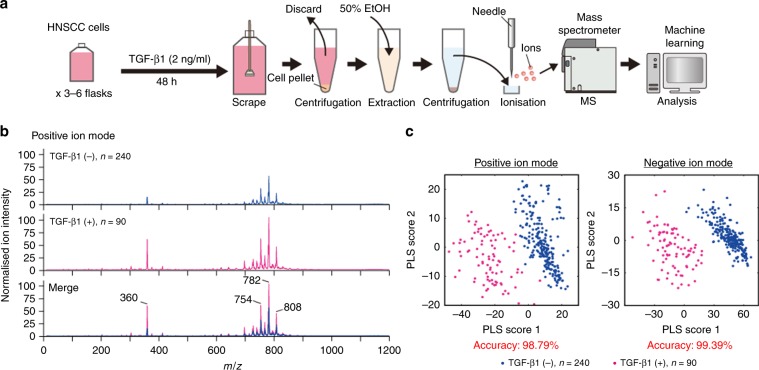
We established a rapid diagnostic system based on the combination of probe electrospray ionisation-mass spectrometry (PESI-MS) and machine learning without the aid of immunohistological and biochemical procedures to identify tumour areas with heterogeneous TGF-β signalling status in head and neck squamous cell carcinoma (HNSCC). A total of 240 and 90 mass spectra were obtained from TGF-β-unstimulated and -stimulated HNSCC cells, respectively, by PESI-MS and were used for the construction of a diagnostic system based on lipidome.
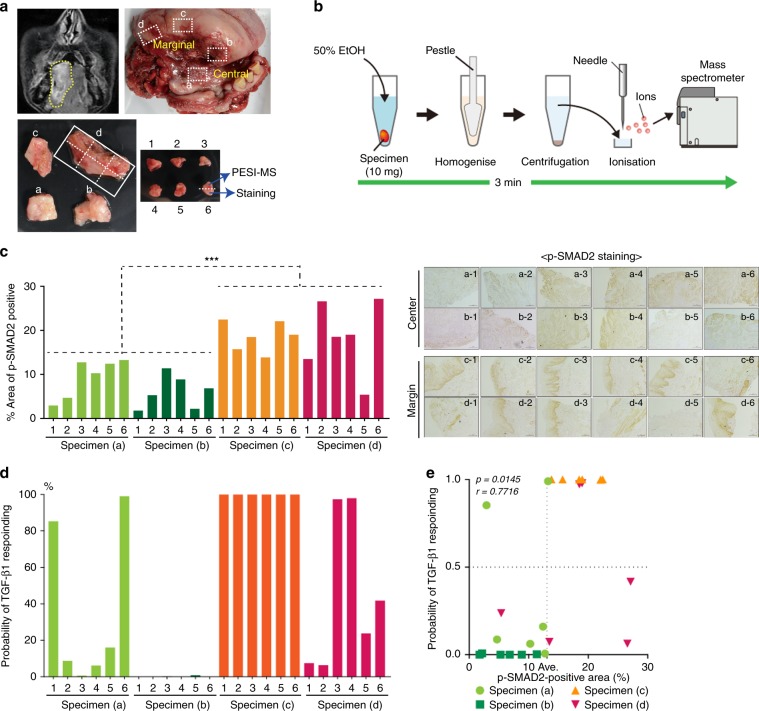
This discriminant algorithm achieved 98.79% accuracy in discrimination of TGF-β1-stimulated cells from untreated cells. In clinical human HNSCC tissues, this approach achieved determination of tumour areas with activated TGF-β signalling as efficiently as a conventional histopathological assessment using phosphorylated-SMAD2 staining. Furthermore, several altered peaks on mass spectra were identified as phosphatidylcholine species in TGF-β-stimulated HNSCC cells.
This diagnostic system combined with PESI-MS and machine learning encourages us to clinically diagnose intratumoural phenotypic heterogeneity induced by TGF-β.
包括肿瘤微环境中的转化生长因子β(TGF-β)信号在内的几种致癌信号会产生肿瘤内表型异质性,导致肿瘤进展和治疗失败。然而,精确诊断含有细胞因子诱导恶性特征的亚克隆的肿瘤区域在临床上仍然具有挑战性。
我们建立了一种快速诊断系统,该系统基于探针电喷雾电离-质谱(PESI-MS)和机器学习的组合,无需免疫组织化学和生化程序即可识别头颈部鳞状细胞癌(HNSCC)中具有异质性 TGF-β 信号状态的肿瘤区域。通过 PESI-MS 分别从未刺激和刺激的 HNSCC 细胞中获得了 240 和 90 个质谱,用于构建基于脂质组学的诊断系统。
该判别算法在区分 TGF-β1 刺激的细胞与未处理的细胞方面达到了 98.79%的准确率。在临床人类 HNSCC 组织中,该方法在确定激活 TGF-β 信号的肿瘤区域方面的效率与使用磷酸化-SMAD2 染色的传统组织病理学评估相当。此外,在 TGF-β 刺激的 HNSCC 细胞中,质谱上的几个改变的峰被鉴定为磷酸胆碱。
该与 PESI-MS 和机器学习相结合的诊断系统鼓励我们对 TGF-β 诱导的肿瘤内表型异质性进行临床诊断。