Mylla Boso Ana Luiza, Gasperi Erica, Fernandes Leticia, Costa Vital Paulino, Alves Monica
Department of Ophthalmology and Otorhinolaryngology, Faculty of Medical Sciences, University of Campinas (UNICAMP), Campinas, Brazil.
Clin Ophthalmol. 2020 Jan 14;14:103-111. doi: 10.2147/OPTH.S229815. eCollection 2020.
Chronic topical treatment for glaucoma may lead to Ocular Surface Disease (OSD). This study aimed to evaluate: (1) the prevalence of OSD in glaucoma patients under topical treatment, quantifying symptoms and objective ocular surface parameters and (2) the impact of ocular surface treatment on OSD and IOP control.
Patients with primary open angle or primary angle closure glaucoma under topical treatment for at least 6 months were enrolled in the study. Patients underwent symptom screening with the ocular surface disease index (OSDI) questionnaire, assessment of objective ocular surface parameters, ocular surface staining and Schirmer test. A treatment for OSD with eyelid hygiene, fluorometholone acetate 0.1%, preservative-free lubricants, free-acid supplementation and oral tetracyclin derivate was started, and the same evaluation was performed.
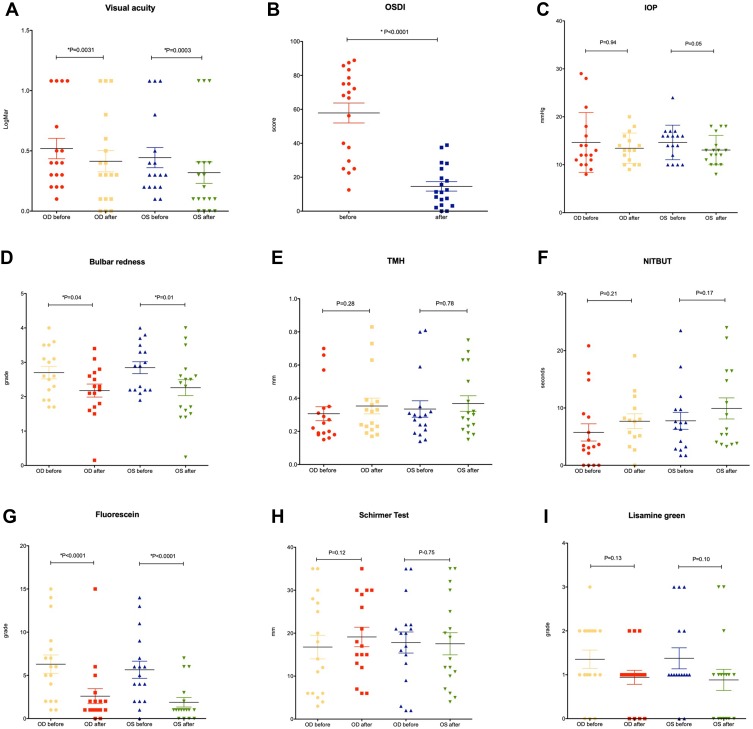
In our sample (n=19), 73.68% of the patients reported severe symptoms of dry eye disease, with OSDI scores higher than 33 at baseline. Tear film instability was found in 50% of patients, while 23.53% had severe meibomian gland abnormalities. Fluorescein and lissamine green stainings were abnormal in 88.24% and 82.35% of patients, respectively. After ocular surface treatment, statistically significant improvement was found in best-corrected visual acuity (p=0.0003), OSDI score (p<0.0001), bulbar redness (p=0.0196) and fluorescein staining (p<0.0001.) Mean IOP following OSD treatment reduced -1.59 mmHg from baseline in the left eye (p=0.0510).
The prevalence of OSD signs and symptoms was high in glaucoma patients under medical treatment. Short-term OSD treatment may improve ocular surface disease and IOP control, with no need to discontinue glaucoma medications.
青光眼的长期局部治疗可能导致眼表疾病(OSD)。本研究旨在评估:(1)局部治疗的青光眼患者中OSD的患病率,量化症状和客观眼表参数;(2)眼表治疗对OSD和眼压控制的影响。
纳入接受局部治疗至少6个月的原发性开角型或原发性闭角型青光眼患者。患者使用眼表疾病指数(OSDI)问卷进行症状筛查,评估客观眼表参数、眼表染色和泪液分泌试验。开始采用眼睑清洁、0.1%醋酸氟米龙、无防腐剂润滑剂、补充游离酸和口服四环素衍生物进行OSD治疗,并进行相同的评估。
在我们的样本(n=19)中,73.68%的患者报告有严重的干眼症状,基线时OSDI评分高于33。50%的患者存在泪膜不稳定,而23.53%的患者有严重的睑板腺异常。88.24%和82.35%的患者分别出现荧光素和丽丝胺绿染色异常。眼表治疗后,最佳矫正视力(p=0.0003)、OSDI评分(p<0.0001)、球结膜充血(p=0.0196)和荧光素染色(p<0.0001)有统计学意义的改善。OSD治疗后左眼平均眼压较基线降低-1.59 mmHg(p=0.0510)。
接受药物治疗的青光眼患者中OSD体征和症状的患病率较高。短期OSD治疗可能改善眼表疾病和眼压控制,且无需停用青光眼药物。