Garcia-Feijoo Julian, Sampaolesi Juan Roberto
Hospital Clínico San Carlos, Instituto de Investigaciones Oftalmólogicas Ramón Castroviejo, Universidad Complutense, Red Temática de Investigación Cooperativa ISCIII, Spain.
Clin Ophthalmol. 2012;6:441-6. doi: 10.2147/OPTH.S29158. Epub 2012 Mar 22.
Glaucoma can be associated with an increase in the occurrence of ocular surface disease (OSD) symptoms. The objective of this study was to examine the prevalence of ocular surface complaints in patients with glaucoma who used topical intraocular pressure (IOP)-lowering therapies.
In this multicenter, international, noninterventional study, adults with glaucoma or ocular hypertension who were using 1 or more topical IOP-lowering medications completed the Ocular Surface Disease Index (OSDI) questionnaire during a regularly scheduled clinic visit. OSDI scores (ranging from 0 to 100) were calculated for each patient. An OSDI score ≥13 indicated a clinically relevant presence of OSD.
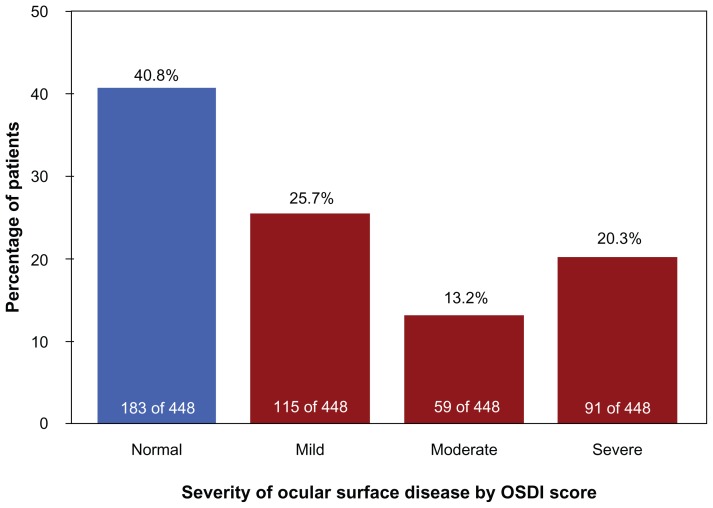
Of the 448 patients who were evaluated, 53.3% were women, 61.6% had a diagnosis of primary open-angle glaucoma, and the mean age was 63 years. The overall OSD prevalence rate in the evaluable population was 59.2%, with 25.7%, 13.2%, and 20.3% of the patients reporting mild, moderate, or severe OSD symptoms, respectively. Patients with glaucoma diagnoses of less than 6 years had a significantly lower mean OSDI score relative to patients with glaucoma diagnoses of 6 years or more (18 [mild OSD] versus 23 [moderate OSD], respectively; P = 0.03). As the number of IOP-lowering treatments increased from one or two medications to three or four medications, the mean OSDI score increased from mild to moderate, though the difference in scores was not statistically significant (P = 0.15).
OSD was highly prevalent in this population of glaucoma patients who were using IOP-lowering medications. Longer duration since diagnosis was significantly correlated with worsening of OSD symptoms. Increases in the number of medications applied also showed a clinically relevant increase in OSD symptom severity.
青光眼可能与眼表疾病(OSD)症状的发生率增加有关。本研究的目的是调查使用局部降眼压(IOP)治疗的青光眼患者眼表不适的患病率。
在这项多中心、国际性、非干预性研究中,正在使用1种或更多种局部降眼压药物的青光眼或高眼压症成人患者在定期门诊就诊期间完成了眼表疾病指数(OSDI)问卷。为每位患者计算OSDI评分(范围为0至100)。OSDI评分≥13表明存在具有临床意义的OSD。
在接受评估的448例患者中,53.3%为女性,61.6%诊断为原发性开角型青光眼,平均年龄为63岁。可评估人群中OSD的总体患病率为59.2%,分别有25.7%、13.2%和20.3%的患者报告有轻度、中度或重度OSD症状。青光眼诊断时间少于6年的患者的平均OSDI评分显著低于青光眼诊断时间为6年或更长时间的患者(分别为18[轻度OSD]和23[中度OSD];P = 0.03)。随着降眼压治疗药物数量从一两种增加到三四 种,平均OSDI评分从轻度增加到中度,尽管评分差异无统计学意义(P = 0.15)。
在这群使用降眼压药物的青光眼患者中,OSD非常普遍。诊断后的时间越长,与OSD症状恶化显著相关。所用药物数量的增加也显示出OSD症状严重程度在临床上有相关增加。