• 文献检索
  • 文档翻译
  • 深度研究
  • 学术资讯
  • Suppr Zotero 插件Zotero 插件
  • 邀请有礼
  • 套餐&价格
  • 历史记录
应用&插件
Suppr Zotero 插件Zotero 插件浏览器插件Mac 客户端Windows 客户端微信小程序
定价
高级版会员购买积分包购买API积分包
服务
文献检索文档翻译深度研究API 文档MCP 服务
关于我们
关于 Suppr公司介绍联系我们用户协议隐私条款
关注我们

Suppr 超能文献

核心技术专利:CN118964589B侵权必究
粤ICP备2023148730 号-1Suppr @ 2026

文献检索

告别复杂PubMed语法,用中文像聊天一样搜索,搜遍4000万医学文献。AI智能推荐,让科研检索更轻松。

立即免费搜索

文件翻译

保留排版,准确专业,支持PDF/Word/PPT等文件格式,支持 12+语言互译。

免费翻译文档

深度研究

AI帮你快速写综述,25分钟生成高质量综述,智能提取关键信息,辅助科研写作。

立即免费体验

存在祖先群体结构时,从基因树上估计物种树的最大似然法。

Maximum Likelihood Estimation of Species Trees from Gene Trees in the Presence of Ancestral Population Structure.

机构信息

Department of Statistics, Pennsylvania State University.

Department of Computer and Electrical Engineering and Computer Science, Florida Atlantic University.

出版信息

Genome Biol Evol. 2020 Feb 1;12(2):3977-3995. doi: 10.1093/gbe/evaa022.

DOI:10.1093/gbe/evaa022
PMID:32022857
原文链接:https://pmc.ncbi.nlm.nih.gov/articles/PMC7061232/
Abstract

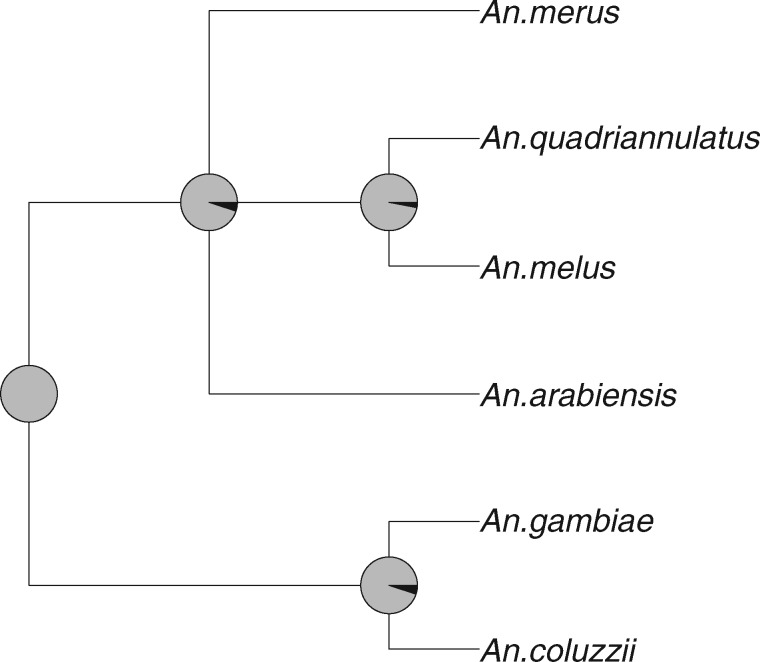
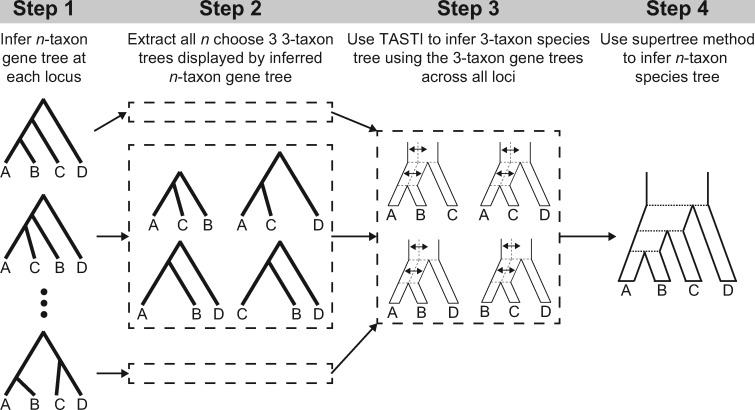
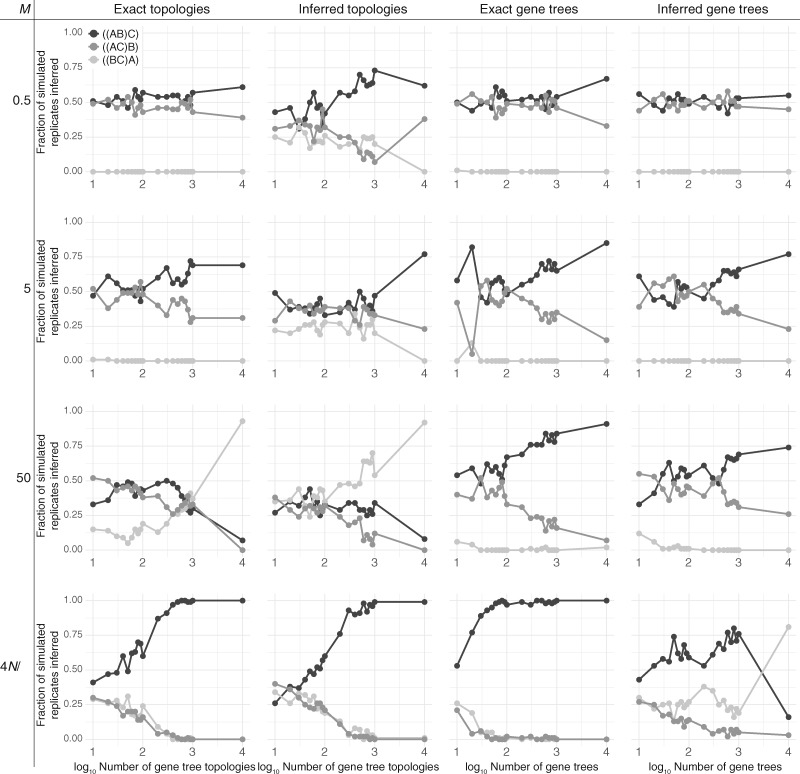
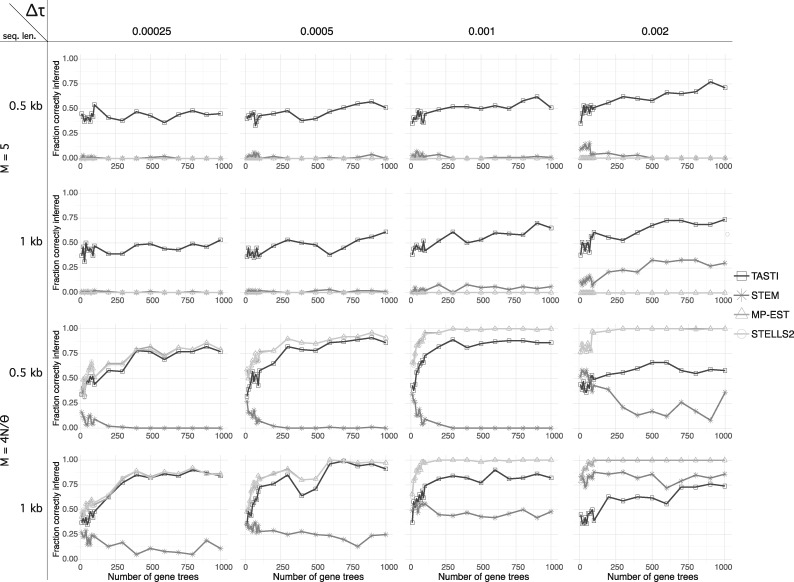
Though large multilocus genomic data sets have led to overall improvements in phylogenetic inference, they have posed the new challenge of addressing conflicting signals across the genome. In particular, ancestral population structure, which has been uncovered in a number of diverse species, can skew gene tree frequencies, thereby hindering the performance of species tree estimators. Here we develop a novel maximum likelihood method, termed TASTI (Taxa with Ancestral structure Species Tree Inference), that can infer phylogenies under such scenarios, and find that it has increasing accuracy with increasing numbers of input gene trees, contrasting with the relatively poor performances of methods not tailored for ancestral structure. Moreover, we propose a supertree approach that allows TASTI to scale computationally with increasing numbers of input taxa. We use genetic simulations to assess TASTI's performance in the three- and four-taxon settings and demonstrate the application of TASTI on a six-species Afrotropical mosquito data set. Finally, we have implemented TASTI in an open-source software package for ease of use by the scientific community.

摘要

尽管大型多位点基因组数据集已导致系统发育推断的整体改进,但它们带来了一个新的挑战,即需要解决整个基因组中相互冲突的信号。特别是,已经在许多不同物种中发现的祖先群体结构会扭曲基因树的频率,从而阻碍物种树估计器的性能。在这里,我们开发了一种新的最大似然方法,称为 TASTI(具有祖先结构的分类单元系统发育推断),它可以在这种情况下推断系统发育,并且发现随着输入基因树数量的增加,它的准确性也在增加,这与未针对祖先结构进行调整的方法的相对较差性能形成对比。此外,我们提出了一种超树方法,允许 TASTI 随着输入分类单元数量的增加而在计算上进行扩展。我们使用遗传模拟来评估 TASTI 在三分类和四分类设置中的性能,并展示了 TASTI 在六个物种的非洲热带蚊子数据集上的应用。最后,我们已经在一个开源软件包中实现了 TASTI,以便科学界易于使用。
https://cdn.ncbi.nlm.nih.gov/pmc/blobs/8bba/7061232/ea5876dfe97e/evaa022f7.jpg
https://cdn.ncbi.nlm.nih.gov/pmc/blobs/8bba/7061232/c93462d97e5b/evaa022f1.jpg
https://cdn.ncbi.nlm.nih.gov/pmc/blobs/8bba/7061232/be1625a4d028/evaa022f2.jpg
https://cdn.ncbi.nlm.nih.gov/pmc/blobs/8bba/7061232/53e4582a9052/evaa022f3.jpg
https://cdn.ncbi.nlm.nih.gov/pmc/blobs/8bba/7061232/13fb007f50cf/evaa022f4.jpg
https://cdn.ncbi.nlm.nih.gov/pmc/blobs/8bba/7061232/3b541fcc50ea/evaa022f5.jpg
https://cdn.ncbi.nlm.nih.gov/pmc/blobs/8bba/7061232/e28dee60cfaf/evaa022f6.jpg
https://cdn.ncbi.nlm.nih.gov/pmc/blobs/8bba/7061232/ea5876dfe97e/evaa022f7.jpg
https://cdn.ncbi.nlm.nih.gov/pmc/blobs/8bba/7061232/c93462d97e5b/evaa022f1.jpg
https://cdn.ncbi.nlm.nih.gov/pmc/blobs/8bba/7061232/be1625a4d028/evaa022f2.jpg
https://cdn.ncbi.nlm.nih.gov/pmc/blobs/8bba/7061232/53e4582a9052/evaa022f3.jpg
https://cdn.ncbi.nlm.nih.gov/pmc/blobs/8bba/7061232/13fb007f50cf/evaa022f4.jpg
https://cdn.ncbi.nlm.nih.gov/pmc/blobs/8bba/7061232/3b541fcc50ea/evaa022f5.jpg
https://cdn.ncbi.nlm.nih.gov/pmc/blobs/8bba/7061232/e28dee60cfaf/evaa022f6.jpg
https://cdn.ncbi.nlm.nih.gov/pmc/blobs/8bba/7061232/ea5876dfe97e/evaa022f7.jpg

相似文献

1
Maximum Likelihood Estimation of Species Trees from Gene Trees in the Presence of Ancestral Population Structure.存在祖先群体结构时,从基因树上估计物种树的最大似然法。
Genome Biol Evol. 2020 Feb 1;12(2):3977-3995. doi: 10.1093/gbe/evaa022.
2
Maximum likelihood estimates of species trees: how accuracy of phylogenetic inference depends upon the divergence history and sampling design.最大似然估计物种树:系统发育推断的准确性如何取决于分歧历史和采样设计。
Syst Biol. 2009 Oct;58(5):501-8. doi: 10.1093/sysbio/syp045. Epub 2009 Aug 20.
3
Consistency and inconsistency of consensus methods for inferring species trees from gene trees in the presence of ancestral population structure.在存在祖先种群结构的情况下,从基因树推断物种树的共识方法的一致性与不一致性
Theor Popul Biol. 2016 Aug;110:12-24. doi: 10.1016/j.tpb.2016.02.002. Epub 2016 Apr 13.
4
To Include or Not to Include: The Impact of Gene Filtering on Species Tree Estimation Methods.包含还是不包含:基因过滤对物种树估计方法的影响。
Syst Biol. 2018 Mar 1;67(2):285-303. doi: 10.1093/sysbio/syx077.
5
Challenges in Species Tree Estimation Under the Multispecies Coalescent Model.多物种溯祖模型下物种树估计的挑战
Genetics. 2016 Dec;204(4):1353-1368. doi: 10.1534/genetics.116.190173.
6
The Effect of Gene Flow on Coalescent-based Species-Tree Inference.基因流对基于合并的种系发生树推断的影响。
Syst Biol. 2018 Sep 1;67(5):770-785. doi: 10.1093/sysbio/syy020.
7
Estimating species phylogeny from gene-tree probabilities despite incomplete lineage sorting: an example from Melanoplus grasshoppers.尽管存在不完全谱系分选现象,仍可根据基因树概率估计物种系统发育:以黑蝗属蝗虫为例。
Syst Biol. 2007 Jun;56(3):400-11. doi: 10.1080/10635150701405560.
8
The inference of gene trees with species trees.基于物种树推断基因树。
Syst Biol. 2015 Jan;64(1):e42-62. doi: 10.1093/sysbio/syu048. Epub 2014 Jul 28.
9
The accuracy of species tree estimation under simulation: a comparison of methods.基于模拟的物种树估计精度:方法比较。
Syst Biol. 2011 Mar;60(2):126-37. doi: 10.1093/sysbio/syq073. Epub 2010 Nov 18.
10
Enumeration of Ancestral Configurations for Matching Gene Trees and Species Trees.匹配基因树和物种树的祖先构型枚举
J Comput Biol. 2017 Sep;24(9):831-850. doi: 10.1089/cmb.2016.0159. Epub 2017 Apr 24.

引用本文的文献

1
A Tale of Too Many Trees: A Conundrum for Phylogenetic Regression.树木过多的故事:系统发育回归的难题
Mol Biol Evol. 2025 Mar 5;42(3). doi: 10.1093/molbev/msaf032.
2
Likelihood-Based Tests of Species Tree Hypotheses.基于似然比的物种树假设检验。
Mol Biol Evol. 2023 Jul 5;40(7). doi: 10.1093/molbev/msad159.
3
Two new Nothophytophthora species from streams in Ireland and Northern Ireland: Nothophytophthora irlandica and N. lirii sp. nov.来自爱尔兰和北爱尔兰溪流的两个新的 Nothophytophthora 物种:爱尔兰 Nothophytophthora 和 N. lirii 新种。

本文引用的文献

1
Phylogeny Estimation by Integration over Isolation with Migration Models.基于隔离迁徙模型的系统发育估计。
Mol Biol Evol. 2018 Nov 1;35(11):2805-2818. doi: 10.1093/molbev/msy162.
2
The Effect of Gene Flow on Coalescent-based Species-Tree Inference.基因流对基于合并的种系发生树推断的影响。
Syst Biol. 2018 Sep 1;67(5):770-785. doi: 10.1093/sysbio/syy020.
3
Bayesian Inference of Species Networks from Multilocus Sequence Data.贝叶斯推断种间网络的多基因序列数据。
PLoS One. 2021 May 26;16(5):e0250527. doi: 10.1371/journal.pone.0250527. eCollection 2021.
4
The Destructive Tree Pathogen Originates from the Laurosilva Forests of East Asia.这种具有破坏性的树木病原体起源于东亚的月桂森林。
J Fungi (Basel). 2021 Mar 18;7(3):226. doi: 10.3390/jof7030226.
Mol Biol Evol. 2018 Feb 1;35(2):504-517. doi: 10.1093/molbev/msx307.
4
Coestimating Reticulate Phylogenies and Gene Trees from Multilocus Sequence Data.从多基因序列数据联合估计网状系统发育树和基因树。
Syst Biol. 2018 May 1;67(3):439-457. doi: 10.1093/sysbio/syx085.
5
TESTING THE CONSTANT-RATE NEUTRAL ALLELE MODEL WITH PROTEIN SEQUENCE DATA.用蛋白质序列数据检验恒速中性等位基因模型
Evolution. 1983 Jan;37(1):203-217. doi: 10.1111/j.1558-5646.1983.tb05528.x.
6
ESTIMATING F-STATISTICS FOR THE ANALYSIS OF POPULATION STRUCTURE.估计用于群体结构分析的F统计量
Evolution. 1984 Nov;38(6):1358-1370. doi: 10.1111/j.1558-5646.1984.tb05657.x.
7
Evolutionary History of the Hymenoptera.膜翅目昆虫的进化历史。
Curr Biol. 2017 Apr 3;27(7):1013-1018. doi: 10.1016/j.cub.2017.01.027. Epub 2017 Mar 23.
8
STELLS2: fast and accurate coalescent-based maximum likelihood inference of species trees from gene tree topologies.STELLS2:基于快速和准确的凝聚算法的最大似然法推断种系发生树的基因树拓扑结构。
Bioinformatics. 2017 Jun 15;33(12):1789-1797. doi: 10.1093/bioinformatics/btx079.
9
Challenges in Species Tree Estimation Under the Multispecies Coalescent Model.多物种溯祖模型下物种树估计的挑战
Genetics. 2016 Dec;204(4):1353-1368. doi: 10.1534/genetics.116.190173.
10
Reconstructing the Backbone of the Saccharomycotina Yeast Phylogeny Using Genome-Scale Data.利用基因组规模数据重建酵母亚门酵母系统发育的主干
G3 (Bethesda). 2016 Dec 7;6(12):3927-3939. doi: 10.1534/g3.116.034744.