TWINCORE-Centre for Experimental and Clinical Infection Research, Institute for Experimental Infection Research, Hanover, Germany.
Paul-Ehrlich-Institut, Division of Immunology, Langen, Germany.
PLoS Pathog. 2020 Feb 5;16(2):e1008279. doi: 10.1371/journal.ppat.1008279. eCollection 2020 Feb.
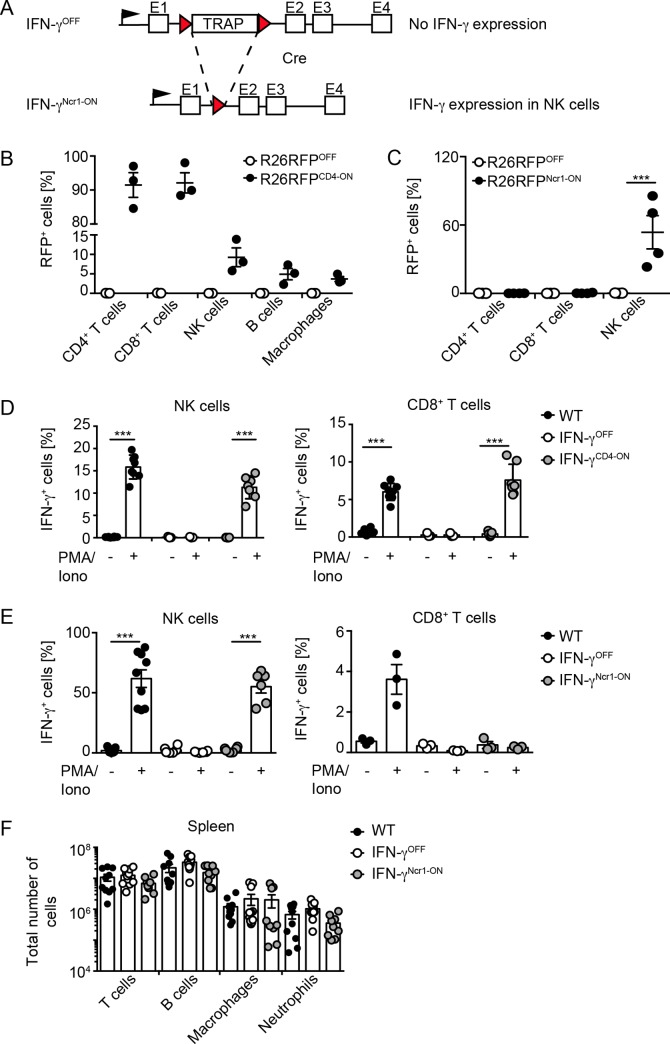
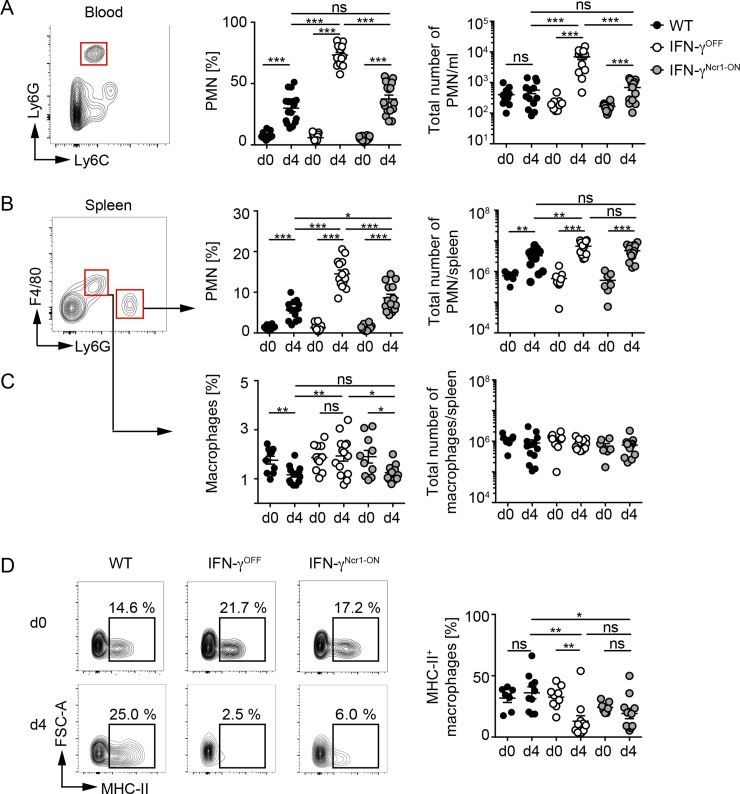
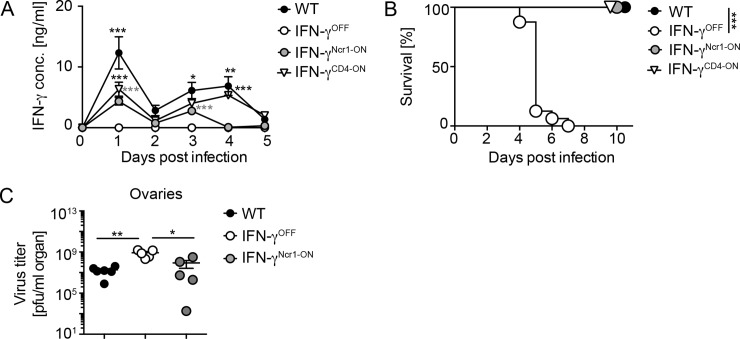
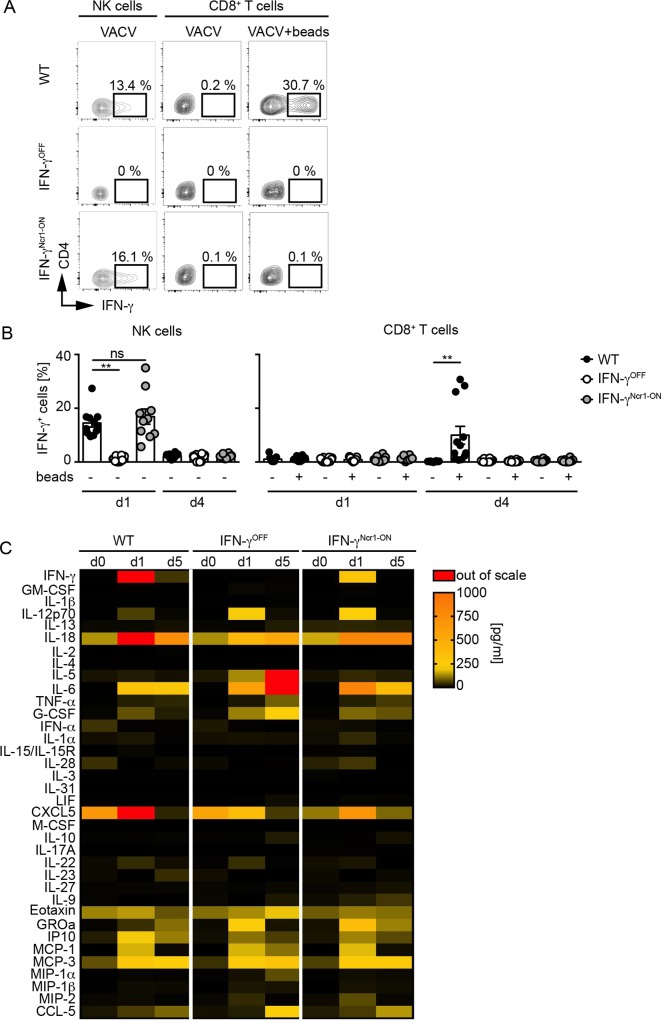
IFN-γ is an enigmatic cytokine that shows direct anti-viral effects, confers upregulation of MHC-II and other components relevant for antigen presentation, and that adjusts the composition and balance of complex cytokine responses. It is produced during immune responses by innate as well as adaptive immune cells and can critically affect the course and outcome of infectious diseases, autoimmunity, and cancer. To selectively analyze the function of innate immune cell-derived IFN-γ, we generated conditional IFN-γOFF mice, in which endogenous IFN-γ expression is disrupted by a loxP flanked gene trap cassette inserted into the first intron of the IFN-γ gene. IFN-γOFF mice were intercrossed with Ncr1-Cre or CD4-Cre mice that express Cre mainly in NK cells (IFN-γNcr1-ON mice) or T cells (IFN-γCD4-ON mice), respectively. Rosa26RFP reporter mice intercrossed with Ncr1-Cre mice showed selective RFP expression in more than 80% of the NK cells, while upon intercrossing with CD4-Cre mice abundant RFP expression was detected in T cells, but also to a minor extent in other immune cell subsets. Previous studies showed that IFN-γ expression is needed to promote survival of vaccinia virus (VACV) infection. Interestingly, during VACV infection of wild type and IFN-γCD4-ON mice two waves of serum IFN-γ were induced that peaked on day 1 and day 3/4 after infection. Similarly, VACV infected IFN-γNcr1-ON mice mounted two waves of IFN-γ responses, of which the first one was moderately and the second one profoundly reduced when compared with WT mice. Furthermore, IFN-γNcr1-ON as well as IFN-γCD4-ON mice survived VACV infection, whereas IFN-γOFF mice did not. As expected, ex vivo analysis of splenocytes derived from VACV infected IFN-γNcr1-ON mice showed IFN-γ expression in NK cells, but not T cells, whereas IFN-γOFF mice showed IFN-γ expression neither in NK cells nor T cells. VACV infected IFN-γNcr1-ON mice mounted normal cytokine responses, restored neutrophil accumulation, and showed normal myeloid cell distribution in blood and spleen. Additionally, in these mice normal MHC-II expression was detected on peripheral macrophages, whereas IFN-γOFF mice did not show MHC-II expression on such cells. In conclusion, upon VACV infection Ncr1 positive cells including NK cells mount two waves of early IFN-γ responses that are sufficient to promote the induction of protective anti-viral immunity.
IFN-γ 是一种神秘的细胞因子,具有直接的抗病毒作用,上调 MHC-II 和其他与抗原呈递相关的成分,并调节复杂细胞因子反应的组成和平衡。它由先天和适应性免疫细胞在免疫反应中产生,可严重影响传染病、自身免疫和癌症的病程和结果。为了选择性地分析先天免疫细胞衍生的 IFN-γ 的功能,我们生成了条件性 IFN-γOFF 小鼠,其中内源性 IFN-γ 表达被插入 IFN-γ 基因第一内含子中的侧翼基因陷阱盒破坏。IFN-γOFF 小鼠与 Ncr1-Cre 或 CD4-Cre 小鼠杂交,Ncr1-Cre 小鼠主要在 NK 细胞(IFN-γNcr1-ON 小鼠)或 T 细胞(IFN-γCD4-ON 小鼠)中表达 Cre。与 Ncr1-Cre 小鼠杂交的 Rosa26RFP 报告小鼠显示超过 80%的 NK 细胞中选择性表达 RFP,而与 CD4-Cre 小鼠杂交则在 T 细胞中检测到丰富的 RFP 表达,但在其他免疫细胞亚群中也有少量表达。先前的研究表明,IFN-γ 的表达对于促进牛痘病毒(VACV)感染的存活是必需的。有趣的是,在野生型和 IFN-γCD4-ON 小鼠的 VACV 感染期间,诱导了两波血清 IFN-γ,其峰值分别在感染后第 1 天和第 3/4 天。同样,VACV 感染 IFN-γNcr1-ON 小鼠也产生了两波 IFN-γ 反应,与 WT 小鼠相比,第一波适度降低,第二波显著降低。此外,IFN-γNcr1-ON 以及 IFN-γCD4-ON 小鼠在 VACV 感染后存活,而 IFN-γOFF 小鼠则不能。正如预期的那样,从 VACV 感染的 IFN-γNcr1-ON 小鼠衍生的脾细胞的体外分析显示 NK 细胞中存在 IFN-γ 表达,但 T 细胞中不存在 IFN-γ 表达,而 IFN-γOFF 小鼠既不在 NK 细胞中也不在 T 细胞中表达 IFN-γ。VACV 感染的 IFN-γNcr1-ON 小鼠产生正常的细胞因子反应,恢复中性粒细胞聚集,并显示血液和脾脏中正常的髓样细胞分布。此外,在这些小鼠中,外周巨噬细胞上检测到正常的 MHC-II 表达,而 IFN-γOFF 小鼠则没有。总之,在 VACV 感染时,包括 NK 细胞在内的 Ncr1 阳性细胞会产生两波早期 IFN-γ 反应,足以促进保护性抗病毒免疫的诱导。