Beijing Key Laboratory of Urban Hydrological Cycle and Sponge City Technology, College of Water Sciences, Beijing Normal University, Beijing 100875, China.
Laboratory of Earth Surface Processes, College of Urban and Environmental Sciences, Peking University, Beijing 100871, China.
Int J Environ Res Public Health. 2020 Jan 31;17(3):889. doi: 10.3390/ijerph17030889.
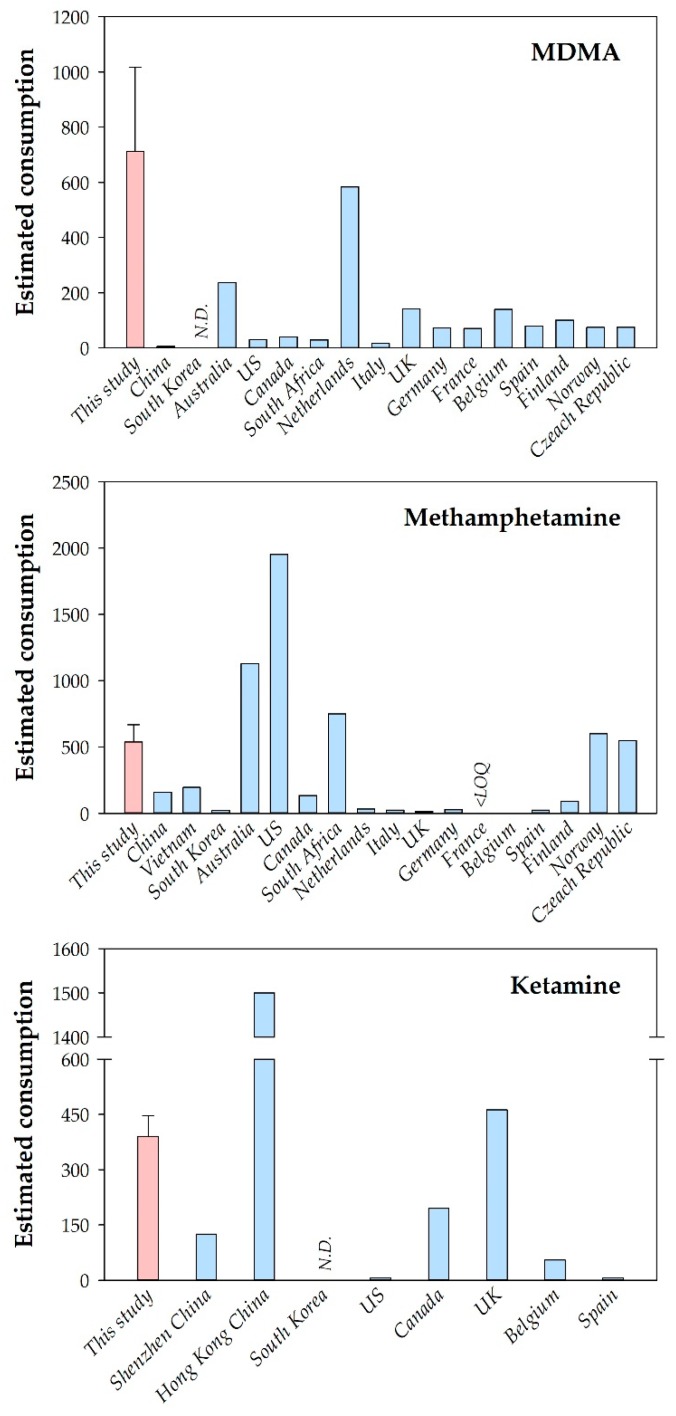
Southeast Asian countries including Malaysia play a major role in global drug trade and abuse. Use of amphetamine-type stimulants has increased in the past decade in Malaysia. This study aimed to apply wastewater-based epidemiology for the first time in Kuala Lumpur, Malaysia, to estimate the consumption of common illicit drugs in urban population. Influent wastewater samples were collected from two wastewater treatment plants in Kuala Lumpur in the summer of 2017. Concentrations of twenty-four drug biomarkers were analyzed for estimating drug consumption. Fourteen drug residues were detected with concentrations of up to 1640 ng/L. Among the monitored illicit drugs, 3,4-methylenedioxy-methamphetamine (MDMA) or ecstasy had the highest estimated per capita consumptions. Consumption and dose of amphetamine-type stimulants (methamphetamine and MDMA) were both an order of magnitude higher than those of opioids (heroin and codeine, methadone and tramadol). Amphetamine-type stimulants were the most prevalent drugs, replacing opioids in the drug market. The prevalence trend measured by wastewater-based epidemiology data reflected the shift to amphetamine-type stimulants as reported by the Association of Southeast Asian Nations Narcotics Cooperation Center. Most of the undetected drug residues were new psychoactive substances (NPSs), suggesting a low prevalence of NPSs in the drug market.
包括马来西亚在内的东南亚国家在全球毒品贸易和滥用中扮演着重要角色。在过去十年中,马来西亚安非他命类兴奋剂的使用有所增加。本研究旨在首次在马来西亚吉隆坡应用基于污水的流行病学方法,估算城市人口中常见非法药物的使用情况。2017 年夏季,从吉隆坡的两个污水处理厂采集了污水样本。分析了 24 种药物生物标志物的浓度,以估算药物使用情况。检测到 14 种药物残留,浓度高达 1640ng/L。在所监测的非法药物中,3,4-亚甲二氧基甲基苯丙胺(MDMA,摇头丸)的估计人均消耗量最高。安非他命类兴奋剂(甲基苯丙胺和 MDMA)的消耗量和剂量均高于阿片类药物(海洛因和可待因、美沙酮和曲马多)。安非他命类兴奋剂是最常见的药物,取代了毒品市场上的阿片类药物。污水流行病学数据测量的流行趋势反映了东南亚国家联盟毒品合作中心报告的向安非他命类兴奋剂的转变。大部分未检出的药物残留是新精神活性物质(NPS),表明药物市场中 NPS 的流行率较低。