Carolina Institute for Developmental Disabilities, University of North Carolina at Chapel Hill, Campus Box 3376, Chapel Hill, NC, 27599, USA.
Department of Psychology, School of Behavioral and Brain Sciences, University of Texas at Dallas, Richardson, TX, USA.
J Neurodev Disord. 2020 Feb 5;12(1):5. doi: 10.1186/s11689-020-9308-7.
Younger siblings of children with autism spectrum disorder (ASD) are at increased likelihood of receiving an ASD diagnosis and exhibiting other developmental concerns. It is unknown how quantitative variation in ASD traits and broader developmental domains in older siblings with ASD (probands) may inform outcomes in their younger siblings.
Participants included 385 pairs of toddler siblings and probands from the Infant Brain Imaging Study. ASD probands (mean age 5.5 years, range 1.7 to 15.5 years) were phenotyped using the Autism Diagnostic Interview-Revised (ADI-R), the Social Communication Questionnaire (SCQ), and the Vineland Adaptive Behavior Scales, Second Edition (VABS-II). Siblings were assessed using the ADI-R, VABS-II, Mullen Scales of Early Learning (MSEL), and Autism Diagnostic Observation Schedule (ADOS) and received a clinical best estimate diagnosis at 24 months using DSM-IV-TR criteria (n = 89 concordant for ASD; n = 296 discordant). We addressed two aims: (1) to determine whether proband characteristics are predictive of recurrence in siblings and (2) to assess associations between proband traits and sibling dimensional outcomes at 24 months.
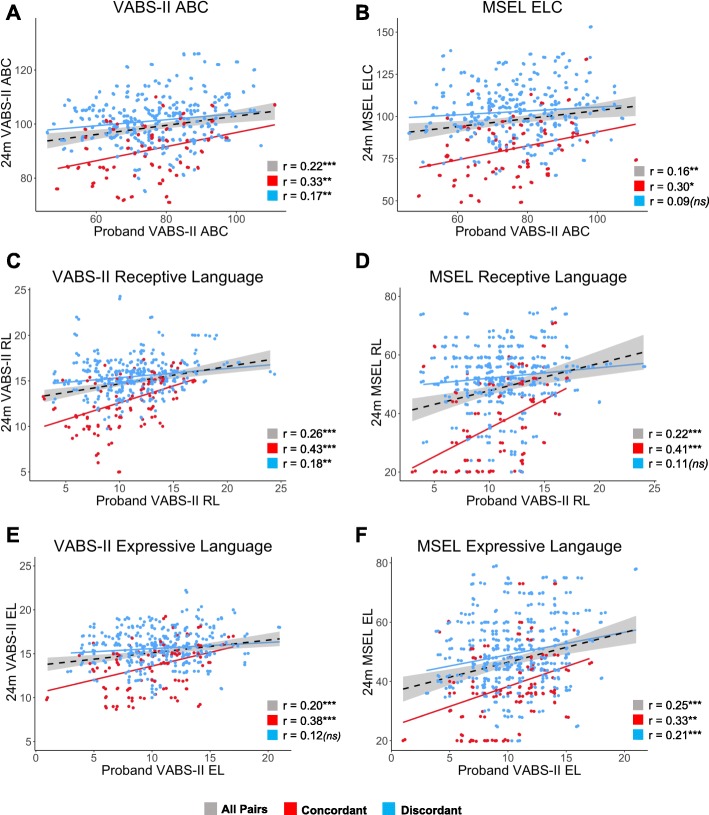
Regarding recurrence risk, proband SCQ scores were found to significantly predict sibling 24-month diagnostic outcome (OR for a 1-point increase in SCQ = 1.06; 95% CI = 1.01, 1.12). Regarding quantitative trait associations, we found no significant correlations in ASD traits among proband-sibling pairs. However, quantitative variation in proband adaptive behavior, communication, and expressive and receptive language was significantly associated with sibling outcomes in the same domains; proband scores explained 9-18% of the variation in cognition and behavior in siblings with ASD. Receptive language was particularly strongly associated in concordant pairs (ICC = 0.50, p < 0.001).
Proband ASD symptomology, indexed by the SCQ, is a predictor of familial ASD recurrence risk. While quantitative variation in social communication and restricted and repetitive behavior were not associated among sibling pairs, standardized ratings of proband language and communication explained significant variation in the same domains in the sibling at 24 months, especially among toddlers with an ASD diagnosis. These data suggest that proband characteristics can alert clinicians to areas of developmental concern for young children with familial risk for ASD.
自闭症谱系障碍(ASD)儿童的年幼兄弟姐妹更有可能被诊断出 ASD,并表现出其他发育问题。目前尚不清楚 ASD 特征和 ASD 先证者(即年长兄弟姐妹)更广泛的发育领域的定量变化如何影响他们年幼兄弟姐妹的预后。
参与者包括来自婴儿大脑成像研究的 385 对幼儿兄弟姐妹和先证者。ASD 先证者(平均年龄 5.5 岁,范围 1.7 至 15.5 岁)使用自闭症诊断访谈修订版(ADI-R)、社交沟通问卷(SCQ)和第二版 Vineland 适应行为量表(VABS-II)进行表型分析。使用 ADI-R、VABS-II、Mullen 早期学习量表(MSEL)和自闭症诊断观察量表(ADOS)对兄弟姐妹进行评估,并根据 DSM-IV-TR 标准在 24 个月时进行临床最佳估计诊断(89 名兄弟姐妹一致诊断为 ASD;296 名兄弟姐妹不一致)。我们解决了两个目标:(1)确定先证者特征是否可预测兄弟姐妹的复发;(2)评估 24 个月时先证者特征与兄弟姐妹维度结局之间的关联。
关于复发风险,先证者的 SCQ 分数显著预测了兄弟姐妹 24 个月的诊断结果(SCQ 增加 1 分的 OR=1.06;95%CI=1.01,1.12)。关于定量特征关联,我们未发现先证者-兄弟姐妹对之间 ASD 特征存在显著相关性。然而,先证者的适应行为、沟通以及表达和接受语言的定量变化与兄弟姐妹在同一领域的结局显著相关;先证者的分数解释了 ASD 兄弟姐妹认知和行为变化的 9-18%。在一致性对中,接受性语言的相关性尤其强(ICC=0.50,p<0.001)。
SCQ 指数的 ASD 症状先证者是家族性 ASD 复发风险的预测因子。虽然先证者之间的社交沟通和受限及重复行为的定量变化没有关联,但 24 个月时先证者语言和沟通的标准化评分解释了兄弟姐妹在同一领域的显著变化,尤其是在 ASD 诊断的幼儿中。这些数据表明,先证者的特征可以提醒临床医生注意有家族性 ASD 风险的幼儿发育关注领域。