Sahin Bilgehan, Zoto Mustafayev Teuta, Gungor Gorkem, Aydin Gokhan, Yapici Bulent, Atalar Banu, Ozyar Enis
Radiation Oncology, Acibadem Maslak Hospital, Istanbul, TUR.
Radiation Oncology, Acibadem University School of Medicine, Istanbul, TUR.
Cureus. 2019 Dec 24;11(12):e6457. doi: 10.7759/cureus.6457.
Objectives Improved soft-tissue visualization, afforded by magnetic resonance imaging integrated into a radiation therapy linear accelerator-based radiation delivery system (MR-linac) promises improved image-guidance. The availability of MR-imaging can facilitate on-table adaptive radiation planning and enable real-time intra-fraction imaging with beam gating without additional exposure to radiation. However, the novel use of magnetic resonance-guided radiation therapy (MRgRT) in the field of radiation oncology also potentially poses challenges for routine clinical implementation. Herein the early experience of a single institution, implementing the first MRgRT system in the country is reported. We aim to describe the workflow and to characterize the clinical utility and feasibility of routine use of an MR-linac system. Methods The ViewRay MRIdian MR-linac system consists of a split-magnet 0.35 T MR-imaging scanner with a double focused multi-leaf collimator (MLC) equipped 6MV linear accelerator. Unique to the system are the control console integrated on-table adaptive radiation therapy (oART) planning capabilities as well as automated beam gating based on real-time intra-fraction MR imaging. From the first day of clinical implementation, oART was performed according to physicians' discretion when medically indicated. All fractions were delivered under real-time imaging with soft tissue-based automated beam gating with individualized gating boundary settings. Patients actively assisted in breath-hold beam gating with the help of custom designed prismatic glasses allowing sight of a computer monitor mounted on the back wall just behind the MRI system bore. Patient demographics and treatment experience, indications for MRgRT including diagnosis and disease site, radiation dose prescribed and fractionation scheme, utilization of oART, respiratory gating settings, as well as duration of each treatment phase were analyzed. Results Between September 2018 and May 2019, 72 patients with 84 tumor sites were treated with MRgRT in 500 total fractions. Median patient age was 66 years (range: 28-83 years). Among 84 tumor sites, the most frequently treated regions were upper abdominal and pelvic (n = 36, 43% and n = 29, 34%, respectively). The most common diagnosis was prostate cancer, with 14 patients treated. In 69 patients (93.2%) oART was used at least once during a treatment course. Twenty-nine targets (43.1%) with significant breathing-related motion were treated in breath-hold with patient visual feedback. Median prescribed dose was 36.25 Gy (range: 24-70 Gy) in median five fractions (range: 3-28 fractions). A gating boundary of 3 mm around a gating region of interest (gROI) was most commonly used (range: 3-5 mm) with 95% of the gROI (range: 93-97%) required to be within the gating boundary for the beam to automatically engage. Mean total treatment time was 47 min (range: 21-125 min) and mean beam-on time was 16.7 min (range: 6-62 min). Conclusions MRgRT afforded by an MR-linac system has been successfully implemented into routine clinical use at our institution as the first system of its kind in Turkey. While the overall number of patients treated and fractions delivered is still limited, we have demonstrated the feasibility of both on-table adaptive radiation therapy as well as automated real-time beam gating on a daily basis in acceptable time schedules.
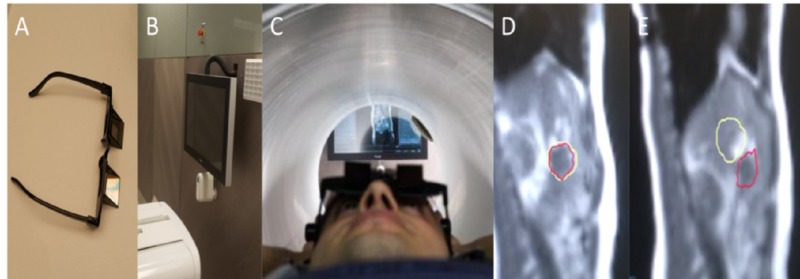
集成于基于直线加速器的放射治疗系统(MR直线加速器)的磁共振成像所提供的软组织可视化改善有望提升图像引导效果。磁共振成像的可用性有助于进行术中自适应放射治疗计划,并能在不增加额外辐射暴露的情况下,通过射束门控实现实时分次内成像。然而,磁共振引导放射治疗(MRgRT)在放射肿瘤学领域的新应用也可能给常规临床实施带来挑战。本文报告了一家机构在国内首次实施MRgRT系统的早期经验。我们旨在描述工作流程,并对MR直线加速器系统常规使用的临床效用和可行性进行特征描述。方法:ViewRay MRIdian MR直线加速器系统由一台0.35T的分体式磁体磁共振成像扫描仪和一台配备双聚焦多叶准直器(MLC)的6MV直线加速器组成。该系统独有的特点包括集成在控制台的术中自适应放射治疗(oART)计划功能以及基于实时分次内磁共振成像的自动射束门控。从临床实施的第一天起,在有医学指征时,根据医生的判断进行oART。所有分次治疗均在实时成像下进行,采用基于软组织的自动射束门控,并设置个性化的门控边界。患者在定制设计的棱镜眼镜帮助下积极协助屏气射束门控,通过该眼镜可以看到安装在MRI系统孔道后方后壁上的电脑显示器。分析了患者的人口统计学和治疗经验、MRgRT的适应证(包括诊断和疾病部位)、规定的放射剂量和分割方案、oART的使用情况、呼吸门控设置以及每个治疗阶段的持续时间。结果:2018年9月至2019年5月期间,72例患者的84个肿瘤部位接受了MRgRT治疗,共500个分次。患者中位年龄为66岁(范围:28 - 83岁)。在84个肿瘤部位中,最常治疗的区域是上腹部和盆腔(分别为36个,43%;29个,34%)。最常见的诊断是前列腺癌,有14例患者接受治疗。69例患者(93.2%)在一个疗程中至少使用了一次oART。29个有明显呼吸相关运动的靶区(43.1%)在患者视觉反馈下屏气治疗。中位规定剂量为36.25Gy(范围:24 - 70Gy),中位分次数为5次(范围:3 - 28次)。最常使用的门控边界是在感兴趣门控区域(gROI)周围3mm(范围:3 - 5mm),95%的gROI(范围:93 - 97%)需要在门控边界内,射束才能自动开启。平均总治疗时间为47分钟(范围:21 - 125分钟),平均射束开启时间为16.7分钟(范围:6 - 62分钟)。结论:作为土耳其首个此类系统,MR直线加速器系统提供的MRgRT已在我们机构成功应用于常规临床。虽然治疗的患者总数和分次数量仍然有限,但我们已经证明了术中自适应放射治疗以及日常自动实时射束门控在可接受的时间安排内的可行性。