Klüter Sebastian
Department of Radiation Oncology, University Hospital Heidelberg, Heidelberg Institute for Radiation Oncology (HIRO), National Center for Radiation Research in Oncology (NCRO), Heidelberg, Germany.
Clin Transl Radiat Oncol. 2019 Apr 8;18:98-101. doi: 10.1016/j.ctro.2019.04.007. eCollection 2019 Sep.
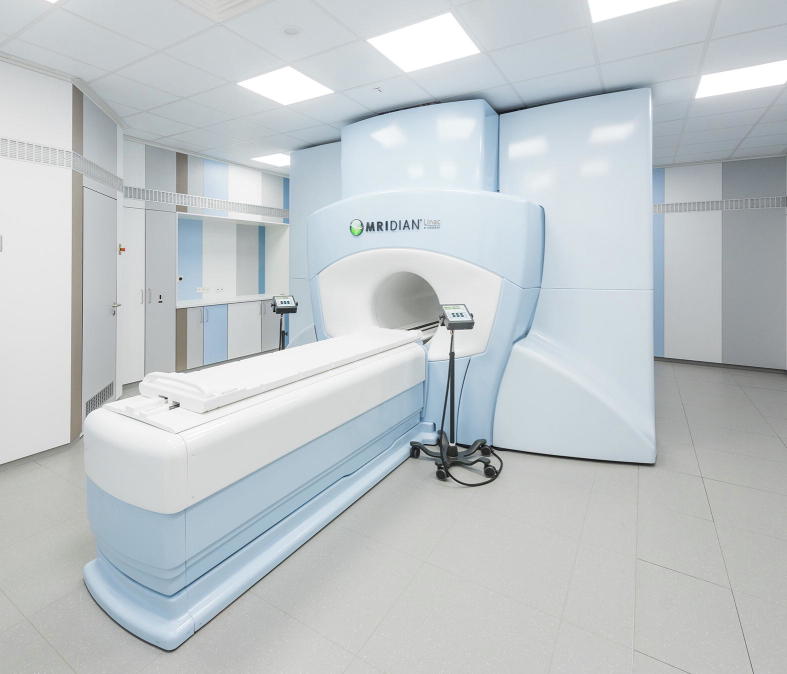
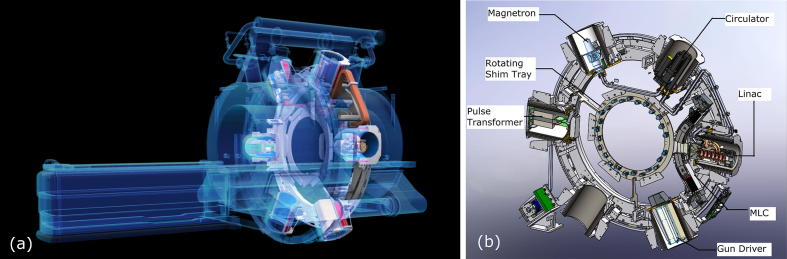
The integration of magnetic resonance (MR) imaging and linear accelerators into hybrid treatment systems has made MR-guided radiation therapy a clinical reality. This work summarizes the technical design of a 0.35 T MR-Linac and corresponding clinical concepts. The system facilitates 3D-conformal as well as IMRT treatments with 6MV photons. Daily MR imaging provides superior soft-tissue contrast for patient setup and also enables on-table adaption of treatment plans, which is fully integrated into the treatment workflow of the system. Automated beam gating during delivery is facilitated by cine MR imaging and structure tracking. Combining different novel features compared to conventional image-guided radiotherapy, this technology offers the potential for margin reduction as well as dose escalation.
将磁共振(MR)成像与直线加速器集成到混合治疗系统中,已使磁共振引导的放射治疗成为临床现实。本文总结了一台0.35T磁共振直线加速器的技术设计及相应的临床概念。该系统可使用6MV光子进行三维适形放疗以及调强放疗。每日的磁共振成像可为患者摆位提供卓越的软组织对比度,还能在治疗台上对治疗计划进行调整,且该调整完全融入系统的治疗工作流程。电影磁共振成像和结构跟踪有助于在放疗过程中实现自动束流门控。与传统图像引导放射治疗相比,该技术结合了不同的新颖特性,具有减少 margins 以及提高剂量的潜力。 (注:原文中“margin”未明确给出中文释义,可能在医学中有特定含义,这里保留英文未翻译)