Department of Anesthesiology, Affiliated Shenzhen Maternity & Child Healthcare Hospital, Southern Medical University, Shenzhen 518028, China.
Department of Obstetrics, Affiliated Shenzhen Maternity & Child Healthcare Hospital, Southern Medical University, Shenzhen 518028, China.
Biomed Res Int. 2020 Jan 16;2020:2408063. doi: 10.1155/2020/2408063. eCollection 2020.
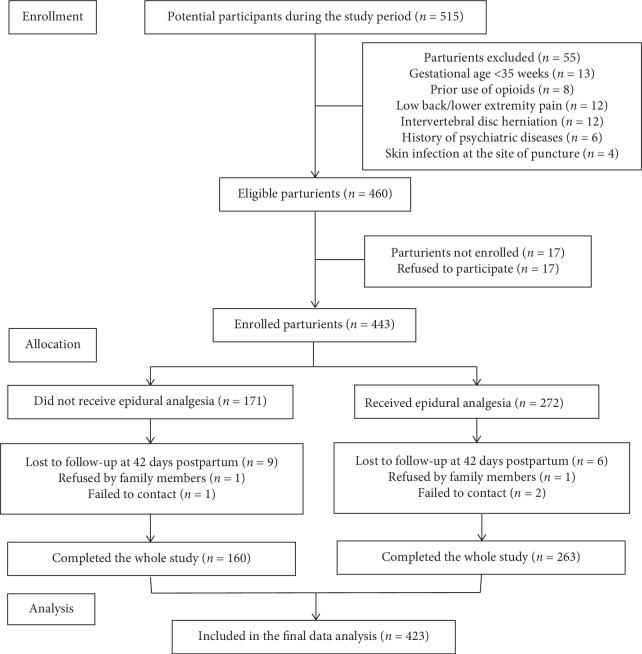
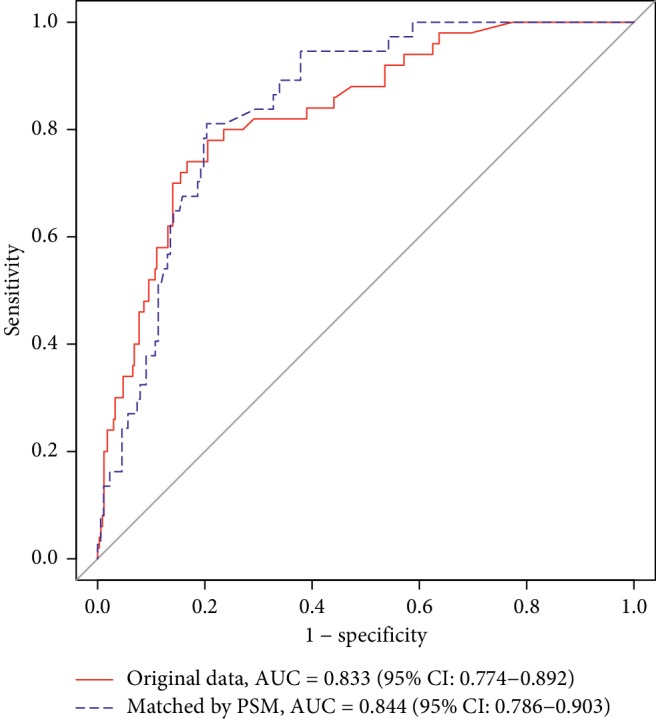
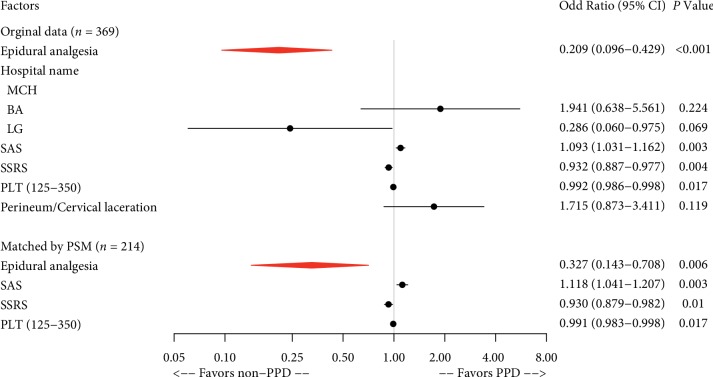
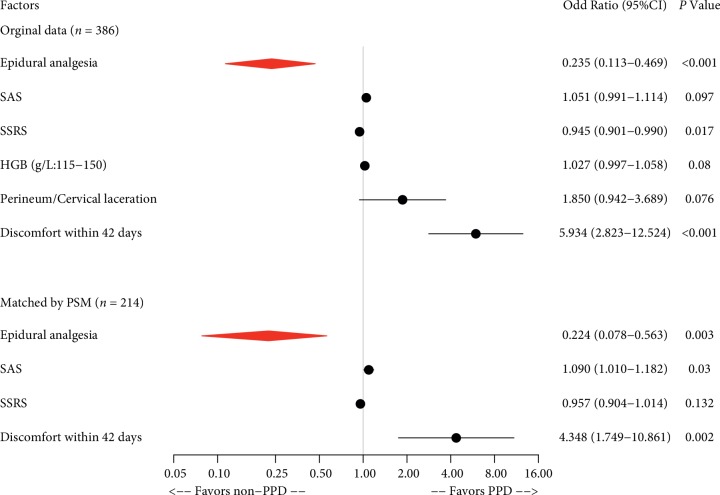
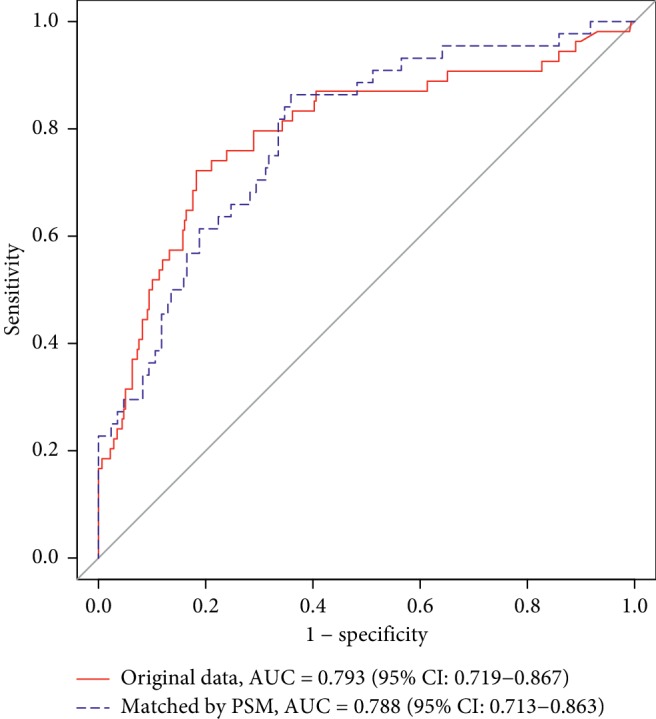
Postpartum depression is a disabling mental disorder commonly seen in parturients under trial of labor after cesarean, which causes serious harm to the parturients. The etiology is unclear. We hypothesized that epidural labor analgesia can reduce the incidence rate of postpartum depression. Enrolled multiparas were divided into the epidural labor analgesia group ( = 263) or nonanalgesia group ( = 160) according to their own request. Edinburgh Postnatal Depression Scale was used to assess their mental status at 48 hours and 42 days after delivery. Relative perinatal variables were collected and further analyzed using univariate analysis and multivariate logistic regression analysis to assess the relation of epidural analgesia with the occurrence of postpartum depression under trial of labor after cesarean. The Edinburgh Postnatal Depression Scale score 48 hours ≥ 10 in the no epidural analgesia group was 26.42% while the epidural analgesia group was 8.49% (OR, 0.209; 95% CI, 0.096-0.429; < 0.001). The Edinburgh Postnatal Depression Scale score 42 day ≥ 10 in the no epidural analgesia group was 25.16% while the epidural analgesia group was 6.59% (OR, 0.235; 95% CI, 0.113-0.469; < 0.001). The incidence of postpartum depression was significantly lower in the epidural labor analgesia group at 48 hours and 42 days. There was also a significant relation between the Edinburgh Postnatal Depression Scale scores at 48 hours and 42 days after delivery. Epidural analgesia, discomfort within 42 days, and self-rating anxiety scale are independent predictors of postpartum depression for trial of labor after cesarean in 42 days. Epidural labor analgesia is associated with a decreased risk of postpartum depression. Further study with a large sample size and more centers is needed to evaluate the impact of epidural analgesia on the occurrence of postpartum depression. Chinese Clinical Trial Register, ChiCTR-ONC-17010654.
产后抑郁症是一种常见的致残性精神障碍,见于剖宫产后试产的产妇,对产妇危害严重。其病因不明。我们假设硬膜外分娩镇痛可以降低产后抑郁症的发生率。根据产妇自身要求,将经产妇分为硬膜外分娩镇痛组(n=263)或非镇痛组(n=160)。采用爱丁堡产后抑郁量表(Edinburgh Postnatal Depression Scale,EPDS)于产后 48 小时和 42 天评估其精神状态。收集相关围产变量,采用单因素分析和多因素 logistic 回归分析进一步评估硬膜外镇痛与剖宫产后试产中产后抑郁症发生的关系。非镇痛组 EPDS 评分≥10 分者 48 小时为 26.42%,而镇痛组为 8.49%(OR=0.209,95%CI 0.0960.429; < 0.001)。非镇痛组 EPDS 评分≥10 分者 42 天为 25.16%,而镇痛组为 6.59%(OR=0.235,95%CI 0.1130.469; < 0.001)。产后 48 小时和 42 天,镇痛组产后抑郁症发生率明显低于非镇痛组。产后 48 小时和 42 天 EPDS 评分之间也存在显著关系。产后 42 天,硬膜外镇痛、42 天内不适和自评焦虑量表是剖宫产试产后产后抑郁的独立预测因素。硬膜外分娩镇痛可降低产后抑郁症的风险。需要进一步开展更大样本量和更多中心的研究,以评估硬膜外镇痛对产后抑郁症发生的影响。中国临床试验注册中心,ChiCTR-ONC-17010654。