Shigematsu-Locatelli Marie, Kawano Takashi, Koyama Tsuyoshi, Iwata Hideki, Nishigaki Atsushi, Aoyama Bun, Tateiwa Hiroki, Kitaoka Noriko, Yokoyama Masataka
Department of Anesthesiology and Intensive Care Medicine, Kochi Medical School, Kohasu, Oko-cho, Nankoku, Kochi, 783-8505, Japan.
JA Clin Rep. 2019 Oct 30;5(1):68. doi: 10.1186/s40981-019-0289-z.
Long-term opioid treatment for chronic non-cancer pain has become controversial, given the increasing prevalence of opioid dependence. However, there is little information on therapeutic strategies for this condition in Japanese patients. Here, we present a case of successful management of iatrogenic opioid dependence with tramadol in a patient with chronic low back pain.
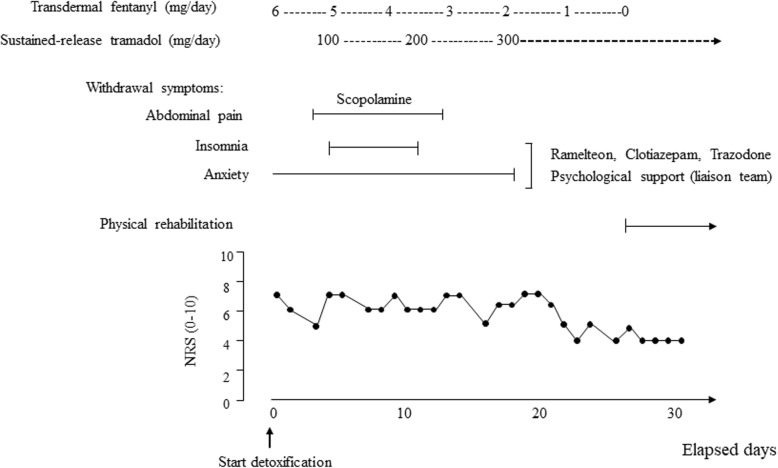
A 68-year-old male suffering from intractable low back pain was referred to our pain clinic. He was previously treated in another hospital with transdermal fentanyl patches 6 mg/day and fentanyl sublingual tablets (100 μg as required) for this condition. On the basis of medical examination, including a review of the patient's medical history, physical examination, X-ray, and his family statement, we diagnosed him with iatrogenic opioid dependence due to inadequate fentanyl use. Then, we developed a treatment plan consisting in fentanyl detoxification with a weak opioid, tramadol. At first, the use of fentanyl sublingual tablets was interrupted after obtaining informed consent. Then, we reduced the dose of transdermal fentanyl 1 mg per 4-5 days replacing with oral sustained-release tramadol. The patient developed mild to moderate withdrawal symptoms during this period, which could be effectively managed by supportive treatments. The hospital psychiatry liaison team continuously provided the patient and his wife with information, counseling, and education regarding the treatment of opioid dependence. Throughout the detoxification process, his reported pain did not exacerbate, even slightly improved over time. The final prescription was sustained-release tramadol 300 mg/day without fentanyl, and his activities of daily living drastically improved. However, unfortunately, he died due to an aortic dissection of stent-graft edge 65 days after surgery.
Our case highlighted that sustained-release tramadol could be effectively applied as a detoxification agent for iatrogenic opioid dependence in patients with chronic non-cancer pain.
鉴于阿片类药物依赖的患病率不断上升,长期使用阿片类药物治疗慢性非癌性疼痛已引发争议。然而,关于日本患者这种情况的治疗策略,相关信息较少。在此,我们报告一例慢性腰痛患者成功使用曲马多治疗医源性阿片类药物依赖的病例。
一名68岁男性因顽固性腰痛被转诊至我们的疼痛诊所。他此前在另一家医院接受治疗,使用6毫克/天的透皮芬太尼贴剂及芬太尼舌下片(按需服用100微克)治疗该疾病。基于包括患者病史回顾、体格检查、X线检查及家属陈述在内的医学检查,我们诊断他因芬太尼使用不当导致医源性阿片类药物依赖。随后,我们制定了一项治疗计划,即使用弱阿片类药物曲马多进行芬太尼脱毒治疗。首先,在获得知情同意后,中断芬太尼舌下片的使用。然后,每4 - 5天将透皮芬太尼剂量减少1毫克,同时换用口服缓释曲马多。在此期间,患者出现了轻至中度戒断症状,通过支持性治疗可有效控制。医院精神科联络团队持续为患者及其妻子提供有关阿片类药物依赖治疗的信息、咨询及教育。在整个脱毒过程中,他自述的疼痛并未加剧,甚至随时间略有改善。最终处方为无芬太尼的缓释曲马多300毫克/天,其日常生活能力大幅改善。然而,不幸的是,他在术后65天因支架移植物边缘主动脉夹层破裂去世。
我们的病例表明,缓释曲马多可有效用作慢性非癌性疼痛患者医源性阿片类药物依赖的脱毒药物。