Amaral Ana Carolina Soares, Stice Eric, Ferreira Maria Elisa Caputo
Federal Institute of Education, Science and Technology of Southern of Minas Gerais, 204 Monsenhor José Augusto, São José, Barbacena, 36205-018, Brazil.
Oregon Research Institute, 1776 Millrace Drive, Eugene, OR, 97403, USA.
Psicol Reflex Crit. 2019 Jun 17;32(1):13. doi: 10.1186/s41155-019-0126-3.
Given that most young women with eating disorders do not receive treatment, implementing effective prevention programs is a public health priority. The Body Project is a group-based eating disorder prevention program with evidence of both efficacy and effectiveness. This trial evaluated the efficacy of this prevention program with Brazilian girls, as no published study has tested whether this intervention is culturally sensitive and efficacious with Latin-American adolescents.
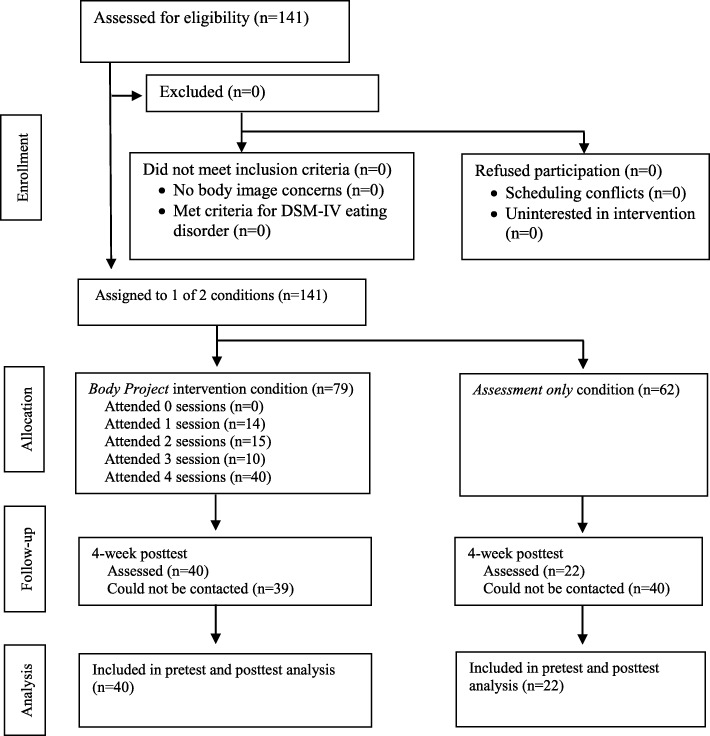
Female students were allocated to a dissonance-based intervention (n = 40) or assessment-only (n = 22) condition. The intervention was a dissonance-based program, consisted of four group sessions aimed to reduce thin-ideal internalization. The sessions included verbal, written, and behavioral exercises. The intervention group was evaluated at pretest and posttest; assessment-only controls completed measures at parallel times.
Compared to assessment-only controls, intervention participants showed a significantly greater reduction in body dissatisfaction, sociocultural influence of the media, depressive symptoms, negative affect, as well as significantly greater increases in body appreciation. There were no significant effects for disordered eating attitudes and eating disorder symptoms.
These results suggest that this dissonance-based eating disorder prevention program was culturally sensitive, or at least culturally adaptive, and efficacious with Brazilian female adolescents. Indeed, the average effect size was slightly larger than has been observed in the large efficacy trial of this prevention program and in recent meta-analytic reviews.
RBR-7prdf2 . Registered 13 August 2018 (retrospectively registered).
鉴于大多数患有饮食失调症的年轻女性未接受治疗,实施有效的预防计划是公共卫生的优先事项。“身体计划”是一项基于群体的饮食失调预防计划,有证据表明其具有有效性和实效性。本试验评估了该预防计划对巴西女孩的效果,因为尚无已发表的研究测试过这种干预措施对拉丁美洲青少年是否具有文化敏感性且有效。
女学生被分配到基于认知失调的干预组(n = 40)或仅进行评估的对照组(n = 22)。干预措施是一个基于认知失调的计划,包括四个旨在减少对瘦理想的内化的小组会议。这些会议包括口头、书面和行为练习。干预组在预测试和后测试时进行评估;仅进行评估的对照组在相同时间完成测量。
与仅进行评估的对照组相比,干预组参与者在身体不满、媒体的社会文化影响、抑郁症状、负面情绪方面的减少幅度显著更大,同时在身体欣赏方面的增加幅度也显著更大。在饮食失调态度和饮食失调症状方面没有显著影响。
这些结果表明,这种基于认知失调的饮食失调预防计划具有文化敏感性,或者至少具有文化适应性,并且对巴西女性青少年有效。事实上,平均效应量略大于在该预防计划的大型有效性试验和最近的荟萃分析综述中观察到的结果。
RBR - 7prdf2。于2018年8月13日注册(追溯注册)。