Shaikh Quratulain, Aljasser Doaa Suliman, Albalawi Abeer Masad
From the IHRC, Indus Hospital, Korangi, Karachi, Pakistan.
From the HSRC, Princess Nora bint Abdulrahman University, Riyadh, Saudi Arabia.
Ann Saudi Med. 2020 Jan-Feb;40(1):49-54. doi: 10.5144/0256-4947.2020.49. Epub 2020 Feb 6.
Divorce is considered a sentinel event influencing the economic, psychosocial and physical health of the family as a whole. Research shows a negative impact of parental marital discord (PMD) on the psychological health and social well-being of children. Only one study from Saudi Arabia has assessed educational and social attainment among young females, and the children were school girls aged 12-16 years.
Explore the relationship between parental marital discord and depression, anxiety, stress, social support and self-esteem of the female child. We also studied the parenting behaviors and their association with the psychosocial health of adolescents.
Cross-sectional questionnaire.
Women's university in Saudi Arabia.
REDCap was used for collecting data through email invitations sent to all students at the university. Data on family structure, parental relationship, self-esteem and psycho-social health was collected.
Depression, anxiety, stress, self-esteem and social support of the adolescent. Parenting behaviors of both parents were also assessed.
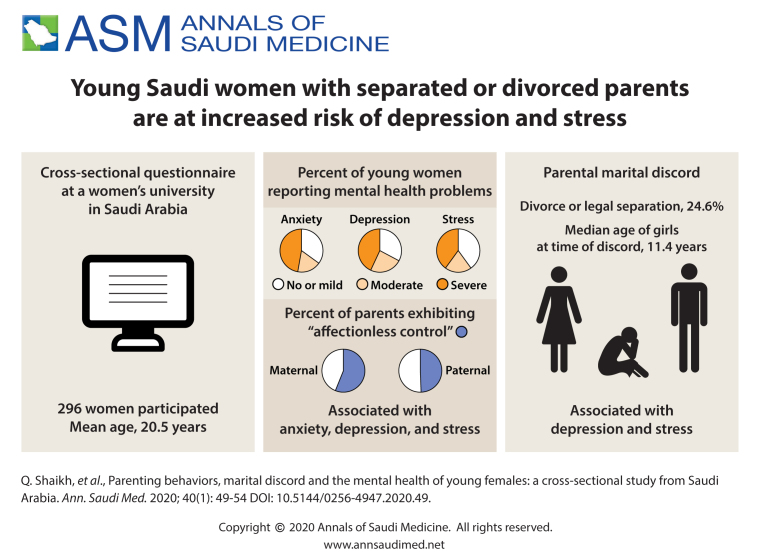
The mean (SD) age of participants was 20.5 (2.4) years (median 20.0, IQR 19-22). The frequency of PMD was 24.6% (73/296). Overall, 38% of the students had extra severe anxiety, 26.5% had extra severe depression and 20.5% had extra severe stress on the Depression Anxiety and Stress Scale (DASS). The mean self-esteem score was 20.8 (5.5) and social support score was 57 (19.7). Both parents demonstrated low care and high protection trait on the Parental Bonding Instrument (PBI). Among those with PMD, mean (SD) age at discord was 11.4 (6.7) years. Mean (SD) duration of parental marriage was 20.9 (10.7) years and 35% of daughters received no financial help from the father. There was a significant association between PMD and depression, anxiety, stress and poor social support. PMD was associated with low paternal care and high protection trait.
The study showed an alarming burden of mental health problems including depression, anxiety and stress among young Saudi females. Marital discord is prevalent in Saudi Arabia and is significantly related to poor psychosocial health in the child. Parents undergoing marital discord should be educated about healthy parenting styles and their children should be provided with counselling and coping strategies to maintain their emotional and psychological well-being.
Online survey could lead to volunteer bias. Only females are included in the study.
None.
离婚被视为一个影响整个家庭经济、心理社会和身体健康的标志性事件。研究表明,父母婚姻不和(PMD)对儿童的心理健康和社会幸福感有负面影响。沙特阿拉伯仅有一项研究评估了年轻女性的教育和社会成就,这些儿童为12至16岁的女学生。
探讨父母婚姻不和与女童抑郁、焦虑、压力、社会支持和自尊之间的关系。我们还研究了养育行为及其与青少年心理社会健康的关联。
横断面问卷调查。
沙特阿拉伯的女子大学。
使用REDCap通过电子邮件邀请该大学所有学生来收集数据。收集了关于家庭结构、父母关系、自尊和心理社会健康的数据。
青少年的抑郁、焦虑、压力、自尊和社会支持。还评估了父母双方的养育行为。
296。
参与者的平均(标准差)年龄为20.5(2.4)岁(中位数20.0,四分位数间距19 - 22)。PMD的发生率为24.6%(73/296)。总体而言,在抑郁焦虑压力量表(DASS)上,38%的学生有极其严重的焦虑,26.5%有极其严重的抑郁,20.5%有极其严重的压力。自尊平均得分为20.8(5.5),社会支持得分为57(19.7)。在父母关系量表(PBI)上,父母双方都表现出低关怀和高保护特质。在有PMD的人群中,不和时的平均(标准差)年龄为11.4(6.7)岁。父母婚姻的平均(标准差)持续时间为20.9(10.7)年,35%的女儿没有得到父亲的经济帮助。PMD与抑郁、焦虑、压力和社会支持不足之间存在显著关联。PMD与低父亲关怀和高保护特质相关。
该研究显示沙特年轻女性中包括抑郁、焦虑和压力在内的心理健康问题负担惊人。婚姻不和在沙特阿拉伯很普遍,且与儿童不良的心理社会健康显著相关。应教育经历婚姻不和的父母采用健康的养育方式,并应为他们的孩子提供咨询和应对策略,以维持其情绪和心理健康。
在线调查可能导致自愿性偏差。该研究仅纳入了女性。
无。