Shim Dong-Hyun, Kim Youngsoo, Roh Jieun, Kang Jongsoo, Park Kyung-Pil, Cha Jae-Kwan, Baik Seung Kug, Kim Yoon
Department of Neurology, Kyungpook National University Hospital, Daegu, Korea.
Department of Neurosurgery, MH Yeonse Hospital, Changwon, Korea.
J Stroke. 2020 Jan;22(1):141-149. doi: 10.5853/jos.2019.00955. Epub 2020 Jan 31.
Endovascular recanalization therapy (ERT) is becoming increasingly important in the management of acute ischemic stroke (AIS). However, the hospital volume threshold for optimal ERT remains unknown. We investigated the relationship between hospital volume of ERT and risk-adjusted patient outcomes.
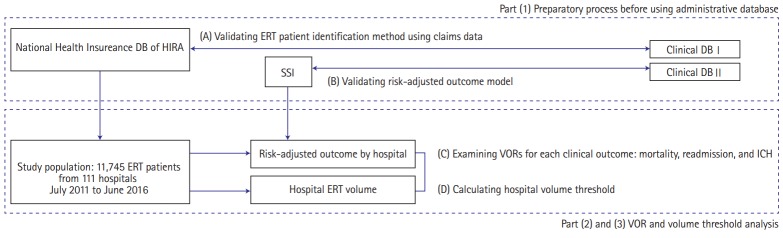
From the National Health Insurance claims data in Korea, 11,745 patients with AIS who underwent ERT from July 2011 to June 2016 in 111 hospitals were selected. We measured the hospital's ERT volume and patient outcomes, including the 30-day mortality, readmission, and postprocedural intracranial hemorrhage (ICH) rates. For each outcome measure, we constructed risk-adjusted prediction models incorporating demographic variables, the modified Charlson comorbidity index, and the stroke severity index (SSI), and validated them. Risk-adjusted outcomes of AIS cases were compared across hospital quartiles to confirm the volume-outcome relationship (VOR) in ERT. Spline regression was performed to determine the volume threshold.
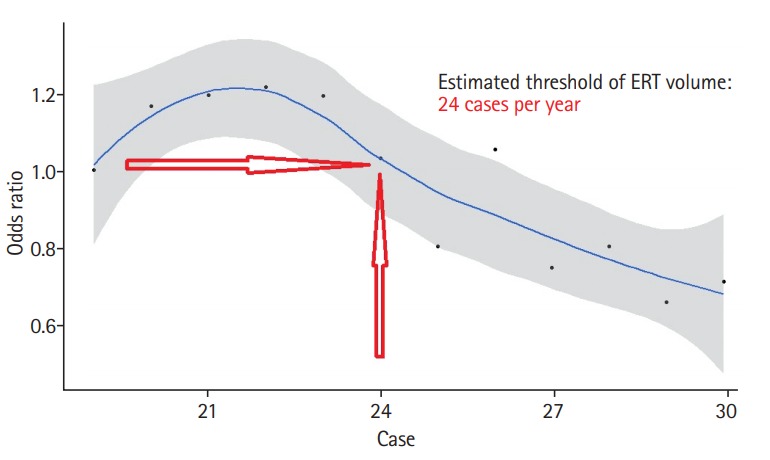
The mean AIS volume was 14.8 cases per hospital/year and the unadjusted means of mortality, readmission, and ICH rates were 11.6%, 4.6%, and 8.6%, respectively. The VOR was observed in the risk-adjusted 30-day mortality rate across all quartile groups, and in the ICH rate between the first and fourth quartiles (P<0.05). The volume threshold was 24 cases per year.
There was an association between hospital volume and outcomes, and the volume threshold in ERT was identified. Policies should be developed to ensure the implementation of the AIS volume threshold for hospitals performing ERT.
血管内再通治疗(ERT)在急性缺血性卒中(AIS)的管理中变得越来越重要。然而,最佳ERT的医院治疗量阈值仍不清楚。我们研究了ERT的医院治疗量与风险调整后的患者结局之间的关系。
从韩国国家健康保险索赔数据中,选取了2011年7月至2016年6月期间在111家医院接受ERT治疗的11745例AIS患者。我们测量了医院的ERT治疗量和患者结局,包括30天死亡率、再入院率和术后颅内出血(ICH)率。对于每个结局指标,我们构建了纳入人口统计学变量、改良Charlson合并症指数和卒中严重程度指数(SSI)的风险调整预测模型,并对其进行了验证。比较了各医院四分位数区间内AIS病例的风险调整后结局,以确认ERT中的治疗量-结局关系(VOR)。进行样条回归以确定治疗量阈值。
每家医院每年AIS的平均治疗量为14.8例,未调整的死亡率、再入院率和ICH率的平均值分别为11.6%、4.6%和8.6%。在所有四分位数组的风险调整后30天死亡率中观察到了VOR,在第一和第四四分位数之间的ICH率中也观察到了VOR(P<0.05)。治疗量阈值为每年24例。
医院治疗量与结局之间存在关联,并确定了ERT中的治疗量阈值。应制定政策,以确保对进行ERT的医院实施AIS治疗量阈值。