Tumor Immunology and Gene Therapy Center, Third Affiliated Hospital of Second Military Medical University, 225 Changhai Road, Shanghai 200438, China.
Tumor Immunology and Gene Therapy Center, Third Affiliated Hospital of Second Military Medical University, 225 Changhai Road, Shanghai 200438, China.
Mol Ther. 2020 Mar 4;28(3):874-888. doi: 10.1016/j.ymthe.2020.01.018. Epub 2020 Jan 21.
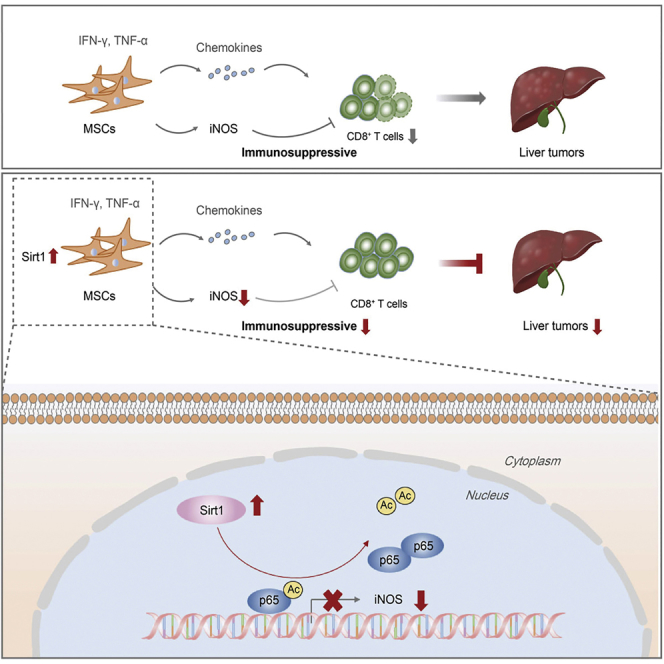
The major obstacles for the efficacy of tumor immunotherapies are their immune-related systemic adverse events. Therefore, tumor tropism property and pro-inflammatory ability of mesenchymal stem cells (MSCs) could be utilized in combination to potentiate local immunity for cancer eradication. We previously observed that MSCs with the type III histone deacetylase silent information regulator 2 homologue 1 (Sirt1) overexpression displayed a pro-inflammatory capacity. However, the anti-tumor effect of Sirt1-overexpressing MSCs and the role of Sirt1 in regulating the pro-inflammatory capacity of MSCs still need to be clarified. In this study, utilizing the hepatic metastasis model of colorectal carcinoma, we demonstrated that Sirt1-overexpressing MSCs significantly exerted anti-tumor activity through increasing the number of CD8 T cells. Furthermore, Sirt1 did not affect chemokine secretion in MSCs induced by inflammatory cytokines, but impaired the immunosuppressive ability of MSCs through suppressing inflammatory cytokine-stimulated inducible nitric oxide synthase (iNOS) production via deacetylating p65. iNOS overexpression negated the anti-tumor effect of Sirt1-overexpressing MSCs. Collectively, our data defined Sirt1 as the critical regulator for modulating the pro-inflammatory ability of MSCs, and they suggested that Sirt1-overexpressing MSCs secreting chemokines but little iNOS under the inflammatory milieu were capable of attracting immune cells to close proximity without suppressing their proliferation, thereby achieving a potent anti-tumor effect.
肿瘤免疫疗法疗效的主要障碍是其免疫相关的全身不良反应。因此,可以利用间充质干细胞(MSCs)的肿瘤趋向性和促炎能力相结合,增强局部免疫以消灭癌症。我们之前观察到,过表达 III 型组蛋白去乙酰化酶沉默信息调节因子 2 同源物 1(Sirt1)的 MSC 表现出促炎能力。然而,Sirt1 过表达 MSC 的抗肿瘤作用以及 Sirt1 在调节 MSC 促炎能力中的作用仍需要阐明。在这项研究中,利用结直肠癌肝转移模型,我们证明了 Sirt1 过表达 MSC 通过增加 CD8 T 细胞的数量显著发挥抗肿瘤活性。此外,Sirt1 不影响炎症细胞因子诱导的 MSC 中趋化因子的分泌,但通过去乙酰化 p65 抑制炎症细胞因子刺激的诱导型一氧化氮合酶(iNOS)的产生来损害 MSC 的免疫抑制能力。iNOS 过表达否定了 Sirt1 过表达 MSC 的抗肿瘤作用。总之,我们的数据将 Sirt1 定义为调节 MSC 促炎能力的关键调节剂,并表明在炎症环境下分泌趋化因子但很少产生 iNOS 的 Sirt1 过表达 MSC 能够吸引免疫细胞靠近而不抑制其增殖,从而产生强大的抗肿瘤作用。