Pensato Viviana, Magri Stefania, Bella Eleonora Dalla, Tannorella Pierpaola, Bersano Enrica, Sorarù Gianni, Gatti Marta, Ticozzi Nicola, Taroni Franco, Lauria Giuseppe, Mariotti Caterina, Gellera Cinzia
Unit of Medical Genetics and Neurogenetics, Fondazione IRCCS Istituto Neurologico Carlo Besta, 20133 Milan, Italy.
3rd Neurology Unit, Motor Neuron Diseases Centre, Fondazione IRCCS Istituto Neurologico Carlo Besta, 20133 Milan, Italy.
J Clin Med. 2020 Feb 3;9(2):412. doi: 10.3390/jcm9020412.
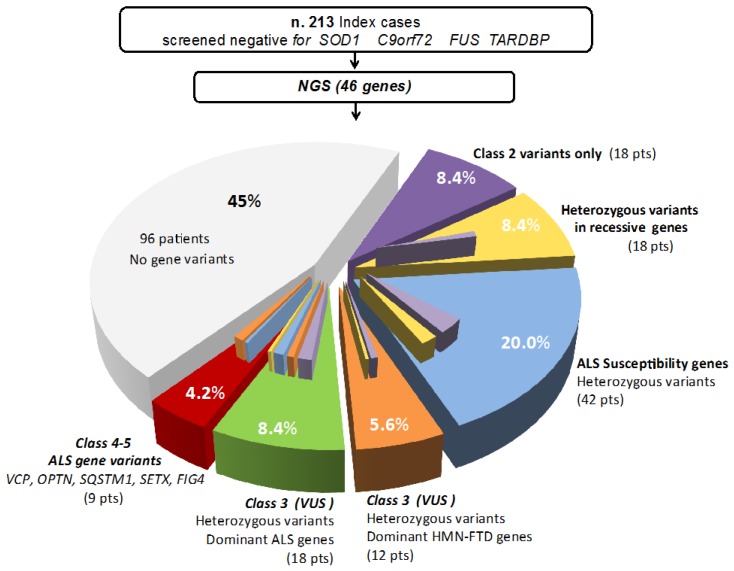
Amyotrophic lateral sclerosis (ALS) is an adult-onset progressive neurodegenerative disease due to motor neuron loss variably associated with frontotemporal dementia (FTD). Next generation sequencing technology revealed an increasing number of rare and novel genetic variants and interpretation of their pathogenicity represents a major challange in the diagnosis of ALS. We selected 213 consecutive patients with sporadic or familial (16%) ALS, tested negative for , , , and mutations. To reveal rare forms of genetic ALS, we performed a comprehensive multi-gene panel screening including 46 genes associated with ALS, hereditary motor neuronopathies, spastic paraplegia, and FTD. Our study allowed the identification of pathogenic or likely pathogenic variants in 4.2% of patients. The genes with the highest percentage of pathogenic variants were (1%), VCP (1%) , , , and ) genes. We also found 49 novel or rare gene variants of unknown significance in 30 patients (14%), 44 unlikely pathogenic variants (39%), and 48 variants in ALS susceptibility genes. The results of our study suggest the screening of , , and genes in routine diagnostic investigations for both sporadic and familial cases, and confirm the importance of diagnosis and couselling for patients and their relative family members.
肌萎缩侧索硬化症(ALS)是一种成年起病的进行性神经退行性疾病,由于运动神经元丧失,与额颞叶痴呆(FTD)存在不同程度的关联。下一代测序技术揭示了越来越多罕见和新的基因变异,对其致病性的解读是ALS诊断中的一项重大挑战。我们选取了213例连续的散发性或家族性(16%)ALS患者,对 、 、 和 突变检测呈阴性。为了揭示罕见形式的遗传性ALS,我们进行了全面的多基因panel筛查,包括46个与ALS、遗传性运动神经元病、痉挛性截瘫和FTD相关的基因。我们的研究在4.2%的患者中鉴定出了致病性或可能致病性变异。致病性变异比例最高的基因是 (1%)、VCP(1%) 、 、 和 基因。我们还在30例患者(14%)中发现了49个意义不明的新的或罕见基因变异、44个不太可能致病的变异(39%)以及48个ALS易感基因变异。我们的研究结果表明,在散发性和家族性病例的常规诊断检查中对 、 和 基因进行筛查,并证实了对患者及其亲属进行诊断和咨询的重要性。