Scarborough Hospital, York Teaching Hospital NHS Trust, Woodlands drive, Scarborough, YO12 6QL, UK.
Queen Mary University, London, E1 4NS, UK.
Scand J Trauma Resusc Emerg Med. 2020 Feb 6;28(1):9. doi: 10.1186/s13049-020-0705-4.
Resuscitative thoracotomy is a damage control procedure with an established role in the immediate treatment of patients in extremis or cardiac arrest secondary to cardiac tamponade however Its role in resuscitation of patients with abdominal exsanguination is uncertain.
The primary objective of this systematic review was to estimate mortality based on survival to discharge in patients with exsanguinating haemorrhage from abdominal trauma in cardiac arrest or a peri arrest clinical condition following a resuscitative thoracotomy.
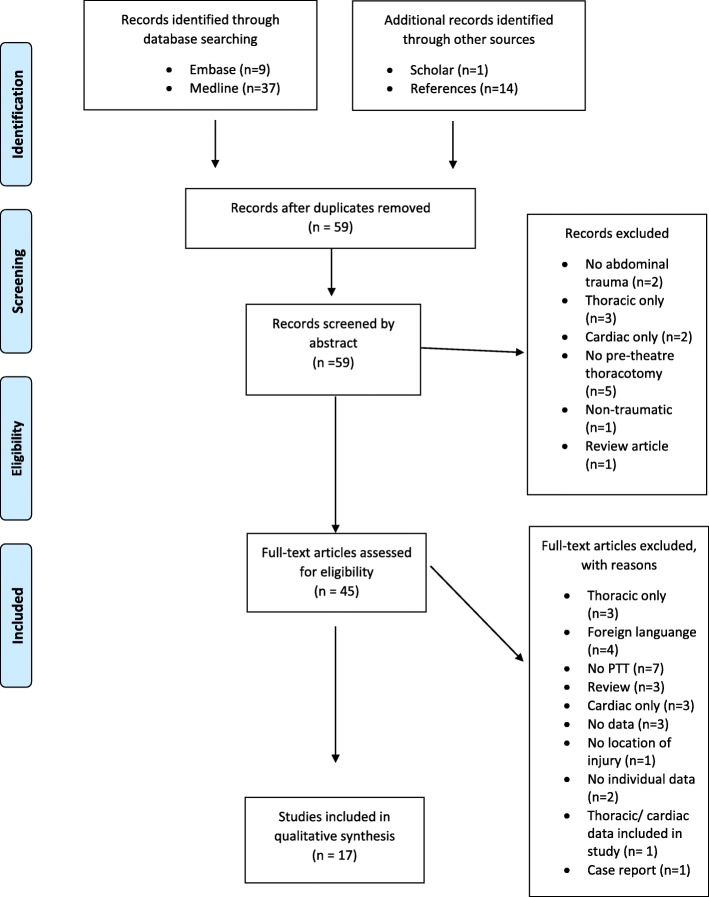
A systematic literature search was performed to identify original research that reported outcomes in resuscitative thoracotomy either in the emergency department or pre-hospital environment in patients suffering or suspected of suffering from intra-abdominal injuries. The primary outcome was to assess survival to discharge. The secondary outcomes assessed were neurological function post procedure and the role of timing of intervention on survival.
Seventeen retrospective case series were reviewed by a single author which described 584 patients with isolated abdominal trauma and an additional 1745 suffering from polytrauma including abdominal injuries. Isolated abdominal trauma survival to discharge ranged from 0 to 18% with polytrauma survival of 0-9.7% with the majority below 1%. Survival following a thoracotomy for abdominal trauma varied between studies and with no comparison non-intervention group no definitive conclusions could be drawn. Timing of thoracotomy was important with improved mortality in patients not in cardiac arrest or having the procedure performed just after a loss of signs of life. Normal neurological function at discharge ranged from 100 to 28.5% with the presence of a head injury having a negative impact on both survival and long-term morbidity.
Pre-theatre thoracotomy may have a role in peri-arrest or arrested patient with abdominal trauma. The best outcomes are achieved with patients not in cardiac arrest or who have recently arrested and with no head injury present. The earlier the intervention can be performed, the better the outcome for patients, with survival figures of up to 18% following a resuscitative thoracotomy. More high-quality evidence is required to demonstrate a definitive mortality benefit for patients.
复苏性开胸术是一种损伤控制程序,在治疗因心脏压塞导致的极端或心脏骤停的患者方面具有既定作用,但在治疗因腹部出血导致的患者的复苏方面的作用尚不确定。
本系统评价的主要目的是根据复苏性开胸术后因腹部创伤导致出血性休克的患者的出院存活率来评估死亡率,这些患者处于心脏骤停或复苏前临床状态。
进行了系统的文献检索,以确定在急诊科或院前环境中进行复苏性开胸术的原始研究,这些研究报告了患有或疑似患有腹部损伤的患者的结局。主要结局是评估出院存活率。次要结局评估包括术后神经功能和干预时机对存活率的影响。
一位作者回顾了 17 项回顾性病例系列研究,这些研究描述了 584 例单纯腹部创伤患者和另外 1745 例合并腹部损伤的多发创伤患者。单纯腹部创伤的出院存活率为 0 至 18%,多发创伤的存活率为 0 至 9.7%,大多数低于 1%。腹部创伤开胸术后的存活率因研究而异,且无对照组,因此无法得出明确结论。开胸术的时机很重要,在未发生心脏骤停或在生命体征消失后立即进行手术的患者中,死亡率有所降低。出院时的正常神经功能从 100%到 28.5%不等,头部损伤的存在对存活率和长期发病率都有负面影响。
术前开胸术可能对围手术期或因腹部创伤而发生心脏骤停的患者有作用。对于未发生心脏骤停或最近发生心脏骤停且无头部损伤的患者,可获得最佳结局。干预越早,患者的结局越好,进行复苏性开胸术后的存活率高达 18%。需要更多高质量的证据来证明患者的死亡率有明确获益。