School of Health & Life Sciences, Conestoga College Institute of Technology and Advanced Learning, Kitchener, Ontario, Canada
Schlegel Centre for Advancing Seniors' Care, Conestoga College Institute of Technology and Advanced Learning, Kitchener, Ontario, Canada.
BMJ Open. 2020 Feb 5;10(2):e032316. doi: 10.1136/bmjopen-2019-032316.
Nursing home (NH) residents experience a high burden of chronic disease. Chronic disease management (CDM) can be a challenge, as the context of care provision and the way care is provided impact care delivery. This scoping review aimed to identify types of chronic diseases studied in intervention studies in NHs, influential contextual factors addressed by interventions and future CDM research considerations.
The scoping review followed guidelines by Arksey and O'Malley (2005) and Levac, Colquhoun and O'Brien (2010). Six reviewers screened citations for inclusion. Data extraction was performed by one reviewer and verified by a second reviewer.
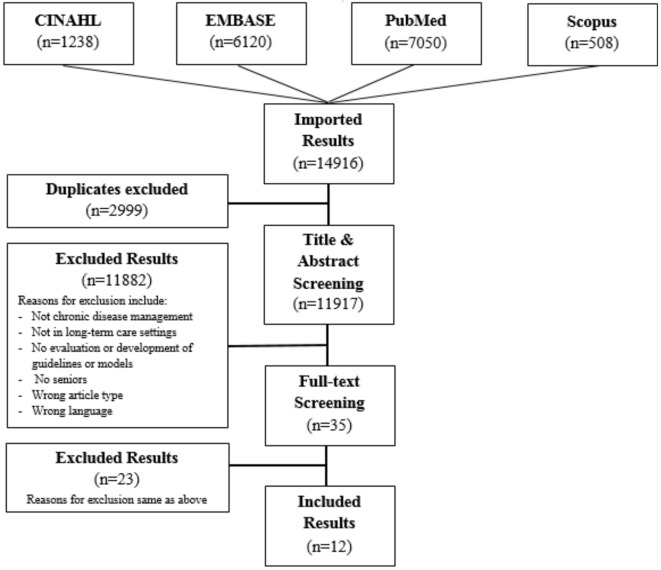
We searched four databases: CINAHL, EMBASE, PubMed and Scopus, in March 2018.
Studies were included if (1) aim of intervention was to improve CDM, (2) intervention incorporated the chronic care model (CCM), (3) included NH residents, (4) analysed the efficacy of the intervention and (5) sample included adults over age 65 years. Studies were limited to English or French language and to those published after 1996, when the CCM was first conceptualised.
Extracted information included the type of chronic disease, the type and number of CCM model components used in the intervention, the method of delivery of the intervention, and outcomes.
On completion of the review of 11 917 citations, 13 studies were included. Most interventions targeted residents living with dementia. There was significant heterogeneity noted among designs, outcomes, and type and complexity of intervention components. There was little evaluation of the sustainability of interventions, including feasibility.
Research was heavily focused on management of dementia. The most commonly included CCM components were multidisciplinary care, evidence-based care, coordinated care and clinical information systems. Future research should include subjective and objective outcomes, which are meaningful for NH residents, for common chronic diseases.
养老院(NH)居民患有多种慢性疾病,负担沉重。慢性病管理(CDM)具有挑战性,因为护理提供的背景和护理提供的方式会影响护理服务的传递。本范围综述旨在确定在 NH 中干预研究中研究的慢性疾病类型、干预措施所涉及的有影响力的背景因素以及未来 CDM 研究的注意事项。
本范围综述遵循 Arksey 和 O'Malley(2005 年)和 Levac、Colquhoun 和 O'Brien(2010 年)的指南。六名评审员筛选了纳入的参考文献。由一名评审员进行数据提取,由另一名评审员进行验证。
我们于 2018 年 3 月在 CINAHL、EMBASE、PubMed 和 Scopus 这四个数据库中进行了检索。
如果(1)干预的目的是改善 CDM,(2)干预纳入了慢性病护理模式(CCM),(3)纳入了 NH 居民,(4)分析了干预的效果,(5)样本中包括 65 岁以上的成年人,则研究被纳入。研究仅限于英文或法文语言,并且仅限于 1996 年首次提出 CCM 概念之后发表的研究。
提取的信息包括慢性疾病的类型、干预中使用的 CCM 模型组件的类型和数量、干预的传递方式以及结果。
在完成对 11917 条引文的审查后,纳入了 13 项研究。大多数干预措施针对患有痴呆症的居民。在设计、结果以及干预组件的类型和复杂性方面,存在显著的异质性。对干预措施的可持续性(包括可行性)评估很少。
研究主要集中在痴呆症的管理上。最常包括的 CCM 组件是多学科护理、基于证据的护理、协调护理和临床信息系统。未来的研究应包括对 NH 居民有意义的常见慢性疾病的主观和客观结果。