Department of Epigenetics and Molecular Carcinogenesis, Science Park, The University of Texas MD Anderson Cancer Center, Smithville, TX, USA.
Department of Molecular Genetics and Microbiology, Stony Brook University, Stony Brook, NY, USA.
Life Sci Alliance. 2020 Feb 6;3(3). doi: 10.26508/lsa.201900526. Print 2020 Mar.
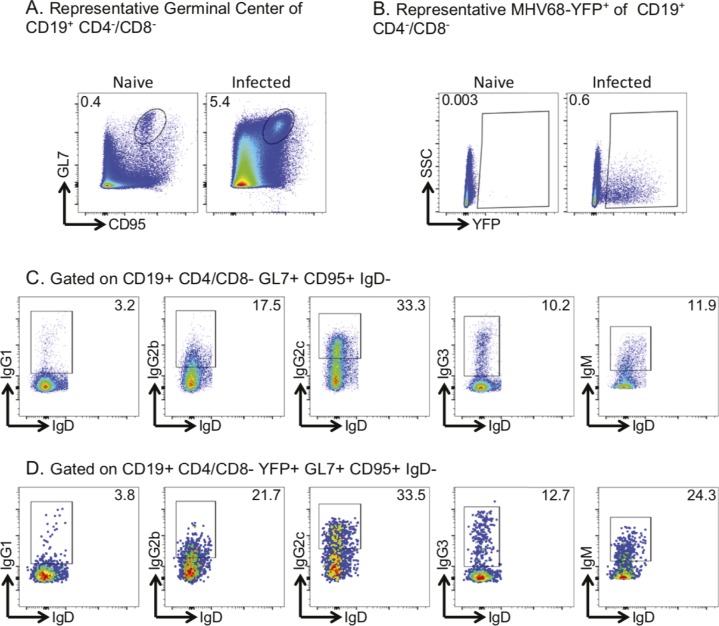
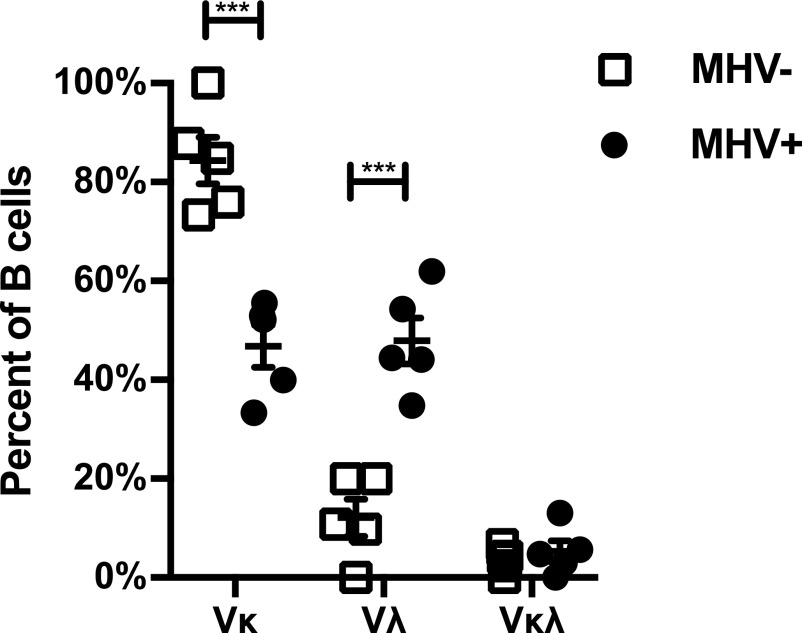
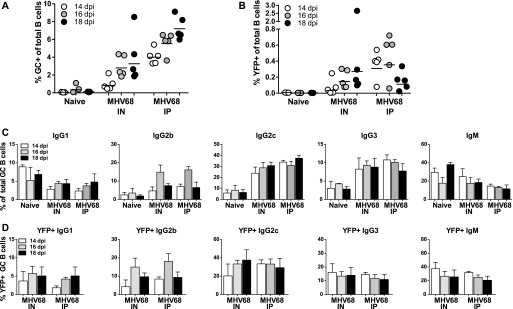
The gammaherpesviruses (γHVs), human Kaposi sarcoma-associated herpesvirus (KSHV), EBV, and murine γHV68 are prevalent infections associated with lymphocyte pathologies. After primary infection, EBV and γHV68 undergo latent expansion in germinal center (GC) B cells and persists in memory cells. The GC reaction evolves and selects antigen-specific B cells for memory development but whether γHV passively transients or manipulates this process in vivo is unknown. Using the γHV68 infection model, we analyzed the Ig repertoire of infected and uninfected GC cells from individual mice. We found that infected cells displayed the hallmarks of affinity maturation, hypermutation, and isotype switching but underwent clonal expansion. Strikingly, infected cells displayed distinct repertoire, not found in uninfected cells, with recurrent utilization of certain Ig heavy V segments including In a manner observed with KSHV, γHV68 infected cells also displayed lambda light chain bias. Thus, γHV68 subverts GC selection to expand in a specific B cell subset during the process that develops long-lived immunologic memory.
γ 疱疹病毒(γHVs)、人类卡波济肉瘤相关疱疹病毒(KSHV)、EBV 和鼠 γHV68 是与淋巴细胞病理相关的常见感染。原发性感染后,EBV 和 γHV68 在生发中心(GC)B 细胞中进行潜伏扩增,并在记忆细胞中持续存在。GC 反应不断发展,并选择抗原特异性 B 细胞进行记忆发育,但 γHV 是被动地瞬时存在还是在体内操纵这个过程尚不清楚。利用 γHV68 感染模型,我们分析了来自单个小鼠的感染和未感染 GC 细胞的 Ig 库。我们发现,感染细胞表现出亲和力成熟、超突变和同种型转换的特征,但经历了克隆扩增。引人注目的是,感染细胞显示出与未感染细胞不同的特征,存在某些 Ig 重链 V 区的反复利用,包括在观察到 KSHV 的方式中,γHV68 感染细胞也表现出 lambda 轻链偏倚。因此,γHV68 颠覆了 GC 选择,在形成长期免疫记忆的过程中,在特定的 B 细胞亚群中扩增。