Gervilla V, Almyras G A, Lü B, Sarakinos K
Nanoscale Engineering Division, Department of Physics, Chemistry and Biology, Linköping University, SE 581 83, Linköping, Sweden.
Sci Rep. 2020 Feb 6;10(1):2031. doi: 10.1038/s41598-020-58712-1.
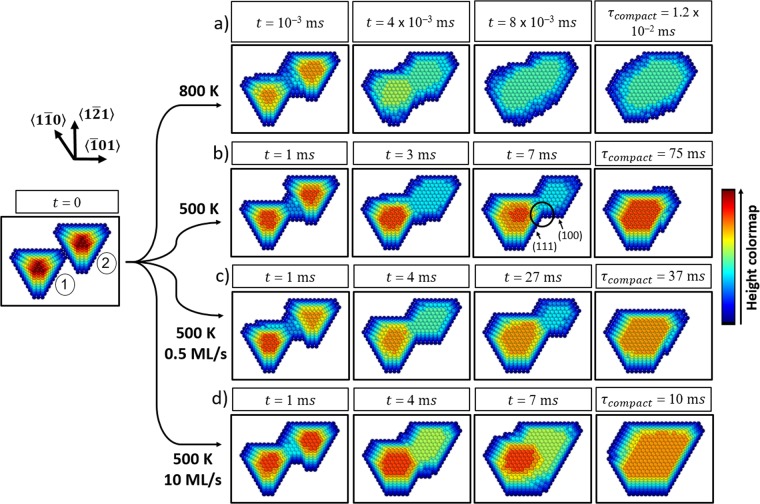
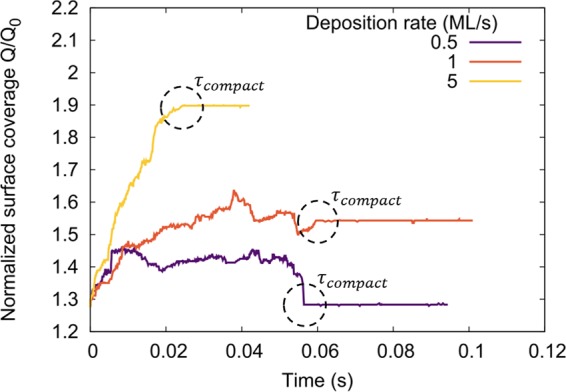
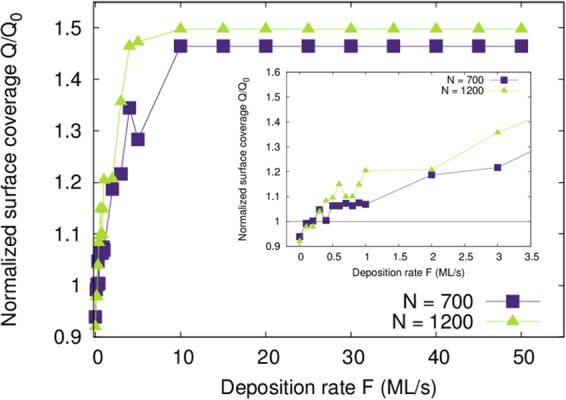
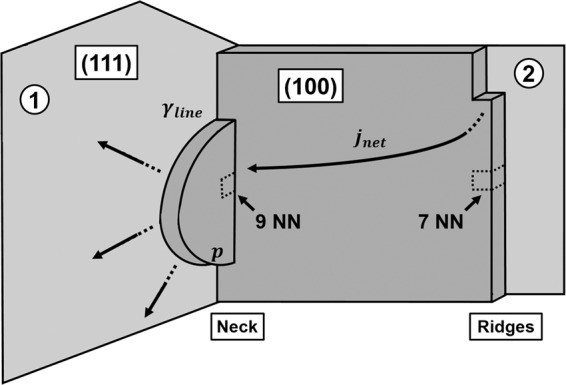
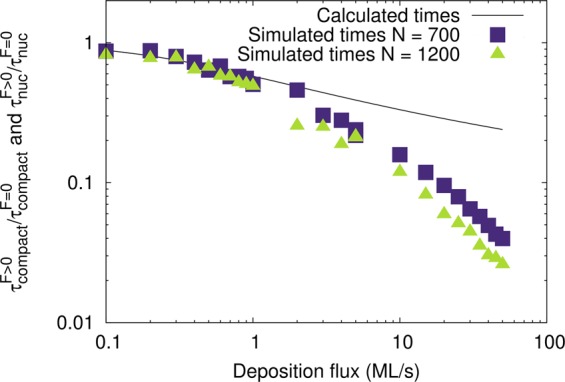
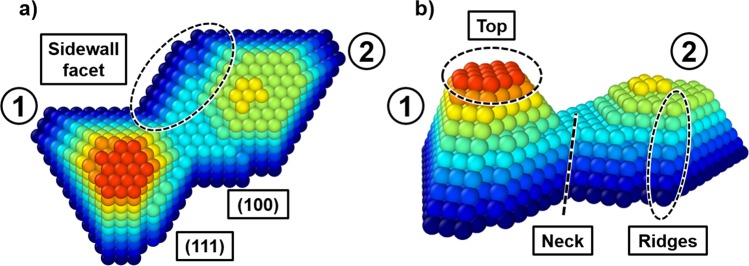
We use kinetic Monte Carlo simulations and analytical modelling to study coalescence of three-dimensional (3D) nanoscale faceted silver island pairs on weakly-interacting fcc(111) substrates, with and without concurrent supply of mobile adatoms from the vapor phase. Our simulations show that for vapor flux arrival rates F < 1 monolayer/second (ML/s) coalescence manifests itself by one of the islands absorbing the other via sidewall facet migration. This process is mediated by nucleation and growth of two-dimensional (2D) layers on the island facets, while the supply of mobile atoms increases the nucleation probability and shortens the time required for coalescence completion. When F is increased above 1 ML/s, coalescence is predominantly governed by deposition from the vapor phase and the island pair reaches a compact shape via agglomeration. The crucial role of facets for the coalescence dynamics is further supported by a mean-field thermodynamic description of the nucleation energetics and kinetics. Our findings explain experimental results which show that two-dimensional film growth morphology on weakly-interacting substrates is promoted when the rate of island coalescence is suppressed. The present study also highlights that deviations of experimentally reported film morphological evolutions in weakly-interacting film/substrate systems from predictions based on the sintering and particle growth theories may be understood in light of the effect of deposition flux atoms on the energetics and kinetics of facet-layer nucleation during coalescence.
我们使用动力学蒙特卡罗模拟和解析模型来研究在弱相互作用的面心立方(fcc)(111)衬底上三维(3D)纳米级刻面银岛对的合并情况,同时考虑有无来自气相的移动吸附原子的并发供应。我们的模拟表明,对于气相通量到达率F < 1单层/秒(ML/s),合并表现为其中一个岛通过侧壁刻面迁移吸收另一个岛。这个过程由岛刻面上二维(2D)层的成核和生长介导,而移动原子的供应增加了成核概率并缩短了合并完成所需的时间。当F增加到1 ML/s以上时,合并主要由气相沉积控制,岛对通过团聚达到紧凑形状。成核能量学和动力学的平均场热力学描述进一步支持了刻面对合并动力学的关键作用。我们的发现解释了实验结果,即当岛合并速率受到抑制时,弱相互作用衬底上的二维薄膜生长形态会得到促进。本研究还强调,鉴于沉积通量原子对合并过程中刻面层成核能量学和动力学的影响,可以理解弱相互作用薄膜/衬底系统中实验报道的薄膜形态演变与基于烧结和颗粒生长理论的预测之间的偏差。