Diaz Abbey, Soerjomataram Isabelle, Moore Suzanne, Whop Lisa J, Bray Freddie, Hoberg Hana, Garvey Gail
Charles Darwin University, Casuarina, NT, Australia.
International Agency for Research on Cancer, Lyon, France.
JCO Glob Oncol. 2020 Feb;6:133-142. doi: 10.1200/JGO.19.00119.
Worldwide, Indigenous people often have disproportionally worse health and lower life expectancy than their non-Indigenous counterparts. Despite the impact of cancer on life expectancy, little is known about the burden of cancer for Indigenous people primarily because of the paucity of data. We investigated the collection and reporting of Indigenous status information among a global sample of population-based cancer registries (PBCRs).
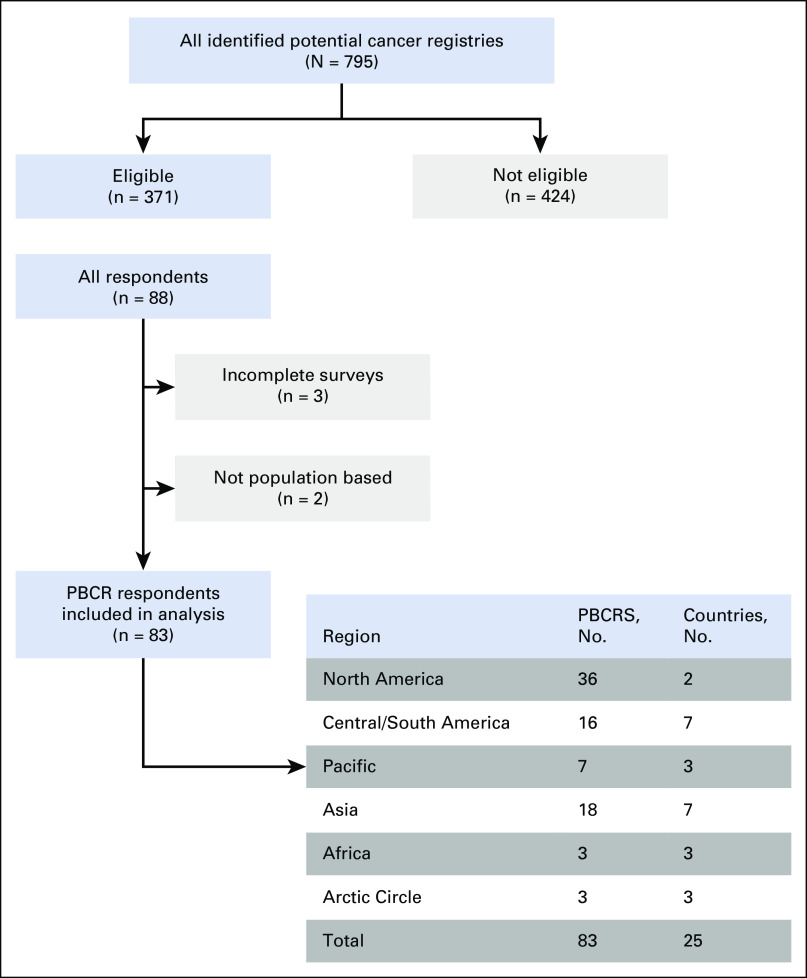
An online survey was e-mailed to eligible registries using set inclusion criteria. Respondents were asked questions on the collection, reporting, and quality assessment of Indigenous status in their registers.
Eighty-three PBCRs from 25 countries were included. Of these, 66% reported that their registry collected Indigenous status data, although the quality of this variable had been assessed in less than half in terms of completeness (38%) and accuracy (47%). Two thirds of PBCRs who collected Indigenous status data (67%), from nine of 25 countries responded that cancer statistics for Indigenous people were reported using registry data. Key barriers to the collection of Indigenous status information included the lack of data collection at the point of care (79%), lack of transfer of Indigenous status to the cancer registry (46%), inadequate information systems (43%), and legislative limitations (32%). Important variations existed among world regions, although the lack of Indigenous status data collection at the point of care was commonly reported across all regions.
High-quality data collection is lacking for Indigenous peoples in many countries. To ensure the design and implementation of cancer control activities required to reduce disparities for Indigenous populations, health information systems, including cancer registries, need to be strengthened, and this must be done in dialogue with Indigenous leaders.
在全球范围内,原住民的健康状况往往比非原住民差得多,预期寿命也更低。尽管癌症对预期寿命有影响,但由于数据匮乏,对于原住民的癌症负担知之甚少。我们调查了全球基于人群的癌症登记处(PBCR)样本中关于原住民身份信息的收集和报告情况。
使用设定的纳入标准,通过电子邮件向符合条件的登记处发送在线调查问卷。询问受访者关于其登记处中对原住民身份的收集、报告和质量评估的问题。
纳入了来自25个国家的83个PBCR。其中,66%报告其登记处收集了原住民身份数据,不过就完整性(38%)和准确性(47%)而言,对该变量质量进行评估的不到一半。收集了原住民身份数据的PBCR中有三分之二(67%),来自25个国家中的9个,回复称使用登记处数据报告了原住民的癌症统计数据。收集原住民身份信息的主要障碍包括在医疗服务点缺乏数据收集(79%)、缺乏将原住民身份信息传递给癌症登记处(46%)、信息系统不完善(43%)以及立法限制(32%)。尽管所有地区普遍报告在医疗服务点缺乏原住民身份数据收集情况,但世界各地区之间存在重要差异。
许多国家缺乏针对原住民的高质量数据收集。为确保设计和实施减少原住民人群差异所需的癌症控制活动,包括癌症登记处在内的健康信息系统需要得到加强,而且这必须在与原住民领袖对话的过程中进行。