• 文献检索
  • 文档翻译
  • 深度研究
  • 学术资讯
  • Suppr Zotero 插件Zotero 插件
  • 邀请有礼
  • 套餐&价格
  • 历史记录
应用&插件
Suppr Zotero 插件Zotero 插件浏览器插件Mac 客户端Windows 客户端微信小程序
定价
高级版会员购买积分包购买API积分包
服务
文献检索文档翻译深度研究API 文档MCP 服务
关于我们
关于 Suppr公司介绍联系我们用户协议隐私条款
关注我们

Suppr 超能文献

核心技术专利:CN118964589B侵权必究
粤ICP备2023148730 号-1Suppr @ 2026

文献检索

告别复杂PubMed语法,用中文像聊天一样搜索,搜遍4000万医学文献。AI智能推荐,让科研检索更轻松。

立即免费搜索

文件翻译

保留排版,准确专业,支持PDF/Word/PPT等文件格式,支持 12+语言互译。

免费翻译文档

深度研究

AI帮你快速写综述,25分钟生成高质量综述,智能提取关键信息,辅助科研写作。

立即免费体验

中度而非严重低温会导致心脏电生理学的致心律失常变化。

Moderate but not severe hypothermia causes pro-arrhythmic changes in cardiac electrophysiology.

机构信息

Experimental and Clinical Pharmacology, Department of Medical Biology, UiT, The Arctic University of Norway, 9037 Tromsø, Norway.

Anesthesia and Critical Care Research Group, Department of Clinical Medicine, UiT, The Arctic University of Norway, Norway.

出版信息

Cardiovasc Res. 2020 Nov 1;116(13):2081-2090. doi: 10.1093/cvr/cvz309.

DOI:10.1093/cvr/cvz309
PMID:32031595
原文链接:https://pmc.ncbi.nlm.nih.gov/articles/PMC7584464/
Abstract

AIMS

Treatment of arrhythmias evoked by hypothermia/rewarming remains challenging, and the underlying mechanisms are unclear. This in vitro experimental study assessed cardiac electrophysiology in isolated rabbit hearts at temperatures occurring in therapeutic and accidental hypothermia.

METHODS AND RESULTS

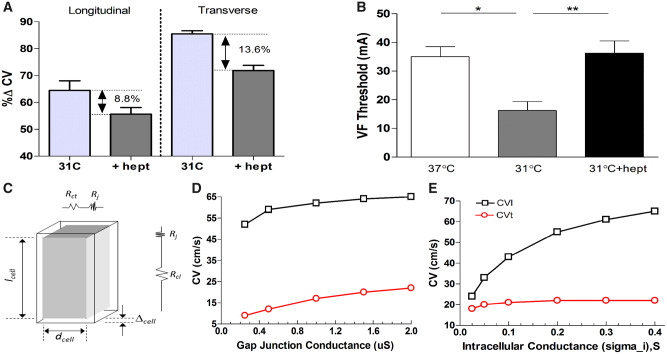
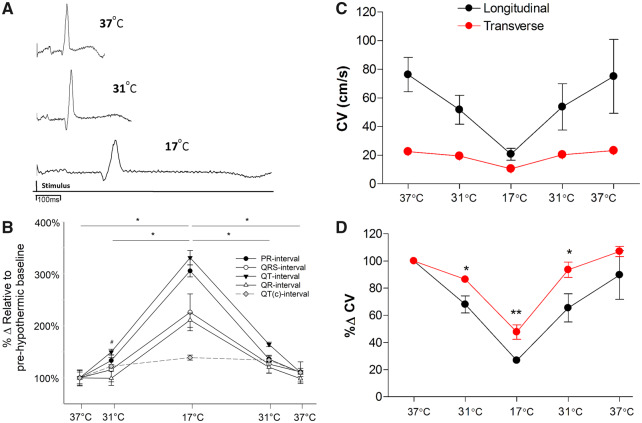
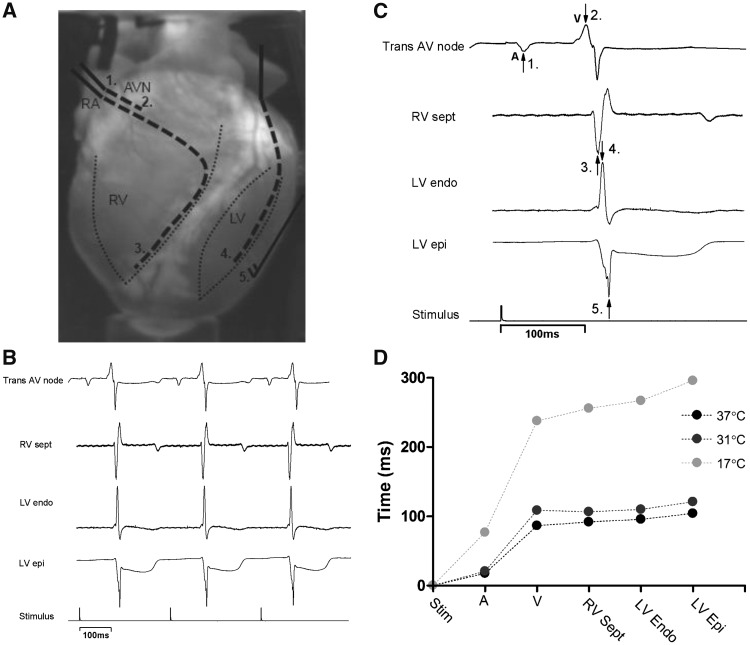
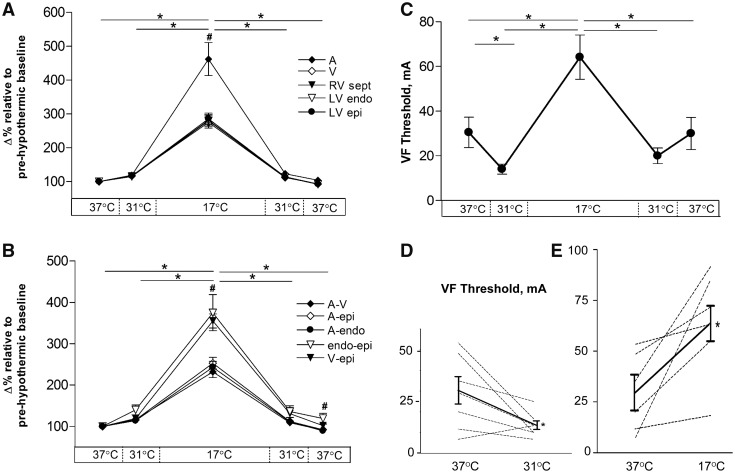
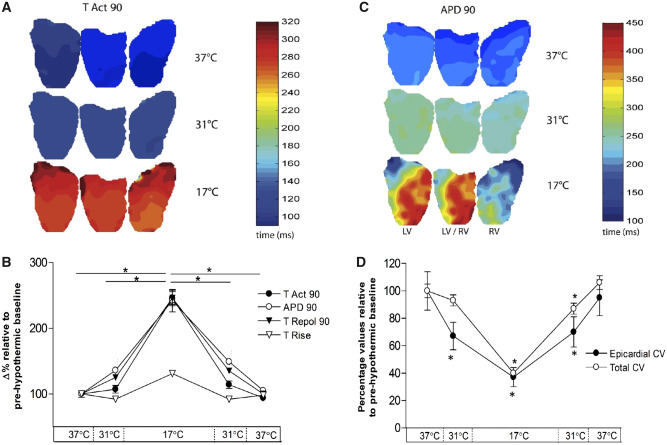
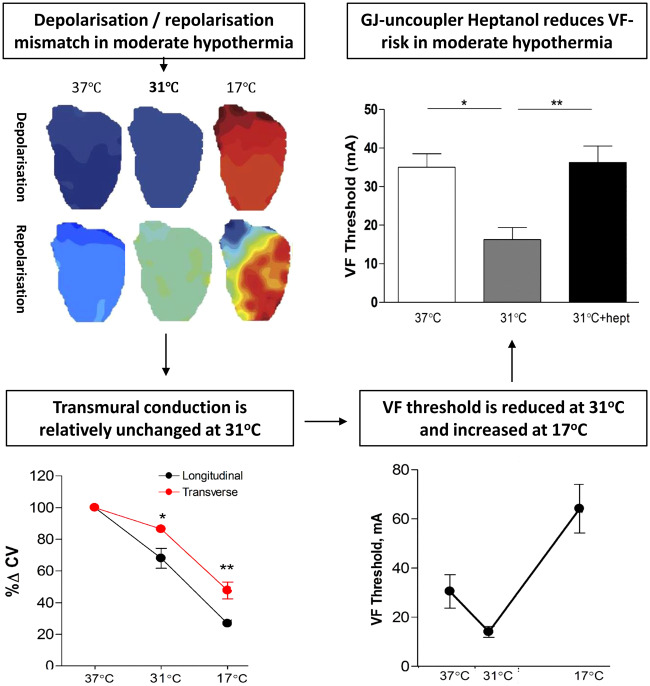
Detailed ECG, surface electrogram, and panoramic optical mapping were performed in isolated rabbit hearts cooled to moderate (31°C) and severe (17°C) hypothermia. Ventricular activation was unchanged at 31°C while action potential duration (APD) was significantly prolonged (176.9 ± 4.2 ms vs. 241.0 ± 2.9 ms, P < 0.05), as was ventricular repolarization. At 17°C, there were proportionally similar delays in both activation and repolarization. These changes were reflected in the QRS and QT intervals of ECG recordings. Ventricular fibrillation threshold was significantly reduced at 31°C (16.3 ± 3.1 vs. 35 ± 3.5 mA, P < 0.05) but increased at 17°C (64.2 ± 9.9, P < 0.05). At 31°C, transverse conduction was relatively unchanged by cooling compared to longitudinal conduction, but at 17°C both transverse and longitudinal conduction were proportionately reduced to a similar extent. The gap junction uncoupler heptanol had a larger relative effect on transverse than longitudinal conduction and was able to restore the transverse/longitudinal conduction ratio, returning ventricular fibrillation threshold to baseline values (16.3 ± 3.1 vs. 36.3 ± 4.3 mA, P < 0.05) at 31°C. Rewarming to 37°C restored the majority of the electrophysiological parameters.

CONCLUSIONS

Moderate hypothermia does not significantly change ventricular conduction time but prolongs repolarization and is pro-arrhythmic. Further cooling to severe hypothermia causes parallel changes in ventricular activation and repolarization, changes which are anti-arrhythmic. Therefore, relative changes in QRS and QT intervals (QR/QTc) emerge as an ECG-biomarker of pro-arrhythmic activity. Risk for ventricular fibrillation appears to be linked to the relatively low temperature sensitivity of ventricular transmural conduction, a conclusion supported by the anti-arrhythmic effect of heptanol at 31°C.

摘要

目的

低温/复温诱发的心律失常的治疗仍然具有挑战性,其潜在机制尚不清楚。这项离体实验研究评估了在治疗和意外低温中发生的温度下,分离兔心的心脏电生理学。

方法和结果

在冷却至中度(31°C)和重度(17°C)低温的分离兔心中进行详细的心电图、表面电图和全景光学映射。在 31°C 时心室激活没有改变,而动作电位持续时间(APD)显著延长(176.9±4.2 ms 比 241.0±2.9 ms,P<0.05),心室复极也是如此。在 17°C 时,激活和复极的延迟比例相似。这些变化反映在心电图记录的 QRS 和 QT 间隔中。在 31°C 时,心室颤动阈值显著降低(16.3±3.1 比 35±3.5 mA,P<0.05),但在 17°C 时增加(64.2±9.9,P<0.05)。在 31°C 时,与纵向传导相比,冷却对横向传导的影响相对较小,但在 17°C 时,横向和纵向传导都按比例减少到相似程度。缝隙连接解偶联剂庚醇对横向传导的相对影响大于纵向传导,并且能够恢复横向/纵向传导比,使心室颤动阈值恢复到基线值(16.3±3.1 比 36.3±4.3 mA,P<0.05)在 31°C 时。复温至 37°C 可恢复大多数电生理参数。

结论

中度低温不会显著改变心室传导时间,但会延长复极并引起心律失常。进一步冷却至严重低温会导致心室激活和复极的平行变化,这些变化具有抗心律失常作用。因此,QRS 和 QT 间隔(QR/QTc)的相对变化成为心律失常活动的心电图生物标志物。心室颤动的风险似乎与心室透壁传导的相对低温敏感性有关,庚醇在 31°C 时的抗心律失常作用支持了这一结论。
https://cdn.ncbi.nlm.nih.gov/pmc/blobs/cd08/7584464/aa5f7206117c/cvz309f5.jpg
https://cdn.ncbi.nlm.nih.gov/pmc/blobs/cd08/7584464/a0621c6fda80/cvz309f6.jpg
https://cdn.ncbi.nlm.nih.gov/pmc/blobs/cd08/7584464/3cb448f512af/cvz309f1.jpg
https://cdn.ncbi.nlm.nih.gov/pmc/blobs/cd08/7584464/336c3bbbe204/cvz309f2.jpg
https://cdn.ncbi.nlm.nih.gov/pmc/blobs/cd08/7584464/02ec307dbdbd/cvz309f3.jpg
https://cdn.ncbi.nlm.nih.gov/pmc/blobs/cd08/7584464/a262c64400d0/cvz309f4.jpg
https://cdn.ncbi.nlm.nih.gov/pmc/blobs/cd08/7584464/aa5f7206117c/cvz309f5.jpg
https://cdn.ncbi.nlm.nih.gov/pmc/blobs/cd08/7584464/a0621c6fda80/cvz309f6.jpg
https://cdn.ncbi.nlm.nih.gov/pmc/blobs/cd08/7584464/3cb448f512af/cvz309f1.jpg
https://cdn.ncbi.nlm.nih.gov/pmc/blobs/cd08/7584464/336c3bbbe204/cvz309f2.jpg
https://cdn.ncbi.nlm.nih.gov/pmc/blobs/cd08/7584464/02ec307dbdbd/cvz309f3.jpg
https://cdn.ncbi.nlm.nih.gov/pmc/blobs/cd08/7584464/a262c64400d0/cvz309f4.jpg
https://cdn.ncbi.nlm.nih.gov/pmc/blobs/cd08/7584464/aa5f7206117c/cvz309f5.jpg

相似文献

1
Moderate but not severe hypothermia causes pro-arrhythmic changes in cardiac electrophysiology.中度而非严重低温会导致心脏电生理学的致心律失常变化。
Cardiovasc Res. 2020 Nov 1;116(13):2081-2090. doi: 10.1093/cvr/cvz309.
2
A novel ECG-biomarker for cardiac arrest during hypothermia.一种用于低温时心脏骤停的新型心电图生物标志物。
Scand J Trauma Resusc Emerg Med. 2020 Apr 10;28(1):27. doi: 10.1186/s13049-020-00721-0.
3
Enhanced dispersion of repolarization explains increased arrhythmogenesis in severe versus therapeutic hypothermia.复极离散度增加解释了严重低温与治疗性低温相比心律失常发生增加的机制。
Circ Arrhythm Electrophysiol. 2011 Feb;4(1):79-86. doi: 10.1161/CIRCEP.110.958355. Epub 2010 Dec 16.
4
Gap junction modifier rotigaptide decreases the susceptibility to ventricular arrhythmia by enhancing conduction velocity and suppressing discordant alternans during therapeutic hypothermia in isolated rabbit hearts.缝隙连接调节剂罗替戈汀通过提高传导速度和抑制治疗性低温期间兔离体心脏中的不和谐交替,降低室性心律失常的易感性。
Heart Rhythm. 2016 Jan;13(1):251-61. doi: 10.1016/j.hrthm.2015.07.023. Epub 2015 Jul 15.
5
Effect of bretylium tosylate on ventricular fibrillation threshold during hypothermia in dogs.甲苯磺丁苄胺对犬低温时室颤阈值的影响。
Am J Emerg Med. 1994 Jul;12(4):407-12. doi: 10.1016/0735-6757(94)90049-3.
6
Therapeutic hypothermia (30 degrees C) enhances arrhythmogenic substrates, including spatially discordant alternans, and facilitates pacing-induced ventricular fibrillation in isolated rabbit hearts.治疗性低温(30°C)增强了致心律失常的基质,包括空间不同步的交替,并且在离体兔心中促进起搏诱导的心室颤动。
Circ J. 2009 Dec;73(12):2214-22. doi: 10.1253/circj.cj-09-0432. Epub 2009 Sep 29.
7
Hypothermia and cardiac electrophysiology: a systematic review of clinical and experimental data.低温与心脏电生理学:临床与实验数据的系统评价。
Cardiovasc Res. 2019 Mar 1;115(3):501-509. doi: 10.1093/cvr/cvy305.
8
Dynamicity of hypothermia-induced J waves and the mechanism involved.低温诱导 J 波的动态变化及其涉及的机制。
Heart Rhythm. 2019 Jan;16(1):74-80. doi: 10.1016/j.hrthm.2018.07.024. Epub 2018 Jul 23.
9
Quantitative assessment of the effects of therapeutic hypothermia on early repolarization in idiopathic ventricular fibrillation survivors: a 7-year cohort study.定量评估治疗性低温对特发性室颤幸存者早期复极的影响:一项 7 年队列研究。
Circ Arrhythm Electrophysiol. 2014 Feb;7(1):120-6. doi: 10.1161/CIRCEP.113.000555. Epub 2014 Jan 1.
10
Hypothermia-induced spatially discordant action potential duration alternans and arrhythmogenesis in nonhibernating versus hibernating mammals.低温诱导的非冬眠与冬眠哺乳动物的空间离散动作电位时程交替和心律失常发生。
Am J Physiol Heart Circ Physiol. 2012 Oct 15;303(8):H1035-46. doi: 10.1152/ajpheart.00786.2011. Epub 2012 Aug 10.

引用本文的文献

1
Seasonal variations in ventricular repolarization and tachyarrhythmias in hibernating brown bears (Ursus arctos arctos).冬眠棕熊(棕熊指名亚种)心室复极和快速性心律失常的季节性变化
Physiol Rep. 2025 Sep;13(17):e70531. doi: 10.14814/phy2.70531.
2
Fever management with or without a temperature control device after out-of-hospital cardiac arrest and resuscitation (TEMP-CARE): A study protocol for a randomized clinical trial.院外心脏骤停与复苏后使用或不使用温度控制设备进行发热管理(TEMP-CARE):一项随机临床试验的研究方案
Acta Anaesthesiol Scand. 2025 May;69(5):e70034. doi: 10.1111/aas.70034.
3
Post-surgical spontaneous paroxysmal hypothermia: a case series.

本文引用的文献

1
Hypothermia and cardiac electrophysiology: a systematic review of clinical and experimental data.低温与心脏电生理学:临床与实验数据的系统评价。
Cardiovasc Res. 2019 Mar 1;115(3):501-509. doi: 10.1093/cvr/cvy305.
2
ECG features and proarrhythmic potentials of therapeutic hypothermia.治疗性低温的心电图特征及促心律失常可能性
Heart. 2016 Oct 1;102(19):1558-65. doi: 10.1136/heartjnl-2015-308821. Epub 2016 May 20.
3
R-Peak Time: An Electrocardiographic Parameter with Multiple Clinical Applications.R波峰时间:一种具有多种临床应用的心电图参数。
术后自发性阵发性低温:病例系列
Clin Auton Res. 2024 Aug;34(4):463-466. doi: 10.1007/s10286-024-01048-x. Epub 2024 Jul 2.
4
Hypothermia: Beyond the Narrative Review-The Point of View of Emergency Physicians and Medico-Legal Considerations.体温过低:超越叙述性综述——急诊医生的观点及法医学考量
J Pers Med. 2023 Dec 5;13(12):1690. doi: 10.3390/jpm13121690.
5
Proarrhythmic changes in human cardiomyocytes during hypothermia by milrinone and isoprenaline, but not levosimendan: an experimental in vitro study.米力农和异丙肾上腺素而非左西孟旦在人类心肌细胞低温时的致心律失常变化:一项实验性体外研究。
Scand J Trauma Resusc Emerg Med. 2023 Oct 25;31(1):61. doi: 10.1186/s13049-023-01134-5.
6
Associations between prehospital defibrillation and outcomes of out-of-hospital cardiac arrests presumed to be caused by hypothermia: A nationwide observational study with epidemiological analysis.院外心脏骤停患者体温过低导致的与院前除颤和结局之间的关联:一项基于流行病学分析的全国性观察研究。
Medicine (Baltimore). 2023 Apr 25;102(17):e33618. doi: 10.1097/MD.0000000000033618.
7
Epicardial electrical heterogeneity after amiodarone treatment increases vulnerability to ventricular arrhythmias under therapeutic hypothermia.胺碘酮治疗后心外膜电异质性增加了在治疗性低温下发生室性心律失常的易感性。
PLoS One. 2023 Apr 20;18(4):e0282943. doi: 10.1371/journal.pone.0282943. eCollection 2023.
8
Pharmacodynamic properties for inhibition of cAMP- and cGMP elimination by pentoxifylline remain unaltered in vitro during hypothermia.在体外低温条件下,己酮可可碱对 cAMP 和 cGMP 消除的抑制作用的药效学性质保持不变。
Scand J Trauma Resusc Emerg Med. 2022 Dec 15;30(1):73. doi: 10.1186/s13049-022-01060-y.
9
Early prediction of hypothermia in pediatric intensive care units using machine learning.利用机器学习对儿科重症监护病房中的体温过低进行早期预测。
Front Physiol. 2022 Sep 2;13:921884. doi: 10.3389/fphys.2022.921884. eCollection 2022.
10
Targeted Temperature Management After Cardiac Arrest: A Systematic Review.心脏骤停后的目标温度管理:一项系统综述。
Cureus. 2022 Sep 11;14(9):e29016. doi: 10.7759/cureus.29016. eCollection 2022 Sep.
Ann Noninvasive Electrocardiol. 2016 Jan;21(1):10-9. doi: 10.1111/anec.12323. Epub 2015 Nov 2.
4
Electrocardiographic Changes Caused by Severe Accidental Hypothermia.严重意外低温导致的心电图变化
J Cardiothorac Vasc Anesth. 2015 Dec;29(6):e83-6. doi: 10.1053/j.jvca.2015.07.019. Epub 2015 Jul 14.
5
Part 8: Post-Cardiac Arrest Care: 2015 American Heart Association Guidelines Update for Cardiopulmonary Resuscitation and Emergency Cardiovascular Care.第8部分:心脏骤停后护理:2015年美国心脏协会心肺复苏及心血管急救指南更新
Circulation. 2015 Nov 3;132(18 Suppl 2):S465-82. doi: 10.1161/CIR.0000000000000262.
6
Neuroprotective effects of hypothermia.低温的神经保护作用。
Tidsskr Nor Laegeforen. 2015 Oct 6;135(18):1646-51. doi: 10.4045/tidsskr.14.1250.
7
The efficacy and safety of prehospital therapeutic hypothermia in patients with out-of-hospital cardiac arrest: A systematic review and meta-analysis.院外心脏骤停患者院前治疗性低温的疗效和安全性:一项系统评价和荟萃分析。
Resuscitation. 2015 Nov;96:170-9. doi: 10.1016/j.resuscitation.2015.08.005. Epub 2015 Aug 21.
8
The role of the induction of mild hypothermia in adult patient outcomes after cardiac arrest: Systematic review and meta-analysis of randomized controlled studies.轻度低温诱导对心脏骤停成年患者预后的作用:随机对照研究的系统评价和荟萃分析
J Int Med Res. 2015 Aug;43(4):471-82. doi: 10.1177/0300060515576010. Epub 2015 May 26.
9
Mechanisms of cardiac conduction: a history of revisions.心脏传导机制:修订史。
Am J Physiol Heart Circ Physiol. 2014 Mar 1;306(5):H619-27. doi: 10.1152/ajpheart.00760.2013. Epub 2014 Jan 10.
10
Targeted temperature management at 33°C versus 36°C after cardiac arrest.心脏骤停后 33°C 与 36°C 的目标温度管理。
N Engl J Med. 2013 Dec 5;369(23):2197-206. doi: 10.1056/NEJMoa1310519. Epub 2013 Nov 17.