School of Life Sciences, University of Hawai'i at Mānoa, Honolulu, Hawaii, United States of America.
Pacific Island Network Inventory and Monitoring Program, National Park Service, Volcano, Hawaii, United States of America.
PLoS One. 2020 Feb 7;15(2):e0228573. doi: 10.1371/journal.pone.0228573. eCollection 2020.
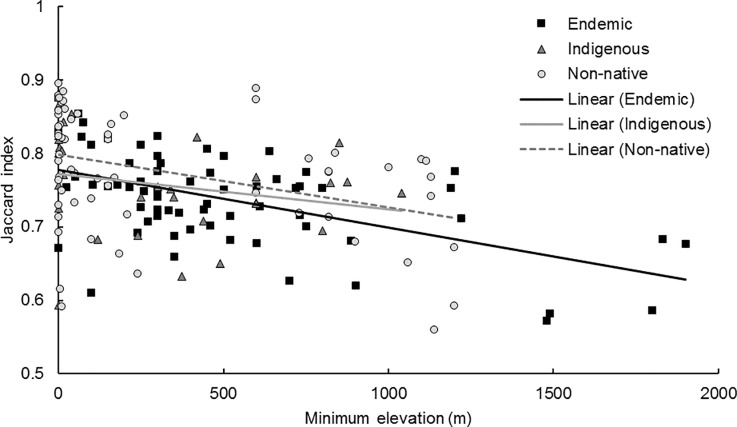
Plant communities on tropical high islands, such as the Hawaiian Islands, are predicted to experience rapid climate change, resulting in novel climates. If increased temperature and/or drought exceed plant species' current tolerances, species that are unable to adapt or shift ranges risk extinction. By definition, habitat generalists have a wide niche breadth and thrive in a variety of habitats, whereas habitat specialists have a narrow niche breadth, and typically thrive under more specific climatic characteristics (e.g., cold). The objectives of this study were to: (1) classify plant species in the Hawaiian Islands along a habitat generalist-specialist continuum; (2) independently test the validity of species rankings, using environmental and biogeographic ranges; and (3) identify species' life-history traits that predict species location along the continuum. We quantified specialization for 170 plant species using species co-occurrence data from over one thousand plots to rank species' realized habitat niche breadth using the Jaccard index. The distribution of species along this continuum differed by species biogeographic origin, with endemic plant species ranked on the specialist end and non-native plant species ranked on the generalist end. Habitat specialization rankings also differed for four of nine tested variables (while controlling for biogeographic origin): number of habitat moisture types, minimum elevation, number of Hawaiian Islands, and life form. Life form was the only trait tested that differed across the continuum, with woody species ranked as stronger generalists than herbaceous species; this pattern was particularly evident for non-native species. This indirect method of estimating species' potential climatic flexibility uses increasingly available large plant community data sets with output rankings which represent species' realized habitat niches. Identifying species and plant communities that are on the habitat specialist end of the continuum allows for their prioritization in conservation planning, as globally the loss of specialists is an indication of degradation.
热带高岛(如夏威夷群岛)上的植物群落预计将经历快速的气候变化,从而形成新的气候。如果温度升高和/或干旱超过了植物物种目前的耐受范围,那些无法适应或转移范围的物种将面临灭绝的风险。从定义上讲,生境广适种具有较宽的生态位宽度,能在多种生境中茁壮成长,而生境特化种具有较窄的生态位宽度,通常在更具体的气候特征下(如寒冷)茁壮成长。本研究的目的是:(1)沿着生境广适种-特化种连续体对夏威夷群岛的植物物种进行分类;(2)使用环境和生物地理范围独立测试物种排序的有效性;(3)确定预测物种在连续体上位置的物种生活史特征。我们使用来自一千多个样方的物种共存数据,量化了 170 种植物物种的特化程度,使用 Jaccard 指数对物种实现的生态位宽度进行了排序。物种沿着连续体的分布因物种生物地理起源而异,特有植物物种排在特化端,非本地植物物种排在广适端。在控制生物地理起源的情况下,有四个测试变量中的四个(而非全部九个变量)的生境特化程度排名不同:生境水分类型数量、最低海拔、夏威夷群岛数量和生活型。生活型是唯一在连续体上存在差异的特征,木本物种被认为比草本物种更具广适性;这种模式在非本地物种中尤为明显。这种间接估计物种潜在气候灵活性的方法利用了越来越多的大型植物群落数据集,输出的排名代表了物种实现的生态位。识别处于连续体特化端的物种和植物群落,可以优先进行保护规划,因为在全球范围内,特化种的丧失是退化的一个迹象。