Department of Experimental Psychology, The John Paul II Catholic University of Lublin, Lublin, Poland.
Sci Rep. 2020 Feb 7;10(1):2087. doi: 10.1038/s41598-020-59222-w.
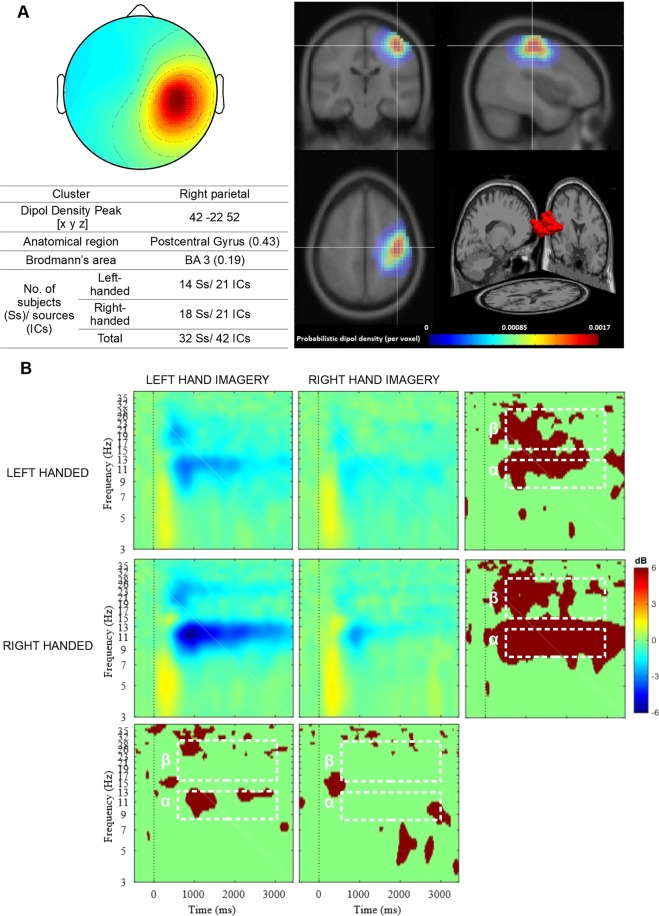
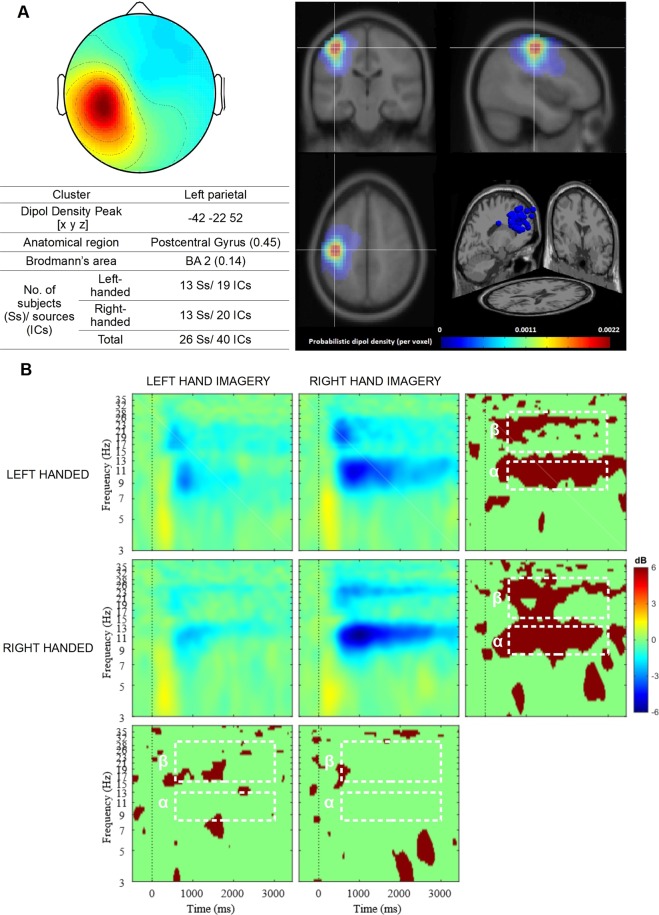
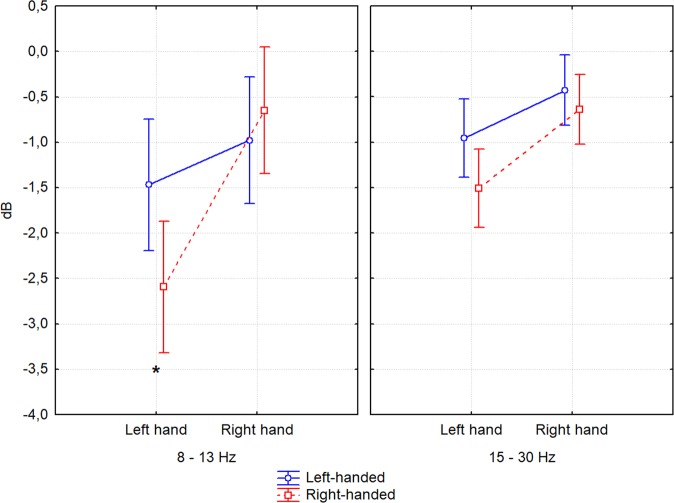
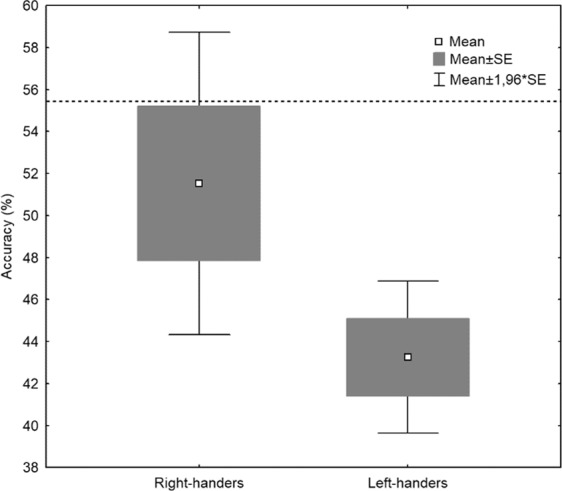
Brain-computer interfaces (BCIs) allow control of various applications or external devices solely by brain activity, e.g., measured by electroencephalography during motor imagery. Many users are unable to modulate their brain activity sufficiently in order to control a BCI. Most of the studies have been focusing on improving the accuracy of BCI control through advances in signal processing and BCI protocol modification. However, some research suggests that motor skills and physiological factors may affect BCI performance as well. Previous studies have indicated that there is differential lateralization of hand movements' neural representation in right- and left-handed individuals. However, the effects of handedness on sensorimotor rhythm (SMR) distribution and BCI control have not been investigated in detail yet. Our study aims to fill this gap, by comparing the SMR patterns during motor imagery and real-feedback BCI control in right- (N = 20) and left-handers (N = 20). The results of our study show that the lateralization of SMR during a motor imagery task differs according to handedness. Left-handers present lower accuracy during BCI performance (single session) and weaker SMR suppression in the alpha band (8-13 Hz) during mental simulation of left-hand movements. Consequently, to improve BCI control, the user's training should take into account individual differences in hand dominance.
脑机接口 (BCI) 允许仅通过大脑活动来控制各种应用程序或外部设备,例如通过运动想象期间的脑电图进行测量。许多用户无法充分调节他们的大脑活动来控制 BCI。大多数研究都集中在通过信号处理和 BCI 协议修改方面的进展来提高 BCI 控制的准确性。然而,一些研究表明,运动技能和生理因素也可能影响 BCI 的性能。先前的研究表明,在右利手和左利手中,手部运动的神经表示存在差异的偏侧化。然而,关于利手对感觉运动节律 (SMR) 分布和 BCI 控制的影响尚未进行详细研究。我们的研究旨在通过比较运动想象和真实反馈 BCI 控制期间右利手 (N = 20) 和左利手 (N = 20) 的 SMR 模式来填补这一空白。我们的研究结果表明,在运动想象任务中 SMR 的偏侧化根据利手不同而不同。左利手在 BCI 性能(单次会话)中表现出较低的准确性,并且在心理模拟左手运动时,alpha 波段(8-13 Hz)的 SMR 抑制较弱。因此,为了提高 BCI 控制的准确性,用户的训练应该考虑到手的优势的个体差异。