Thakkar Samarthkumar, Rupareliya Chintan, Doshi Rajkumar
Department of Internal Medicine, Rochester General Hospital, Rochester, NY, USA.
Department of Neurology, University of Kentucky, Lexington, KY, USA.
Indian Heart J. 2019 Sep-Oct;71(5):422-424. doi: 10.1016/j.ihj.2019.09.009. Epub 2019 Sep 13.
Despite noteworthy advancements in the design of the left ventricular assist device (LVAD), stroke remains one of the most significant adverse events. This study aims to analyze the incidence and short-term outcomes associated with stroke (ischemic and hemorrhagic) after implantation of LVAD.
Study cohorts were identified from the National Inpatient Sample database from January 2009 to September 2015 using the International Classification of Diseases, Ninth Revision codes. The primary outcome was an incidence of stroke, and secondary outcomes were the associated mortality, length of stay, and cost of hospitalization. A multivariate logistic regression analysis was performed to analyze adjusted in-hospital mortality.
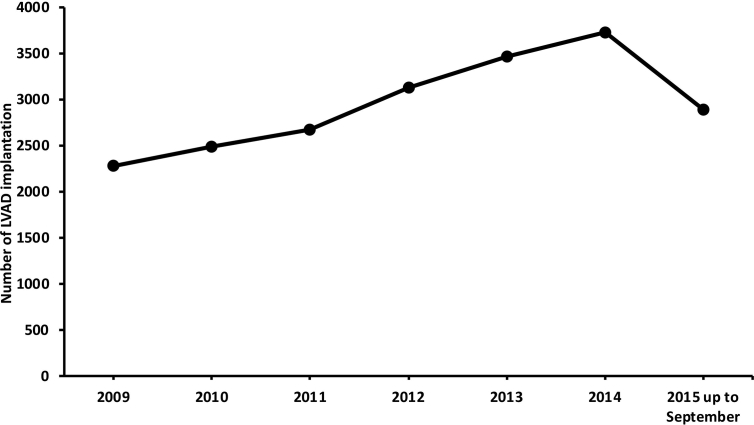
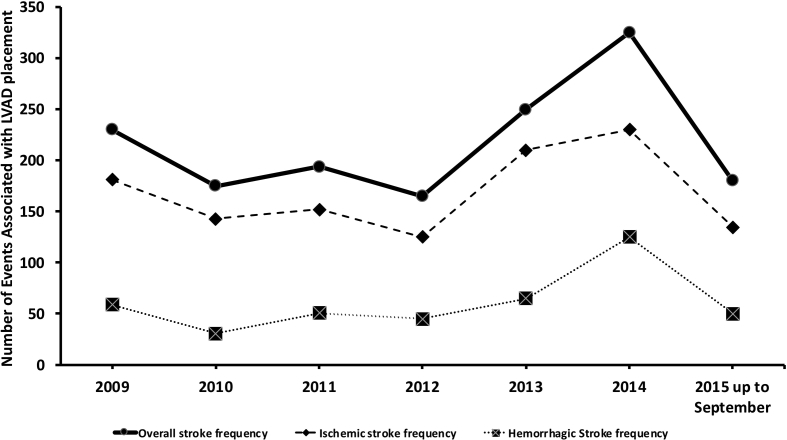
Use of LVADs increased significantly from 2009 to 2014 (2278 in 2009 to 3730 in 2014 [P <0.001]). From a total of 20,656 admissions who underwent LVAD implantation, 1518 (7.4%) developed stroke, among whom 1177 (5.7%) had an ischemic stroke and 426 (2.1%) had a hemorrhagic stroke. Adjusted in-hospital mortality was highest with hemorrhagic stroke. Incidence of stroke was associated with significantly longer length of stay and cost of hospitalization.
The incidence of stroke was ~7% after LVAD placement, and it was associated with significantly higher in-hospital mortality and resource utilization.
尽管左心室辅助装置(LVAD)的设计取得了显著进展,但中风仍然是最严重的不良事件之一。本研究旨在分析LVAD植入术后与中风(缺血性和出血性)相关的发病率和短期预后。
使用国际疾病分类第九版编码,从2009年1月至2015年9月的国家住院样本数据库中确定研究队列。主要结局是中风的发病率,次要结局是相关的死亡率、住院时间和住院费用。进行多因素逻辑回归分析以分析调整后的院内死亡率。
2009年至2014年期间LVAD的使用显著增加(2009年为2278例,2014年为3730例[P<0.001])。在总共20656例接受LVAD植入的住院患者中,1518例(7.4%)发生中风,其中1177例(5.7%)为缺血性中风,426例(2.1%)为出血性中风。出血性中风的调整后院内死亡率最高。中风的发病率与显著更长的住院时间和住院费用相关。
LVAD植入术后中风的发病率约为7%,且与显著更高的院内死亡率和资源利用相关。