Neuroscience Graduate Program, McMaster University, Hamilton, ON, Canada; Mood Disorders Program and Women's Health Concerns Clinic, St. Joseph's Healthcare Hamilton, Hamilton, ON, Canada.
Neuroscience Graduate Program, McMaster University, Hamilton, ON, Canada; Mood Disorders Program and Women's Health Concerns Clinic, St. Joseph's Healthcare Hamilton, Hamilton, ON, Canada; Department of Psychiatry and Behavioural Neurosciences, McMaster University, Hamilton, ON, Canada.
Neuroimage Clin. 2020;25:102178. doi: 10.1016/j.nicl.2020.102178. Epub 2020 Jan 13.
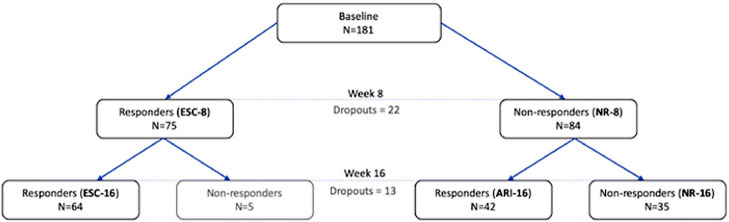
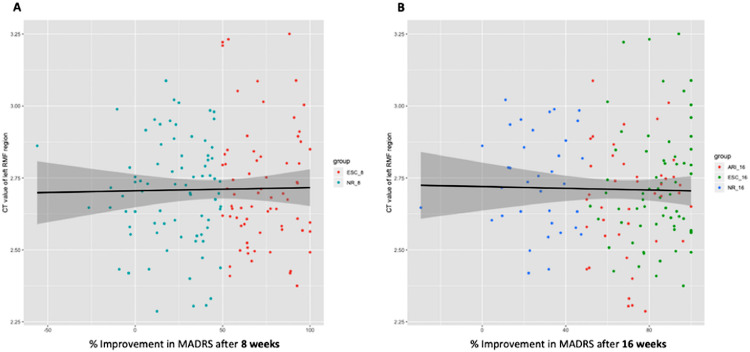
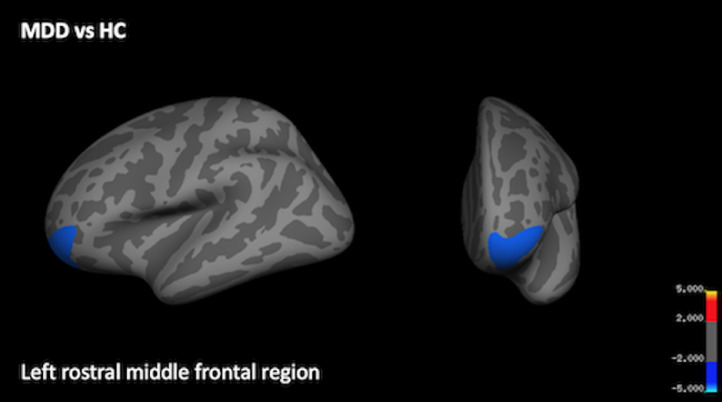
Major depressive disorder (MDD) is considered a highly heterogeneous clinical and neurobiological mental disorder. We employed a novel layered treatment design to investigate whether cortical thickness features at baseline differentiated treatment responders from non-responders after 8 and 16 weeks of a standardized sequential antidepressant treatment. Secondary analyses examined baseline differences between MDD and controls as a replication analysis and longitudinal changes in thickness after 8 weeks of escitalopram treatment. 181 MDD and 95 healthy comparison (HC) participants were studied. After 8 weeks of escitalopram treatment (10-20 mg/d, flexible dosage), responders (>50% decrease in Montgomery-Åsberg Depression Scale score) were continued on escitalopram; non-responders received adjunctive aripiprazole (2-10 mg/d, flexible dosage). MDD participants were classified into subgroups according to their response profiles at weeks 8 and 16. Baseline group differences in cortical thickness were analyzed with FreeSurfer between HC and MDD groups as well as between response groups. Two-stage longitudinal processing was used to investigate 8-week escitalopram treatment-related changes in cortical thickness. Compared to HC, the MDD group exhibited thinner cortex in the left rostral middle frontal cortex [MNI(X,Y,Z=-29,9,54.5,-7.7); CWP=0.0002]. No baseline differences in cortical thickness were observed between responders and non-responders based on week-8 or week-16 response profile. No changes in cortical thickness was observed after 8 weeks of escitalopram monotherapy. In a two-step 16-week sequential clinical trial we found that baseline cortical thickness does not appear to be associated to clinical response to pharmacotherapy at 8 or 16 weeks.
重度抑郁症(MDD)被认为是一种高度异质的临床和神经生物学精神障碍。我们采用了一种新的分层治疗设计,以研究基线时的皮质厚度特征是否可以区分 8 周和 16 周标准化序贯抗抑郁治疗后的治疗反应者和非反应者。二级分析检查了 MDD 和对照组之间的基线差异作为复制分析,以及在依他普仑治疗 8 周后厚度的纵向变化。研究了 181 名 MDD 和 95 名健康对照(HC)参与者。在依他普仑治疗 8 周(10-20mg/d,灵活剂量)后,反应者(蒙哥马利-阿斯伯格抑郁量表评分下降>50%)继续服用依他普仑;非反应者接受阿立哌唑辅助治疗(2-10mg/d,灵活剂量)。根据第 8 周和第 16 周的反应谱,将 MDD 参与者分为亚组。使用 FreeSurfer 分析 HC 和 MDD 组以及反应组之间的皮质厚度基线组差异。使用两阶段纵向处理来研究 8 周依他普仑治疗相关的皮质厚度变化。与 HC 相比,MDD 组左侧额中回前部皮质较薄[MNI(X,Y,Z=-29,9,54.5,-7.7);CWP=0.0002]。基于第 8 周或第 16 周的反应谱,反应者和非反应者之间没有观察到皮质厚度的基线差异。依他普仑单药治疗 8 周后,皮质厚度没有变化。在一项两阶段 16 周序贯临床试验中,我们发现基线皮质厚度似乎与 8 或 16 周时的药物治疗临床反应无关。