Palazzo Giovanni
Ambulatorio di Dermatologia, Ospedale Distrettuale di Tinchi, 75015 Pisticci, MT, Italy.
Oxf Med Case Reports. 2020 Jan 31;2020(1):omz134. doi: 10.1093/omcr/omz134. eCollection 2020 Jan.
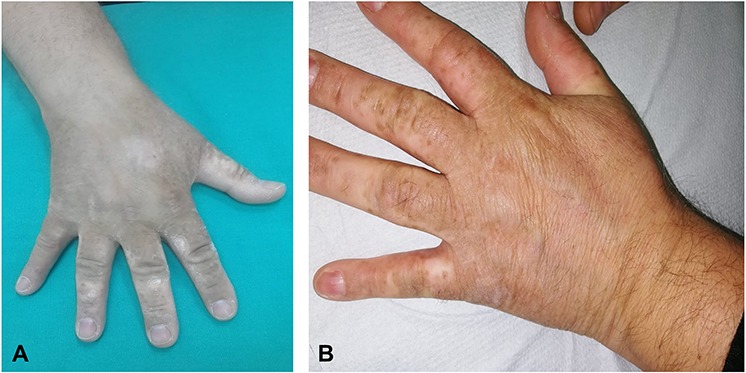
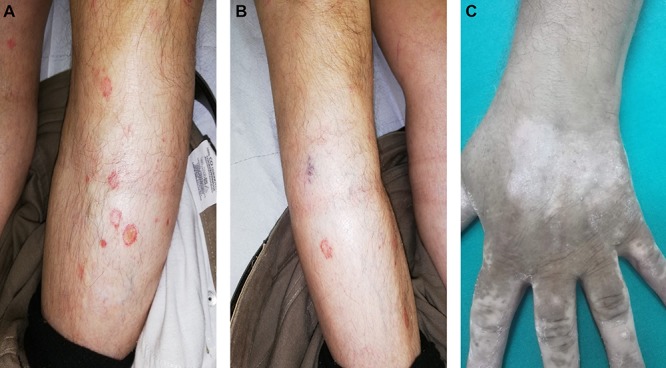
Plaque psoriasis is a chronic debilitating condition, and biologic agents that inhibit tumor necrosis factor-α (TNF-α) are widely employed in management of the condition. Notwithstanding, several paradoxical adverse reactions have been reported with TNF-α inhibitors, including vasculitis, vitiligo, alopecia areata, sarcoidosis and other granulomatous diseases. Herein, we report the case of a 63-year-old man who developed vitiligo while on therapy with adalimumab following failure of conventional agents for plaque psoriasis. After discontinuation of adalimumab and initiation of secukinumab, vitiligo and other psoriatic symptoms gradually resolved. After 1 year of treatment, only small plaque areas were present in the flexor site with complete remission in the extensor area along with near complete resolution of depigmented areas. In this case of possible adalimumab-induced vitiligo in a patient with plaque psoriasis, secukinumab resolved both the symptoms of psoriasis and the likely adalimumab-related vitiligo.
斑块状银屑病是一种慢性致残性疾病,抑制肿瘤坏死因子-α(TNF-α)的生物制剂被广泛用于该疾病的治疗。尽管如此,已有报道称TNF-α抑制剂会引发一些矛盾的不良反应,包括血管炎、白癜风、斑秃、结节病和其他肉芽肿性疾病。在此,我们报告一例63岁男性患者,其在常规药物治疗斑块状银屑病失败后,使用阿达木单抗治疗期间出现了白癜风。停用阿达木单抗并开始使用司库奇尤单抗后,白癜风及其他银屑病症状逐渐缓解。治疗1年后,屈侧仅存在小面积斑块,伸侧完全缓解,色素脱失区域几乎完全消退。在这例斑块状银屑病患者可能由阿达木单抗诱发白癜风的病例中,司库奇尤单抗使银屑病症状及可能与阿达木单抗相关的白癜风均得到缓解。