Wang Shengfeng, Xu Lu, Feng Jingnan, Liu Yang, Liu Lili, Wang Jinxi, Liu Jack, Huang Xiaojun, Gao Pei, Lu Jin, Zhan Siyan
Department of Epidemiology and Biostatistics, School of Public Health, Peking University, Beijing, China.
Beijing Key Laboratory of Hematopoietic Stem Cell Transplantation and Collaborative Innovation Center of Hematology, Peking University People's Hospital, Peking University Institute of Hematology, Beijing, China.
Front Oncol. 2020 Jan 24;9:1513. doi: 10.3389/fonc.2019.01513. eCollection 2019.
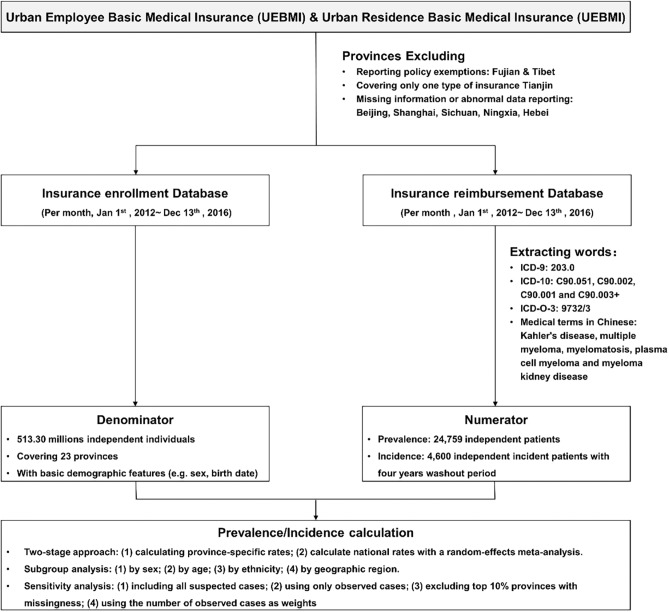
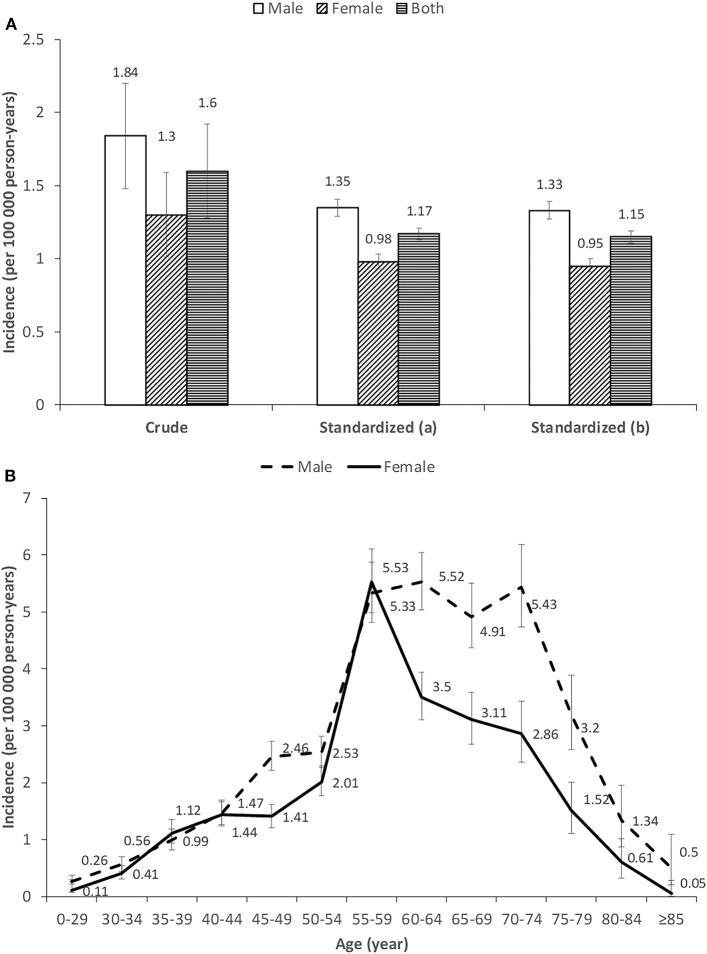
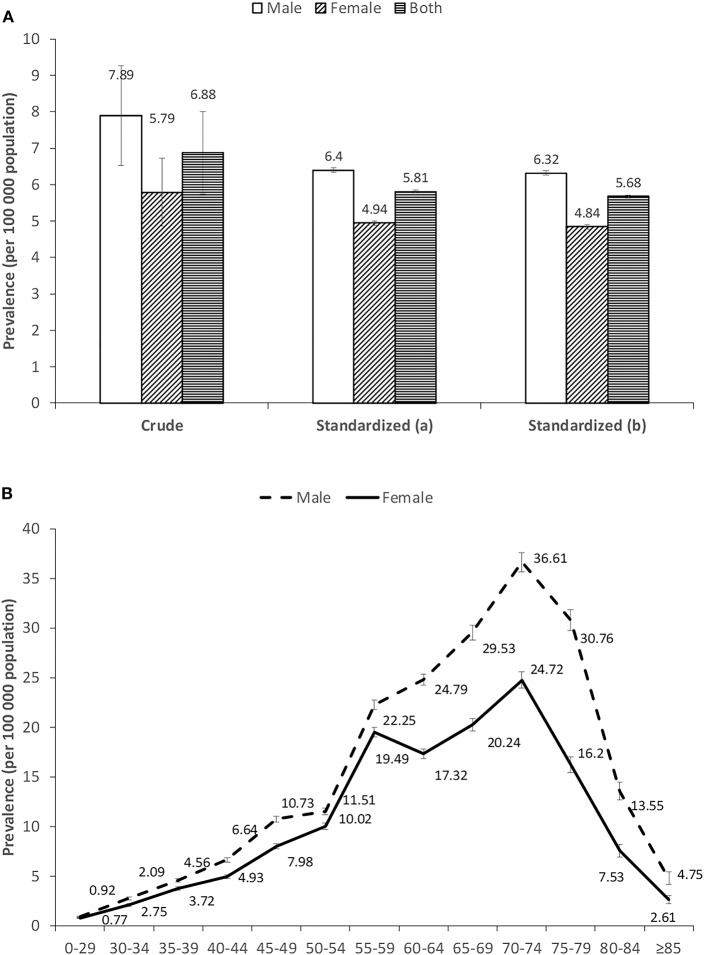
Multiple myeloma (MM) is the second most frequent malignancy of blood, and information on disease burden of MM is limited in developing countries. We aimed to estimate the prevalence and incidence of MM in China. We used data from the national urban employee and urban resident basic medical insurance from 2012 to 2016 in China. MM cases were based on the primary diagnosis (International Classification of Diseases (ICD) code, ICD for oncology, or text of diagnosis) of patients. The crude prevalence and incidence were 6.88 per 100,000 population (95% CI, 5.75-8.00) and 1.60 per 100,000 person-years (1.28-1.92), respectively. The standardized prevalence and incidence were 5.68 (5.64-5.72) and 1.15 (1.11-1.19), respectively. Overall, the rates were higher in males compared with females for prevalence (7.89 vs. 5.79, < 0.05) and incidence (1.84 vs. 1.30, < 0.05). Both rates increased with age, and the mean age (SD) of MM patients was 57.9 (14.4) years. Prevalence peaked between 55 and 74 years old for both genders. The incidence in women aged 55-59 had a significantly high incidence of 5.53 (4.98-6.11). The prevalence and incidence were significantly lower than those in North America, Australia, and Western Europe but were in the same range as those in Japan or Korea. MM should be one of the cancers in the spotlight from both medical and socioeconomic perspectives in low-resource but populous countries because of the incidence of more elderly MM patients in the next decade. Further research is warranted to examine the potential pathophysiologic mechanism.
多发性骨髓瘤(MM)是第二常见的血液恶性肿瘤,而在发展中国家,关于MM疾病负担的信息有限。我们旨在估算中国MM的患病率和发病率。我们使用了中国2012年至2016年全国城镇职工和城镇居民基本医疗保险的数据。MM病例基于患者的初次诊断(国际疾病分类(ICD)编码、肿瘤学ICD或诊断文本)。粗患病率和发病率分别为每10万人6.88例(95%可信区间,5.75 - 8.00)和每10万人年1.60例(1.28 - 1.92)。标准化患病率和发病率分别为5.68(5.64 - 5.72)和1.15(1.11 - 1.19)。总体而言,男性的患病率(7.89对5.79,<0.05)和发病率(1.84对1.30,<0.05)高于女性。两种率均随年龄增长而升高,MM患者的平均年龄(标准差)为57.9(14.4)岁。两性的患病率在55至74岁之间达到峰值。55 - 59岁女性的发病率显著较高,为5.53(4.98 - 6.11)。患病率和发病率显著低于北美、澳大利亚和西欧,但与日本或韩国处于同一范围。由于未来十年老年MM患者的发病率,在资源匮乏但人口众多的国家,从医学和社会经济角度来看,MM都应是备受关注的癌症之一。有必要进一步研究以探讨潜在的病理生理机制。