Leschak Carrianne J, Dutcher Janine M, Haltom Kate E Byrne, Breen Elizabeth C, Bower Julienne E, Eisenberger Naomi I
Department of Psychology, University of California, Los Angeles, CA 90095, USA.
Department of Psychology, Carnegie Mellon University, Pittsburgh, PA 15213, USA.
Soc Cogn Affect Neurosci. 2020 Nov 10;15(10):1056-1063. doi: 10.1093/scan/nsz103.
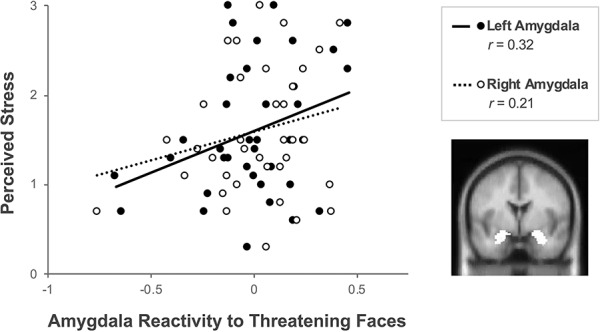
Chronic inflammation in women diagnosed with breast cancer is critically linked with tumor progression, metastasis and survival. C-reactive protein (CRP)-a circulating marker of inflammation-is an important prognostic marker for cancer-related outcomes in breast cancer survivors (e.g. recurrence, fatigue). Psychological stress, which increases circulating markers of inflammation following sympathetic nervous system (SNS) activation, may modulate tumor-relevant inflammatory processes. However, little is known about neural mechanisms that might link stress and downstream SNS-initiated proinflammatory processes, such as elevated CRP. Past work suggests that threat-related neural regions, such as the amygdala, may be key in translating psychological stress into SNS activity and subsequent peripheral inflammation. Thus, we examined amygdala reactivity to socially threatening stimuli in association with perceived stress and plasma CRP levels to further elucidate neuro-immune pathways of social threat processing within breast cancer survivors (N = 37). Significant positive correlations were found between left amygdala reactivity in response to socially threatening stimuli (e.g. angry/fearful faces vs happy faces) and perceived stress in the previous month (r = 0.32, P = 0.025) and between left amygdala reactivity and CRP (r = 0.33, P = 0.025). This work builds on prior research implicating the amygdala as a key structure in crosstalk between threat-related neural circuitries and peripheral inflammation, particularly within cancer survivors.
被诊断患有乳腺癌的女性体内的慢性炎症与肿瘤进展、转移及生存密切相关。C反应蛋白(CRP)——一种炎症的循环标志物——是乳腺癌幸存者癌症相关预后的重要标志物(如复发、疲劳)。心理应激会在交感神经系统(SNS)激活后增加炎症的循环标志物,可能会调节与肿瘤相关的炎症过程。然而,对于可能将应激与下游SNS引发的促炎过程(如CRP升高)联系起来的神经机制,我们却知之甚少。过去的研究表明,与威胁相关的神经区域,如杏仁核,可能在将心理应激转化为SNS活动及随后的外周炎症方面起关键作用。因此,我们研究了杏仁核对社会威胁性刺激的反应性,并将其与感知到的应激和血浆CRP水平相关联,以进一步阐明乳腺癌幸存者(N = 37)中社会威胁处理的神经免疫途径。结果发现,左侧杏仁核对社会威胁性刺激(如愤怒/恐惧的面孔与开心的面孔)的反应性与前一个月感知到的应激之间存在显著正相关(r = 0.32,P = 0.025),左侧杏仁核反应性与CRP之间也存在显著正相关(r = 0.33,P = 0.025)。这项研究建立在先前研究的基础之上,这些研究表明杏仁核是威胁相关神经回路与外周炎症之间相互作用的关键结构,尤其是在癌症幸存者中。