Bossers Koen W, Valadian Roozbeh, Zanoni Silvia, Smeets Remy, Friederichs Nic, Garrevoet Jan, Meirer Florian, Weckhuysen Bert M
Inorganic Chemistry & Catalysis, Debye Institute for Nanomaterials Science , Utrecht University , 3584 CG Utrecht , The Netherlands.
SABIC , P.O. Box 319, 6160 AH Geleen , Netherlands.
J Am Chem Soc. 2020 Feb 26;142(8):3691-3695. doi: 10.1021/jacs.9b13485. Epub 2020 Feb 17.
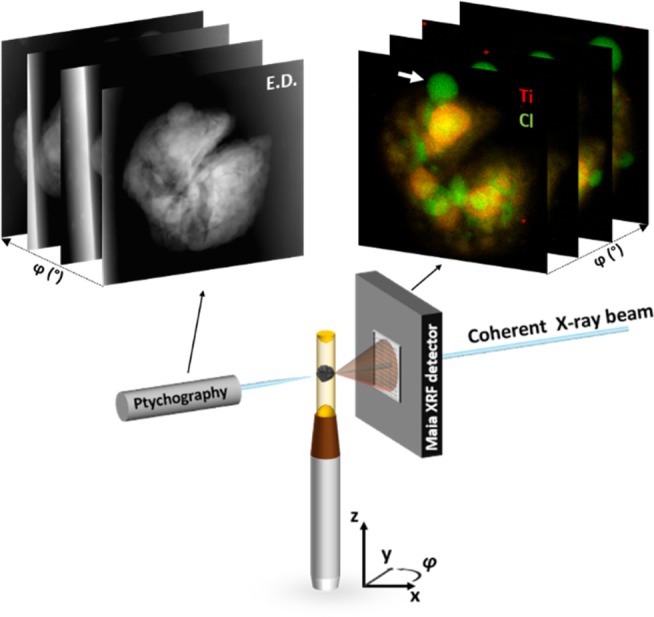
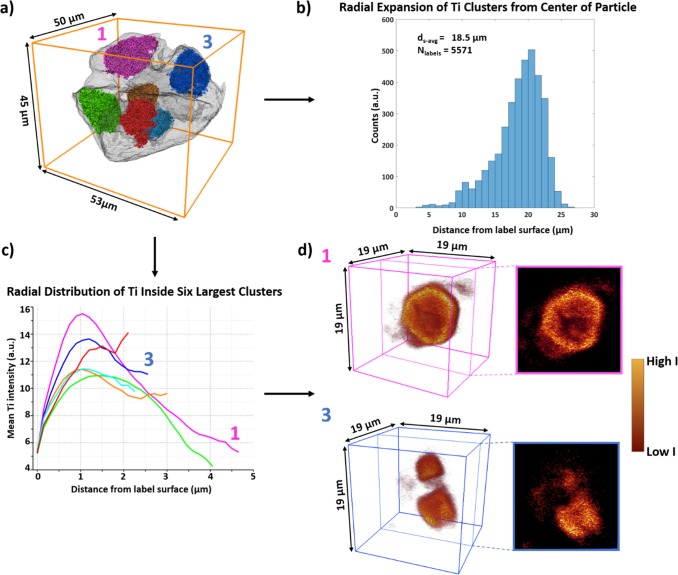
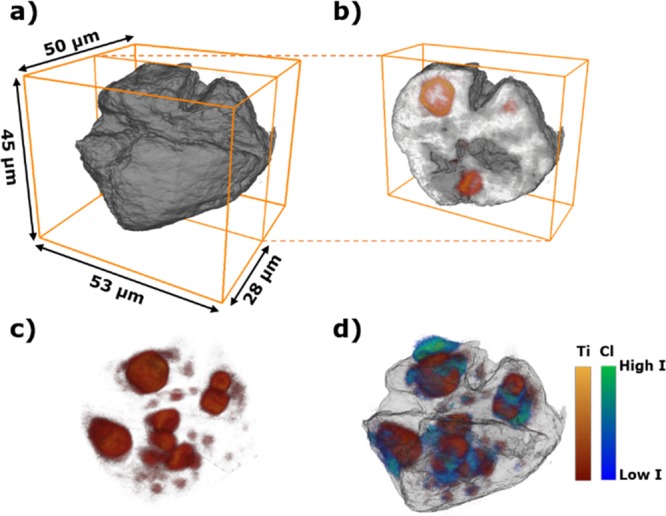
A combination of X-ray ptychography and X-ray fluorescence tomography (XRF) has been used to study the fragmentation behavior of an individual Ziegler-Natta catalyst particle, ∼40 μm in diameter, in the early stages of propylene polymerization with submicron spatial resolution. The electron density signal obtained from X-ray ptychography gives the composite phases of the Ziegler-Natta catalyst particle fragments and isotactic polypropylene, while 3-D XRF visualizes multiple isolated clusters, rich in Ti, of several microns in size. The radial distribution of Ti species throughout the polymer-catalyst composite particle shows that the continuous bisection fragmentation model is the main contributor to the fragmentation pathway of the catalyst particle as a whole. Furthermore, within the largest Ti clusters the fragmentation pathway was found to occur through both the continuous bisection and layer-by-layer models. The fragmentation behavior of polyolefin catalysts was for the first time visualized in 3-D by directly imaging and correlating the distribution of the Ti species to the polymer-catalyst composite phase.
结合X射线叠层成像技术和X射线荧光断层扫描技术(XRF),在亚微米空间分辨率下研究了直径约40μm的单个齐格勒-纳塔催化剂颗粒在丙烯聚合早期的破碎行为。从X射线叠层成像获得的电子密度信号给出了齐格勒-纳塔催化剂颗粒碎片和等规聚丙烯的复合相,而三维XRF则显示出多个尺寸为几微米、富含钛的孤立簇。整个聚合物-催化剂复合颗粒中钛物种的径向分布表明,连续二等分破碎模型是整个催化剂颗粒破碎途径的主要贡献因素。此外,在最大的钛簇中,发现破碎途径是通过连续二等分和逐层模型发生的。通过直接成像并将钛物种的分布与聚合物-催化剂复合相对比,首次以三维方式可视化了聚烯烃催化剂的破碎行为。