Group of Research in Ruminants (G2R), Department of Animal and Food Science, Universitat Autònoma de Barcelona (UAB), Bellaterra, Barcelona, Spain.
Facultad de Medicina Veterinaria, Universidad Agraria del Ecuador (UAE), Guayaquil, Ecuador.
PLoS One. 2020 Feb 10;15(2):e0220221. doi: 10.1371/journal.pone.0220221. eCollection 2020.
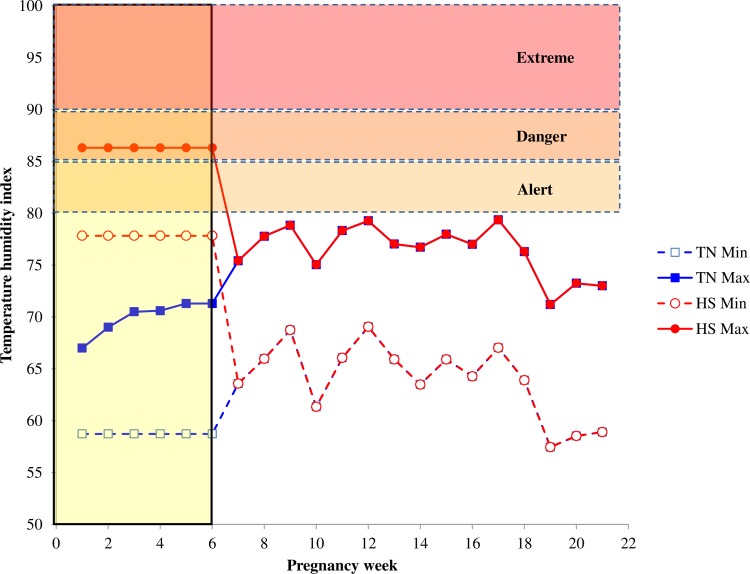
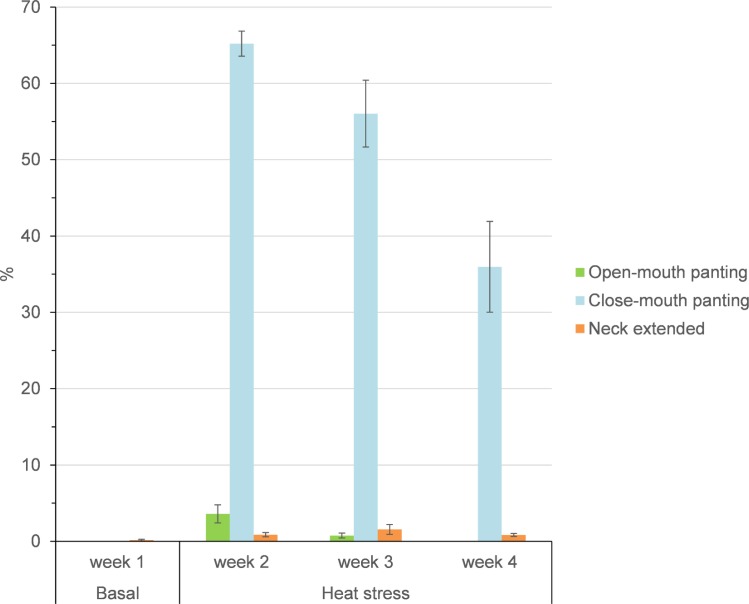
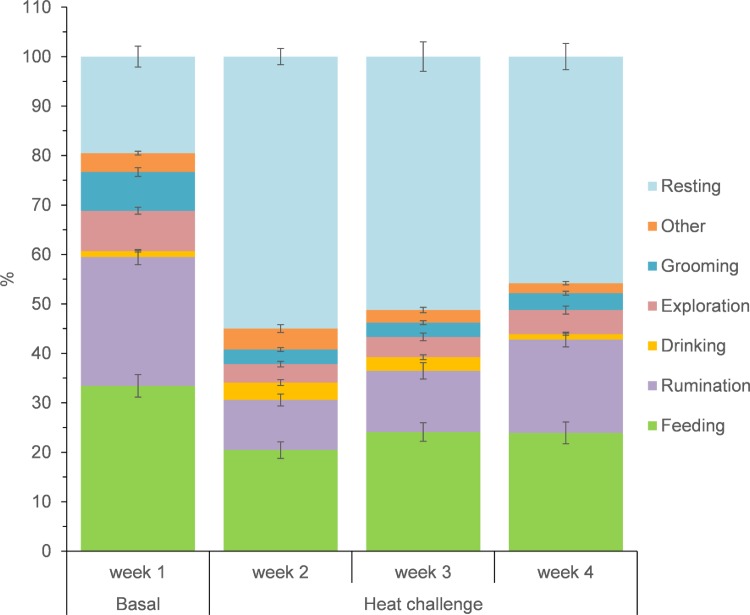
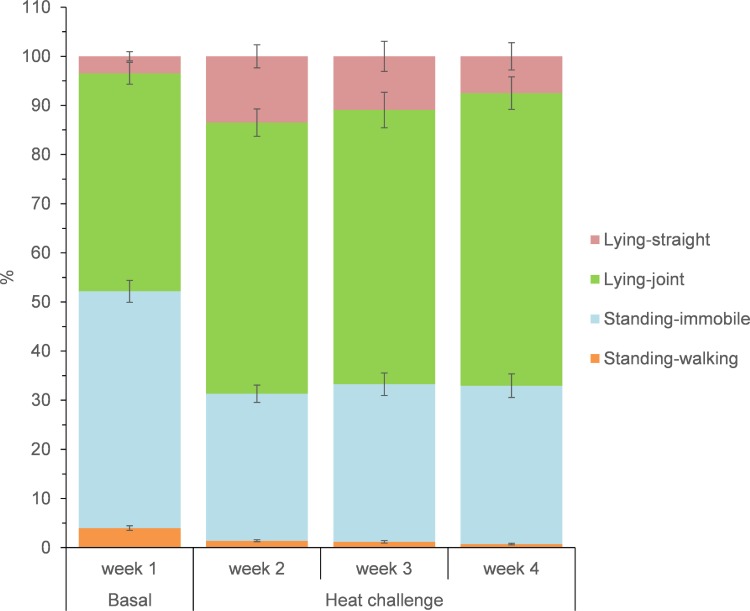
Consequences of heat stress during pregnancy can affect the normal development of the offspring. In the present experiment, 30 Murciano-Granadina dairy goats (41.8 ± 5.7 kg) were exposed to 2 thermal environments varying in temperature-humidity index (THI) from 12 days before mating to 45 days of gestation. The environmental conditions were: gestation under thermal-neutral (TN; THI = 71 ± 3); and gestation under heat stress (HS; THI = 85 ± 3) conditions. At 27 ± 4 days old, female kids exposed to in utero TN (IUTN; n = 16) or in utero HS (IUHS; n = 10) were subjected to 2 tests: arena test (AT) and novel object test (NOT), the latter was repeated at 3 months of age. Additionally, 8 months after birth, a subset of IUTH and IUHS growing goats (n = 8 each; 16.8 ± 3.4 kg BW) were exposed to 2 environmental conditions in 2 consecutive periods: a basal thermal-neutral period (THI = 72 ± 3) for 7 days, and a heat-stress period (THI = 87 ± 2) for 21 days. In both periods, feeding, resting, posture, and thermally-associated behaviors were recorded. The gestation length was shortened by 3 days in GHS goats. In the AT, IUHS kids showed a lower number of sniffs (P < 0.01) compared to IUTN. In the NOT, IUHS kids also tended to show a lower number of sniffs (P = 0.09). During heat exposure, IUTN and IUHS growing goats spent more time resting and exhibited more heat-stress related behaviors such as panting and drinking (P < 0.001); however, no differences were observed between both groups. In conclusion, heat stress during the first third of pregnancy shortened gestation length and influenced the exploratory behavior of the kids in the early life. However, behavior responses to heat stress during the adulthood were not affected by the in utero thermal treatment.
妊娠期间的热应激会影响后代的正常发育。本试验选用 30 只 41.8±5.7kg 的默西亚-格拉纳迪纳奶山羊,从配种前 12 天到妊娠第 45 天,将其暴露在 2 种不同的温度-湿度指数(THI)的热环境中。环境条件为:妊娠处于热中性(TN;THI=71±3)和妊娠处于热应激(HS;THI=85±3)条件下。在 27±4 日龄时,处于宫内 TN(IUTN;n=16)或宫内 HS(IUHS;n=10)的雌性幼崽接受了 2 项测试:竞技场测试(AT)和新奇物体测试(NOT),后者在 3 月龄时重复进行。此外,在出生后 8 个月,IUTH 和 IUHS 生长山羊的一部分(n=8,16.8±3.4kgBW)连续在 2 个环境条件下暴露:7 天基础热中性期(THI=72±3)和 21 天热应激期(THI=87±2)。在这两个时期,记录了采食、休息、姿势和与体温相关的行为。GHS 山羊的妊娠期缩短了 3 天。在 AT 中,IUHS 幼崽的嗅探次数较少(P<0.01),与 IUTN 相比。在 NOT 中,IUHS 幼崽的嗅探次数也较少(P=0.09)。在热暴露期间,IUTN 和 IUHS 生长山羊的休息时间更多,表现出更多的热应激相关行为,如喘气和饮水(P<0.001);然而,两组之间没有观察到差异。总之,妊娠早期的热应激缩短了妊娠期,并影响了幼崽在生命早期的探索行为。然而,成年期对热应激的行为反应不受宫内热处理的影响。