Esporcatte Louise Pellegrino Gomes, Salomão Marcella Q, Lopes Bernardo T, Vinciguerra Paolo, Vinciguerra Riccardo, Roberts Cynthia, Elsheikh Ahmed, Dawson Daniel G, Ambrósio Renato
Rio de Janeiro Corneal Tomography and Biomechanics Study Group, Rio de Janeiro, Brazil.
Instituto de Olhos Renato Ambrósio, Rua Conde de Bonfim 211 / 712, Rio de Janeiro, RJ 20520-050 Brazil.
Eye Vis (Lond). 2020 Feb 5;7:9. doi: 10.1186/s40662-020-0174-x. eCollection 2020.
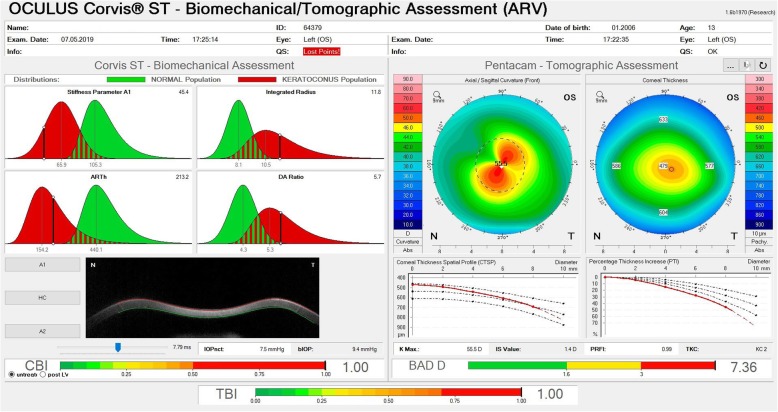
Corneal biomechanics has been a hot topic for research in contemporary ophthalmology due to its prospective applications in diagnosis, management, and treatment of several clinical conditions, including glaucoma, elective keratorefractive surgery, and different corneal diseases. The clinical biomechanical investigation has become of great importance in the setting of refractive surgery to identify patients at higher risk of developing iatrogenic ectasia after laser vision correction. This review discusses the latest developments in the detection of corneal ectatic diseases. These developments should be considered in conjunction with multimodal corneal and refractive imaging, including Placido-disk based corneal topography, Scheimpflug corneal tomography, anterior segment tomography, spectral-domain optical coherence tomography (SD-OCT), very-high-frequency ultrasound (VHF-US), ocular biometry, and ocular wavefront measurements. The ocular response analyzer (ORA) and the Corvis ST are non-contact tonometry systems that provide a clinical corneal biomechanical assessment. More recently, Brillouin optical microscopy has been demonstrated to provide in vivo biomechanical measurements. The integration of tomographic and biomechanical data into artificial intelligence techniques has demonstrated the ability to increase the accuracy to detect ectatic disease and characterize the inherent susceptibility for biomechanical failure and ectasia progression, which is a severe complication after laser vision correction.
由于角膜生物力学在青光眼、选择性角膜屈光手术及不同角膜疾病等多种临床病症的诊断、管理和治疗方面具有潜在应用价值,它已成为当代眼科研究的热点话题。在屈光手术中,临床生物力学研究对于识别激光视力矫正后发生医源性角膜扩张风险较高的患者至关重要。本综述讨论了角膜扩张性疾病检测的最新进展。这些进展应结合多模态角膜和屈光成像来考虑,包括基于普拉西多盘的角膜地形图、Scheimpflug角膜断层扫描、眼前节断层扫描、光谱域光学相干断层扫描(SD - OCT)、甚高频超声(VHF - US)、眼生物测量和眼波前测量。眼反应分析仪(ORA)和Corvis ST是非接触眼压测量系统,可提供临床角膜生物力学评估。最近,布里渊光学显微镜已被证明能够进行体内生物力学测量。将断层扫描和生物力学数据整合到人工智能技术中,已证明能够提高检测角膜扩张性疾病的准确性,并表征生物力学失败和角膜扩张进展的内在易感性,角膜扩张是激光视力矫正后的一种严重并发症。