Sandström H, Rahm M
Department of Chemistry and Chemical Engineering, Chalmers University of Technology, Gothenburg SE-412 96, Sweden.
Sci Adv. 2020 Jan 24;6(4):eaax0272. doi: 10.1126/sciadv.aax0272. eCollection 2020 Jan.
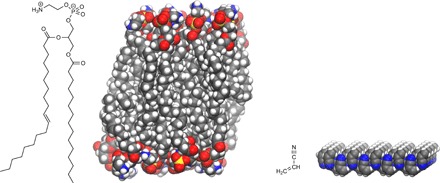
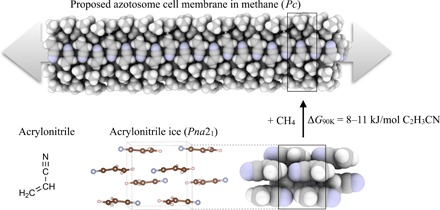
The environmental and chemical limits of life are two of the most central questions in astrobiology. Our understanding of life's boundaries has implications on the efficacy of biosignature identification in exoplanet atmospheres and in the solar system. The lipid bilayer membrane is one of the central prerequisites for life as we know it. Previous studies based on molecular dynamics simulations have suggested that polarity-inverted membranes, azotosomes, made up of small nitrogen-containing molecules, are kinetically persistent and may function on cryogenic liquid hydrocarbon worlds, such as Saturn's moon Titan. We here take the next step and evaluate the thermodynamic viability of azotosome formation. Quantum mechanical calculations predict that azotosomes are not viable candidates for self-assembly akin to lipid bilayers in liquid water. We argue that cell membranes may be unnecessary for hypothetical astrobiology under stringent anhydrous and low-temperature conditions akin to those of Titan.
生命的环境和化学极限是天体生物学中两个最核心的问题。我们对生命边界的理解对外星行星大气层和太阳系中生物特征识别的有效性具有重要意义。脂质双分子层膜是我们所知生命的核心先决条件之一。此前基于分子动力学模拟的研究表明,由含氮小分子组成的极性反转膜——偶氮体,在动力学上具有持久性,可能在低温液态烃世界(如土星的卫星泰坦)中发挥作用。我们在此迈出下一步,评估偶氮体形成的热力学可行性。量子力学计算预测,偶氮体并非类似于液态水中脂质双分子层那样能够自我组装的可行候选物。我们认为,在类似于泰坦的严苛无水和低温条件下,假设的天体生物学中细胞膜可能并非必要。