Kongsuwannakul Kunlaphak
School of Foreign Languages, Suranaree University of Technology, Thailand.
Heliyon. 2020 Jan 30;6(1):e03324. doi: 10.1016/j.heliyon.2020.e03324. eCollection 2020 Jan.
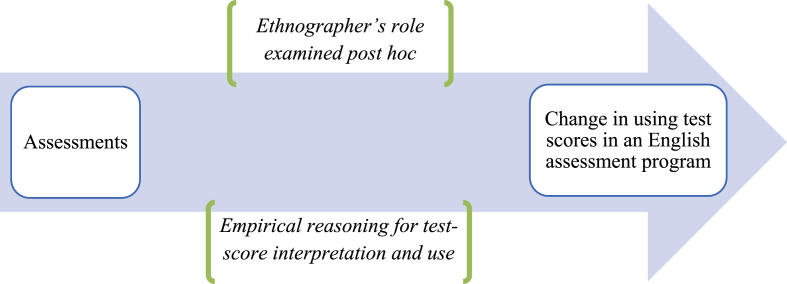
The term 'language testing and assessment' (LTA) seems to often invoke ideas related to numbers, such as mathematical equation and statistical calculation. This may range from scoring performance or responses to examination questions as numbers, to informing stakeholders of test results. This article investigates a series of actions pertaining to LTA by bringing in reflexive ethnography (Davies, C.A. [2008]. . Routledge: London.). The aims are to add a humanistic element to the discipline in general and to feed another piece of applicability information to ethnographers in particular. Attempting at introducing such an approach largely qualitative as ethnography to the field of LTA can be useful because it may open up possibilities for balanced views in assessing language competence in future studies, in which social factors can also be taken explicitly into account for a decision making in LTA. For ethnographers, applicability of reflexive ethnography in LTA could mean the methodology achieves greater generalizability through a larger sample in the universe of admissible observations. A primary research question is whether a change in using CEFR-oriented placement test scores can be justified using empirical reasoning. Participatory observations, situational weigh-in, and statistical analyses are found capable of synergizing using a reflexive-ethnographic perspective for a justifiable decision-making process.
“语言测试与评估”(LTA)这一术语似乎常常引发与数字相关的概念,比如数学方程式和统计计算。这可能涵盖从将考试表现或对试题的回答以数字形式评分,到向利益相关者通报测试结果等诸多方面。本文通过引入反思性人种志(戴维斯,C.A. [2008]。《反思性人种志:重写自我与社会》。劳特利奇出版社:伦敦)来探究与语言测试与评估相关的一系列行动。目的一是总体上为该学科增添人文元素,二是尤其为人种志学者提供另一则适用性信息。尝试将人种志这种本质上具有很大定性的方法引入语言测试与评估领域可能会很有用,因为它或许能为未来研究中评估语言能力时形成平衡观点开辟可能性,在这些研究中,社会因素在语言测试与评估的决策过程中也能被明确考虑进去。对人种志学者而言,反思性人种志在语言测试与评估中的适用性可能意味着该方法通过在可接受观察范围内的更大样本实现更高的普遍性。一个主要研究问题是,使用以欧洲共同语言参考标准(CEFR)为导向的分级测试分数的变化能否通过实证推理得到合理证明。参与观察、情境权衡和统计分析被发现能够从反思性人种志视角协同作用,以实现合理的决策过程。