Graduate Institute of Clinical Medicine, College of Medicine, Kaohsiung Medical University, Kaohsiung, Taiwan; Department of Dermatology, University of California, Davis, Sacramento, CA, USA; Department of Dermatology, Kaohsiung Medical University Hospital, and Department of Dermatology, College of Medicine, Kaohsiung Medical University, Kaohsiung, Taiwan.
Department of Dermatology, University of California, Davis, Sacramento, CA, USA.
J Dermatol Sci. 2020 Mar;97(3):194-200. doi: 10.1016/j.jdermsci.2020.01.011. Epub 2020 Jan 24.
An ever-increasing number of cancer patients are being treated with checkpoint inhibitors such as anti-PD-1 antibodies, and a small percentage of these patients develop a psoriasis-like skin eruption or severe flares of prior psoriasis.
We investigated the role of obesity in immune checkpoint inhibitors-exacerbated psoriasiform eruption.
We fed female C57BL/6 mice a so-called Western diet (WD) or a control diet (CD). Imiquimod (IMQ) was applied topically on ears for 5 consecutive days to induce psoriasiform dermatitis (PsD). Psoriasis-related markers were examined by quantitative real-time PCR. Then we induced PsD in WD- and CD-fed mice in the presence or absence of systemic treatment of anti-PD-1 antibodies to examine if obese mice are more susceptible to anti-PD-1 related PsD than lean mice.
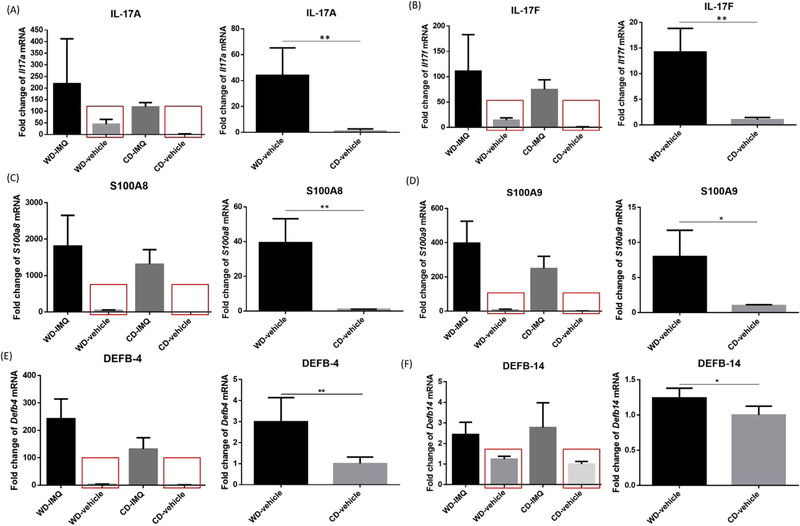
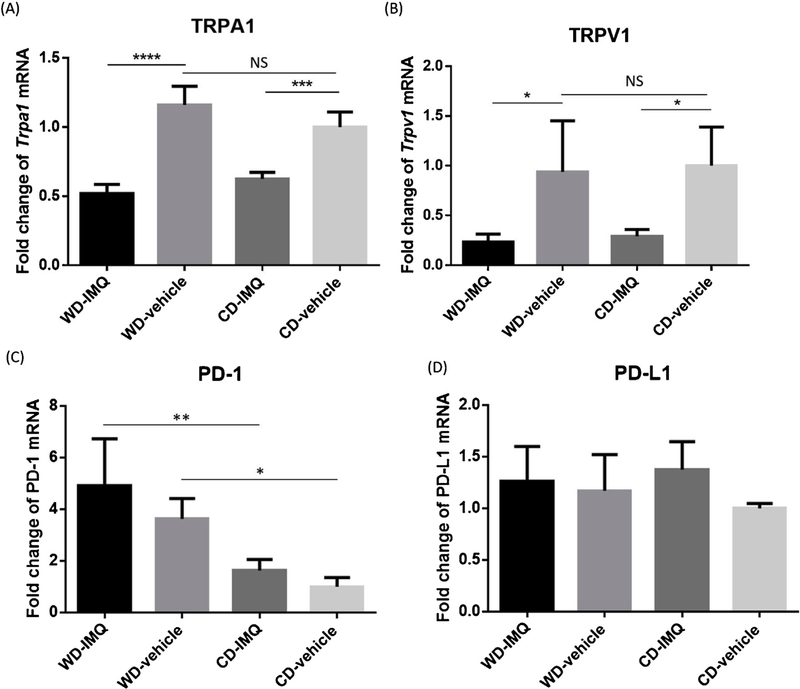
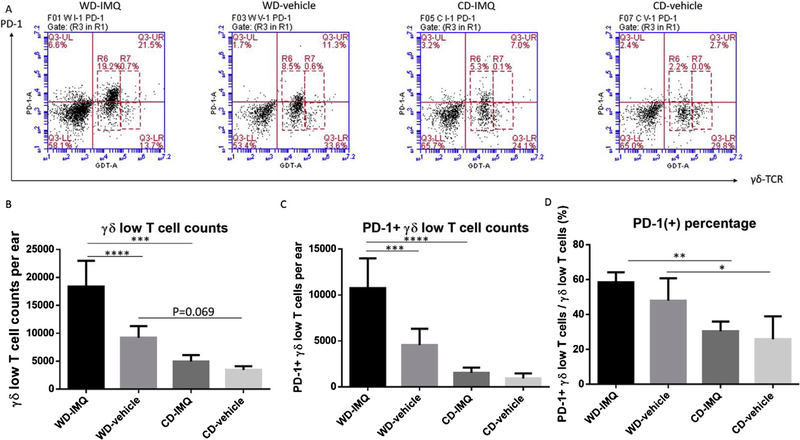
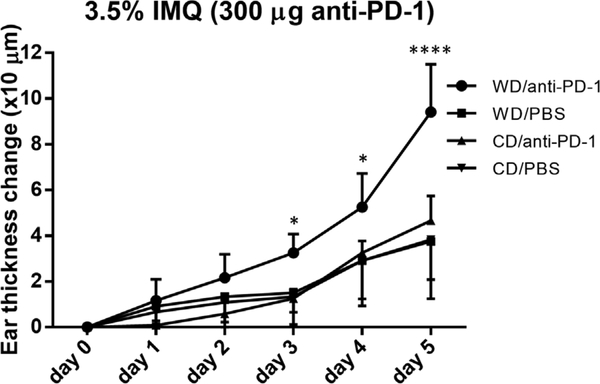
WD-fed mice showed higher baseline mRNA expression levels of psoriasis-associated cytokines such as IL-17, S100A8, and S100A9 compared to mice fed with CD. Furthermore, WD-fed mice had more γδ low (GDL) T cells in the whole skin and higher expression of PD-1 on GDL T cells than CD-fed mice. WD-fed mice receiving anti-PD-1 had more prominent ear swelling than lean mice receiving anti-PD-1 during the 5-day IMQ course (2-fold increase, P < 0.0001 on day 5).
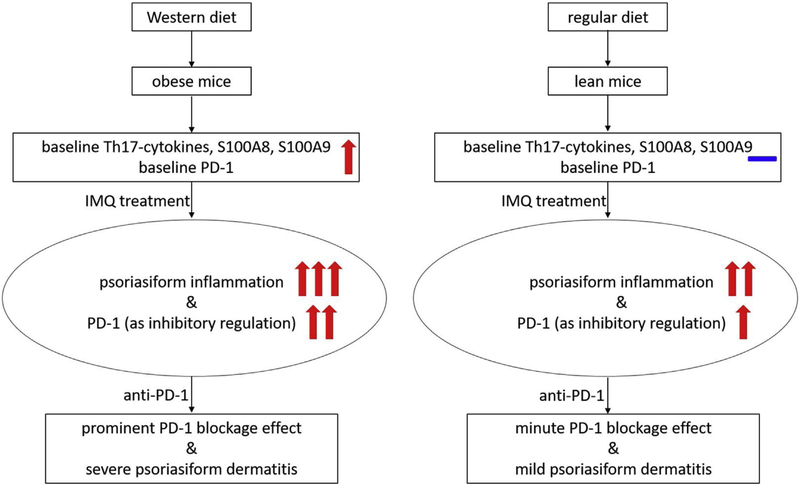
WD-induced obesity enhances IMQ-induced psoriasiform inflammation. The finding that WD-fed mice have a more dramatic response to anti-PD-1 than lean mice in terms of IMQ-induced ear swelling suggests that obesity could be a risk factor in the development of psoriasiform eruption during anti-PD-1 therapy.
越来越多的癌症患者接受了检查点抑制剂(如抗 PD-1 抗体)的治疗,其中一小部分患者出现了银屑病样皮肤疹或先前银屑病的严重发作。
我们研究了肥胖在免疫检查点抑制剂加重的银屑病样疹中的作用。
我们给雌性 C57BL/6 小鼠喂食所谓的西方饮食(WD)或对照饮食(CD)。我们在耳朵上连续 5 天涂抹咪喹莫特(IMQ)以诱导银屑病样皮炎(PsD)。通过定量实时 PCR 检查银屑病相关标志物。然后,我们在 WD 和 CD 喂养的小鼠中诱导 PsD,同时或不进行抗 PD-1 抗体的全身治疗,以检查肥胖小鼠是否比瘦小鼠更容易发生与抗 PD-1 相关的 PsD。
与 CD 喂养的小鼠相比,WD 喂养的小鼠显示出更高的基线银屑病相关细胞因子(如 IL-17、S100A8 和 S100A9)mRNA 表达水平。此外,WD 喂养的小鼠在整个皮肤中具有更多的 γδ 低(GDL)T 细胞,并且 GDL T 细胞上的 PD-1 表达高于 CD 喂养的小鼠。在 5 天 IMQ 过程中,接受抗 PD-1 治疗的 WD 喂养小鼠的耳朵肿胀比接受抗 PD-1 治疗的瘦小鼠更为明显(第 5 天增加 2 倍,P < 0.0001)。
WD 诱导的肥胖增强了 IMQ 诱导的银屑病样炎症。与瘦小鼠相比,WD 喂养的小鼠在 IMQ 诱导的耳朵肿胀方面对抗 PD-1 的反应更为明显,这表明肥胖可能是抗 PD-1 治疗期间发生银屑病样疹的一个危险因素。