Lerner Aaron, Matthias Torsten
AESKU.KIPP Institute, Mikroforum Ring 2, 55234 Wendelsheim, Germany.
Int J Mol Sci. 2020 Feb 8;21(3):1127. doi: 10.3390/ijms21031127.
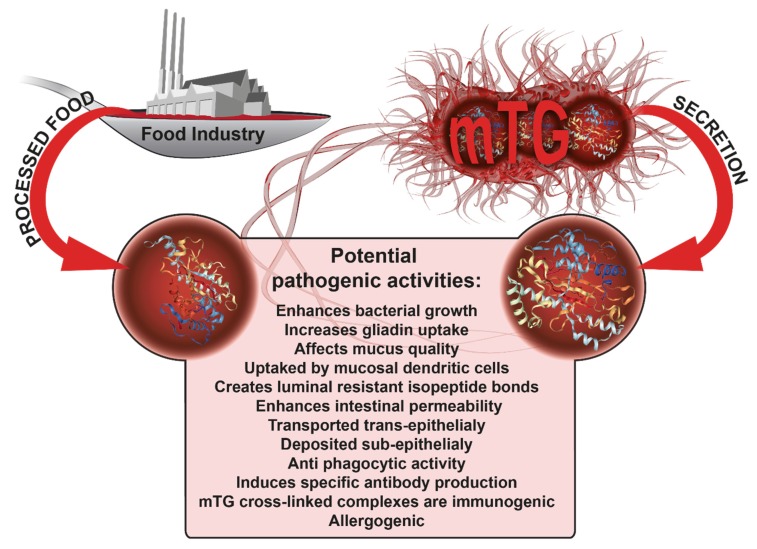
Microbial transglutaminase (mTG) is a survival factor for microbes, but yeasts, fungi, and plants also produce transglutaminase. mTG is a cross-linker that is heavily consumed as a protein glue in multiple processed food industries. According to the manufacturers' claims, microbial transglutaminase and its cross-linked products are safe, i.e., nonallergenic, nonimmunogenic, and nonpathogenic. The regulatory authorities declare it as "generally recognized as safe" for public users. However, scientific observations are accumulating concerning its undesirable effects on human health. Functionally, mTG imitates its family member, tissue transglutaminase, which is the autoantigen of celiac disease. Both these transglutaminases mediate cross-linked complexes, which are immunogenic in celiac patients. The enzyme enhances intestinal permeability, suppresses mechanical (mucus) and immunological (anti phagocytic) enteric protective barriers, stimulates luminal bacterial growth, and augments the uptake of gliadin peptide. mTG and gliadin molecules are cotranscytosed through the enterocytes and deposited subepithelially. Moreover, mucosal dendritic cell surface transglutaminase induces gliadin endocytosis, and the enzyme-treated wheat products are immunoreactive in CD patients. The present review summarizes and updates the potentially detrimental effects of mTG, aiming to stimulate scientific and regulatory debates on its safety, to protect the public from the enzyme's unwanted effects.
微生物转谷氨酰胺酶(mTG)是微生物的一种生存因子,但酵母、真菌和植物也会产生转谷氨酰胺酶。mTG是一种交联剂,在多个加工食品行业中作为蛋白质胶水被大量使用。根据制造商的说法,微生物转谷氨酰胺酶及其交联产物是安全的,即无致敏性、无免疫原性且无致病性。监管机构宣称其对公众使用者“一般认为是安全的”。然而,关于其对人类健康的不良影响的科学观察正在不断积累。在功能上,mTG模仿其家族成员组织转谷氨酰胺酶,而组织转谷氨酰胺酶是乳糜泻的自身抗原。这两种转谷氨酰胺酶都介导交联复合物,而这些复合物在乳糜泻患者中具有免疫原性。该酶会增强肠道通透性,抑制机械性(黏液)和免疫性(抗吞噬)肠道保护屏障,刺激肠腔内细菌生长,并增加麦醇溶蛋白肽的摄取。mTG和麦醇溶蛋白分子通过肠上皮细胞共转胞吞,并沉积在皮下。此外,黏膜树突状细胞表面的转谷氨酰胺酶会诱导麦醇溶蛋白的内吞作用,并且经该酶处理的小麦制品在乳糜泻患者中具有免疫反应性。本综述总结并更新了mTG的潜在有害影响,旨在引发关于其安全性的科学和监管辩论,以保护公众免受该酶的不良影响。